ChatGPT
 Google AI
 Grok
Grok Claude
The problem with most lists of mothers day songs is that they assume one situation. A child performing at a school assembly, an adult putting together a playlist for a lunch, someone recording a message for a mother living overseas, and a family marking a first Mother's Day after a loss are four completely different problems, and the same song will not serve all of them. This guide sorts by occasion. If someone is actually going to sing rather than press play, the guide to easy songs for beginner singers is the practical companion.
What follows covers Hindi and English repertoire together, since most families in Canada use both, organised by what the moment actually requires. There is also a section on which songs a child can realistically learn and perform, which is the question behind a great many of these searches.
What Are the Best Songs for Mother's Day?
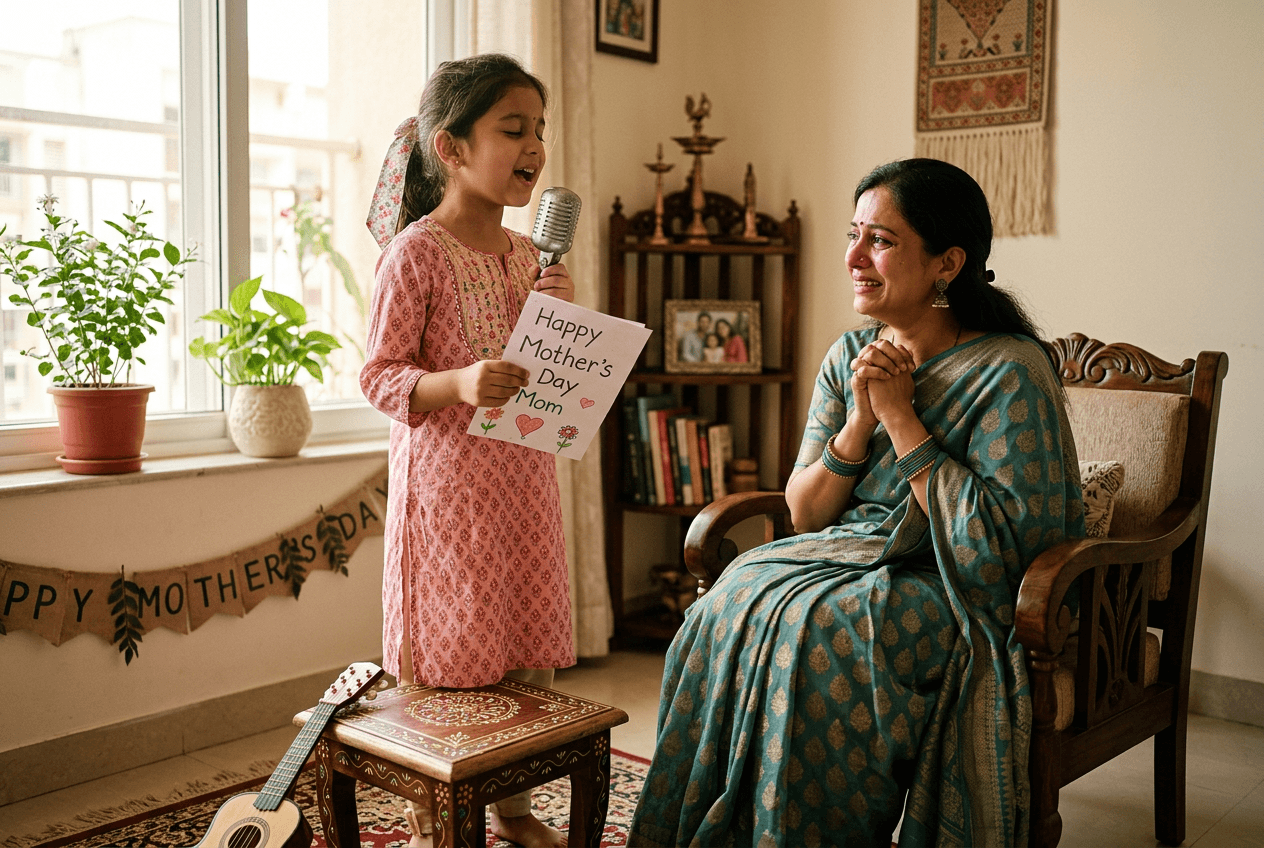 The best mothers day songs in Hindi are Tu Kitni Achhi Hai from Raja Aur Runk, Maa from Taare Zameen Par, Meri Maa from Dasvidaniya, Tujhe Sab Hai Pata from Kal Ho Naa Ho and Mamta Ki Chhaon Mein. In English, Because You Loved Me, You Raise Me Up, Wind Beneath My Wings, A Song for Mama and Simple Man are the standards. For children, Maa and simple lullabies are the most practical.
The Songs by Occasion
Sorting mothers day songs by what the moment actually needs is the single most useful thing this guide does.
The Hindi Repertoire
Tu Kitni Achhi Hai
From Raja Aur Runk, and the oldest of the standards. It is simple, sung as if by a child to a mother, and it has the enormous advantage of being known by older generations completely. At a gathering where grandparents are present, this is the song that lands.
Maa, from Taare Zameen Par
The most emotionally direct song in this repertoire and the one people find hardest to get through. It is written from the perspective of a child separated from their mother and it is unusually specific rather than generically sentimental, which is exactly why it works. Musically it sits in a comfortable range and moves slowly, which makes it more singable than its emotional weight suggests.
Meri Maa, from Dasvidaniya
Gentle, understated and less frequently used than it deserves. It suits a quiet moment rather than a performance, and it works particularly well as accompaniment to a photograph montage where a louder song would compete.
Tujhe Sab Hai Pata
From Kal Ho Naa Ho, and about a mother who understands without being told, which is a more interesting idea than most songs in this category manage. It is also familiar to a wide age range, which matters at a mixed gathering.
The older material
Hindi cinema has produced mother-themed songs continuously for decades, and the earlier repertoire is worth exploring rather than defaulting to the same four. Mamta Ki Chhaon Mein, the Deewaar material, and various songs from the black and white era all carry a directness the modern songs sometimes lack. Older family members will frequently know these and not the recent ones.
The English Repertoire

The reliable choices
Because You Loved Me is the most explicitly dedicatory song in wide circulation and needs no explanation of who it is for. Wind Beneath My Wings works on the idea of someone who stayed in the background while another person received recognition, which fits a parent unusually well. A Song for Mama is direct and warm.
The ones that suit better than expected
Simple Man, written as advice from a mother to a son, is a stronger choice than its rock associations suggest and works well for an adult son who would find the standard repertoire uncomfortable. In My Life is about the people who shaped you and suits a tribute without being explicitly about a mother.
A caution
Several songs used at Mother's Day events were written about romantic relationships and the words do not survive close reading in this context. If you are choosing something because the chorus fits, read the verses before you commit. This is the same care you would take with any public dedication.
Songs for a Child to Perform
 Finding mothers day songs a child can perform is the single most common reason people search this topic, and the one that needs practical rather than sentimental advice.
Choose for the voice, not the sentiment
A song that makes an adult cry is frequently pitched for an adult voice. Children's voices sit higher but have considerably less power at the top of the range, and a child straining at a chorus in front of a room is uncomfortable for everyone. Check the highest note first and transpose down if it is a stretch, which takes five minutes and fixes most problems.
Short phrases and a repeated refrain
The two properties that make a song learnable for a child. A repeated refrain means they can join in confidently even if the verses are shaky, and short phrases mean they will not run out of breath. Maa works on both counts. Long-lined ballads do not.
Meaning before memorisation
A child who understands what they are singing performs it differently from one reciting sounds, and the difference is visible from the audience. This matters particularly for children in Canada learning a Hindi song, where phonetic learning is the default. Explaining the meaning line by line takes ten minutes and transforms the delivery.
Practise standing, out loud, to somebody
Children rehearse quietly and seated, then perform standing to a room, which changes breathing and volume entirely. Two run-throughs standing, to an actual person, is worth more than a week of quiet practice. The support this needs is covered in the guide to breathing techniques for singers.
Consider an instrument instead
A child who plays but is uncomfortable singing can perform an instrumental version, and it is frequently more affecting than a nervous vocal. A simple melody played carefully on keyboard, guitar or violin is a genuine gift, and it removes the exposure that makes children refuse to perform at all.
When Mother's Day Is Difficult
 Choosing mothers day songs when the day is hard is a section most lists avoid, and it matters to a substantial number of readers.
For people whose mother has died, whose relationship is strained, or who have experienced loss around motherhood, the occasion is not straightforwardly celebratory, and a playlist built entirely on warm sentiment can be hard to be around.
If you are choosing music in that situation, gentler and less explicit is usually better. Instrumental versions carry the association without the words. Devotional material, in whatever tradition the family holds, frequently suits a moment of remembrance better than a dedication song does. And there is no obligation to mark the day musically at all.
If you are hosting and someone present is in that position, it is worth thinking about the programme rather than only the songs. A long block of explicitly dedicatory material is difficult to sit through, and mixing in general repertoire gives people somewhere to rest.
Building the Playlist
A handful of rules that make a set of mothers day songs work as an occasion rather than as a folder.
Match the volume to the activity
A lunch needs music people can talk over, which means instrumental or familiar material at low volume. A dedicated performance moment needs everyone's attention and should be short. Running an emotional dedication song at full volume during a meal produces an awkward silence rather than a moment.
Mix languages rather than segregating
For a family gathering in Canada with two or three generations, alternating Hindi and English works considerably better than a block of each, which tends to leave one group waiting. Older guests know the older Hindi repertoire, younger family members know the English and recent material, and alternating keeps everybody present.
Include one thing she actually likes
The obvious point that gets missed while people assemble a list of songs about mothers. A song your mother loves, regardless of whether it has anything to do with motherhood, is a more personal choice than any standard, and the effort of having noticed is the tribute.
Keep the dedication moment short
Two or three minutes, once, with everyone's attention, beats a long programme. Emotional weight does not accumulate with duration and it dissipates when a room's attention starts wandering.
For Families in Canada
Two practical notes for readers here.
Dates differ. Canada, the United States and Australia mark Mother's Day in May, the United Kingdom marks Mothering Sunday in March, and families with relatives in Britain frequently end up observing twice, which is a small logistical annoyance and a reasonable excuse for two phone calls.
Distance is the other. For a great many families here, mothers and grandmothers are in India, and the occasion is marked across a video call rather than in a room. A song performed live on a call, badly, by a grandchild, is worth substantially more than any recording sent afterwards, and it is the thing grandparents report remembering. If the child is nervous, an instrumental piece or singing together as a family removes the exposure.
For children growing up here, these songs also do something beyond the occasion. Learning a Hindi song properly, understanding the words, carries vocabulary and phrasing that daily life may not supply, which is why so many families find music succeeds where formal heritage language teaching has not. The wider tradition is set out in the beginner guide to Hindustani classical music.
Mothers in Indian Music Beyond Film
 Film songs dominate this topic and the older traditions carry a considerable body of material that almost never appears on these lists.
Lullabies
Every Indian language has a lullaby tradition, and these are the oldest mother songs in existence. Lori in Hindi and Urdu, thaaraatu in Malayalam, jo jo in Kannada and equivalents across every region, sung by mothers and grandmothers rather than performed. They are short, narrow in range and repetitive, which makes them among the easiest things a child can learn, and they carry a family association nothing commercial can match.
For a grandmother on a video call, being asked to sing the lullaby she sang to her own children is a considerably better request than being played a film song, and it frequently produces something no one in the family had heard for decades.
The devotional dimension
Indian devotional music addresses the divine as mother extensively, through the goddess in her various forms, and that repertoire carries an emotional register the film songs borrow from. Devotional material addressed to Durga, Kali, Saraswati and Lakshmi is sung across the year and particularly during Navratri, and for families who observe, it sits naturally alongside the secular songs.
Folk material
Folk traditions across India carry songs about mothers, daughters leaving home, and the relationship between generations, frequently with a directness that film writing softens. Bidaai songs sung at weddings as a daughter departs are the clearest example, and they are among the most affecting material in Indian music. The wider traditions are covered in the guide to folk music and folk songs.
Recording Something Instead of Performing
 A route that suits a great many families better than a live performance and which people rarely consider.
For a mother or grandmother living abroad, a recording can be listened to repeatedly, shared with others and kept, which a live performance on a call cannot. It also removes the pressure of performing in the moment, which matters for children and for adults who are not confident singers.
A route that suits a great many families better than a live performance and which people rarely consider.
For a mother or grandmother living abroad, a recording can be listened to repeatedly, shared with others and kept, which a live performance on a call cannot. It also removes the pressure of performing in the moment, which matters for children and for adults who are not confident singers.
Doing it reasonably well
Audio matters far more than video and gets almost no attention. Record in a room with soft furnishings rather than a kitchen or bathroom, since hard surfaces produce reflections that no amount of editing removes. Get the phone closer than feels natural, roughly an arm's length, and record two or three takes rather than accepting the first.
Keep it short. Ninety seconds of one verse and a chorus, sung carefully, beats a full song that runs out of steam. And leave in the imperfections, since a slightly wobbly recording by a grandchild is the point, and a polished one is not.
A family version
Several people singing together removes the exposure entirely and is usually the version that gets kept. Even a family who cannot sing produces something worth having, because the value is in who is singing rather than in how it sounds.
If You Want to Learn One Properly
 A practical note, since a proportion of readers will want to do this properly rather than approximately.
Choose the song by range before anything else. Sing the highest note of whatever you are considering, and if it is a strain, transpose the backing track down two or three semitones. This single step converts several of these songs from difficult into comfortable and almost nobody does it.
Then learn the meaning line by line rather than the sounds. A song delivered by someone who understands each line sounds different from one delivered phonetically, and the difference is audible even to listeners who cannot articulate why. This matters particularly for second-generation singers working in a language they speak better than they read.
Then work on breath rather than volume. Most of this repertoire is slow with long lines, and running out of air mid-phrase is the commonest failure. Planning where to breathe, and practising standing rather than seated, fixes most of it. The general singing tips for beginners cover how to structure that work.
And sing it to somebody before the day. Performing to a room is a separate skill from singing, adrenaline shortens the breath, and a phrase that was comfortable at home becomes difficult in front of family. One rehearsal in front of a person removes most of that surprise.
Making the Day Itself Work
Music is one part of an occasion that frequently goes slightly wrong for predictable reasons, and a small amount of planning prevents most of them.
Decide who is doing what, in advance
The commonest failure is a family who intended to do something musical and never quite got to it, because nobody was responsible for starting it. Nominate one person to cue the moment, and tell whoever is performing when it will happen rather than springing it on them.
Do the musical moment early
Before the meal rather than after. People are attentive, nobody has drifted into separate conversations, and children are not yet tired. A performance attempted at the end of a long lunch competes with everything and usually loses.
Keep the technology simple
Test the speaker, download the tracks rather than streaming them, and have the playlist on one device that one person controls. Wifi failing mid-song at a family gathering is common enough to plan around, and four people with access to the music is how a playlist gets chaotic.
Film it, badly, and send it
Record whatever happens on a phone in landscape, from close enough that the audio is usable, and actually send it to whoever it was for afterwards. Families produce recordings at these occasions constantly and a striking proportion never reach the person they were made for.
Include the person being celebrated
The thing most often forgotten. Ask her to sing something, or to name what she wants played, or to teach a grandchild the lullaby she used to sing. Occasions performed at someone are less enjoyable than occasions shared with them, and older relatives frequently want to participate and wait to be asked.
Songs Across the Generations
A short observation worth acting on, particularly in a household with three generations under one roof or on one video call.
Each generation's mother songs are different, and the assumption that everyone shares a repertoire is usually wrong. A grandmother's associations may be with material from the 1950s and 1960s that nobody younger recognises. A parent's may be with the 1990s. A child's may be with something from the last five years or with English-language material entirely.
The practical response is to ask rather than assume. One question to each generation, in advance, produces a playlist that means something to everyone present instead of one that means a great deal to whoever compiled it. It also frequently surfaces a song with a family story attached, which is worth considerably more than any standard.
For families where the older generation is in India and the younger in Canada, this exercise does something beyond the occasion. Asking a grandmother which songs she associates with her own mother is a genuine piece of family history, and it is the kind of thing that goes unrecorded until it is too late to ask.
Beyond the Playlist
Two suggestions for anyone who wants the day to be more than a set of songs played in the background.
Ask about her music
The most rewarding thing available and the least done. Ask what she listened to at twenty, what her mother sang, what was playing when she got married, what she used to sing while working. These questions produce conversations that no gift does, and they frequently uncover songs nobody in the family knew she cared about.
Write down or record what she says, because this information disappears. Families routinely discover after a bereavement that nobody knows which songs mattered, and an hour of conversation while the answer is still available is worth more than any playlist.
Learn something together
A grandchild and grandparent learning the same song, even a very simple one, produces something neither would get alone. It reverses the usual direction of teaching in a family, gives an older person a role beyond being celebrated, and gives a child a reason to practise that is not an obligation.
This works particularly well with lullabies and simple devotional material, which are short, narrow in range and were designed to be taught this way in the first place. Nothing about it requires anyone to be a good singer.
A note on stepmothers, grandmothers and others who mothered
Worth saying because the standard repertoire assumes one relationship and a great many families do not have that shape. Grandmothers who raised children, aunts, stepmothers, adoptive mothers and family friends who did the work all sit awkwardly against songs written for a single mother-child relationship.
The practical answer is that songs about gratitude, about someone who shaped you, or about a person who stayed in the background rather than songs explicitly naming a mother generally serve better. Wind Beneath My Wings works for anyone. So does In My Life. Choosing on the basis of what the song is actually about, rather than on the category it is filed under, solves most of this.
One more practical point about timing. If the family is spread across time zones, agree the moment in advance rather than trying to coordinate spontaneously, since a video call assembled at short notice across three countries rarely includes everyone. A fixed time announced a week ahead produces a considerably better turnout than good intentions on the day.
Frequently Asked Questions
What are the best songs for Mother's Day?
In Hindi, Tu Kitni Achhi Hai, Maa from Taare Zameen Par, Meri Maa, Tujhe Sab Hai Pata and Mamta Ki Chhaon Mein. In English, Because You Loved Me, Wind Beneath My Wings, A Song for Mama and You Raise Me Up. Choose by occasion, since a school performance and a quiet family lunch need different things.
Which Bollywood songs are about mothers?
Maa from Taare Zameen Par is the most emotionally direct. Tu Kitni Achhi Hai is the oldest standard and known by older generations. Meri Maa from Dasvidaniya is gentler and suits a quiet moment. Tujhe Sab Hai Pata from Kal Ho Naa Ho and Mamta Ki Chhaon Mein complete the core set.
What song should I dedicate to my mom?
Something she actually likes, which is more personal than any song about mothers. If you want a dedication song, Maa and Because You Loved Me are the most direct in their respective languages. Keep the dedication moment to two or three minutes with everyone's attention rather than running a long programme.
What songs can children sing for Mother's Day?
Songs with short phrases and a repeated refrain, checked for range first. Maa from Taare Zameen Par works well and sits comfortably. Simple lullabies and, in English, Count on Me and You've Got a Friend in Me are manageable. Transpose down if the highest note is a stretch.
Should my child sing or play an instrument?
Whichever they are comfortable with. A simple melody played carefully on keyboard, guitar or violin is frequently more affecting than a nervous vocal, and it removes the exposure that makes some children refuse to perform at all. Either way, rehearse standing and out loud to an actual person beforehand.
What music suits a Mother's Day lunch?
Instrumental or familiar material at low volume, since people are talking. Save the emotional dedication song for a short dedicated moment when you have everyone's attention. Playing a heavy dedication song at full volume during a meal produces an awkward silence rather than a moment.
What if Mother's Day is a difficult day?
Gentler and less explicit music usually suits better. Instrumental versions carry the association without the words, and devotional material in whatever tradition the family holds frequently suits remembrance better than a dedication song. There is also no obligation to mark the day musically at all.
When is Mother's Day in Canada?
May, in line with the United States and Australia. The United Kingdom observes Mothering Sunday in March, so families with relatives in Britain sometimes mark it twice. Indian observance follows the May date.
How do I choose a song for a video message?
Something that works underneath images without demanding attention, which means gentler and less lyrically dense. Meri Maa and instrumental versions suit this well. Avoid anything with a dramatic climax, since it will rarely align with the images and will pull focus from them.
Are these songs useful for teaching children Hindi?
Reasonably, provided the child understands the words rather than singing phonetically. Songs carry vocabulary and natural phrasing, they are memorable enough to stick, and children absorb them without any of it being framed as instruction. Explaining the meaning line by line is what makes the difference.
Final Thoughts
The best mothers day songs are not the most emotional ones, they are the ones that fit what you are actually doing. A child at an assembly needs a short refrain in a comfortable key. A family lunch needs something people can talk over. A video call to a grandmother in India needs a child singing live and imperfectly rather than a polished recording sent later.
Sort by occasion, check the range before anyone commits to singing, and include one song she actually likes regardless of whether it is about mothers at all. Art Gharana teaches Hindustani, Carnatic and Bollywood vocals for children and adults live and one-to-one, with a free first class.