ChatGPT
 Google AI
 Grok
 Claude

Online Indian classical music course enrollment increased by roughly 320 percent in the US between 2023 and 2025, driven by pandemic era normalization of online learning, growing yoga and wellness interest in Indian classical sound, and Indian American families seeking deeper cultural connection for their US born children. That growth has produced a genuinely crowded, sometimes confusing marketplace, where tourist style performers occasionally present themselves as teachers, generic apps offer zero real personalization, and time zone mismatches strand US students with impossible scheduling. This guide cuts through that confusion with specific, actionable evaluation criteria.
The Single Biggest Red Flag: Vague Lineage Claims
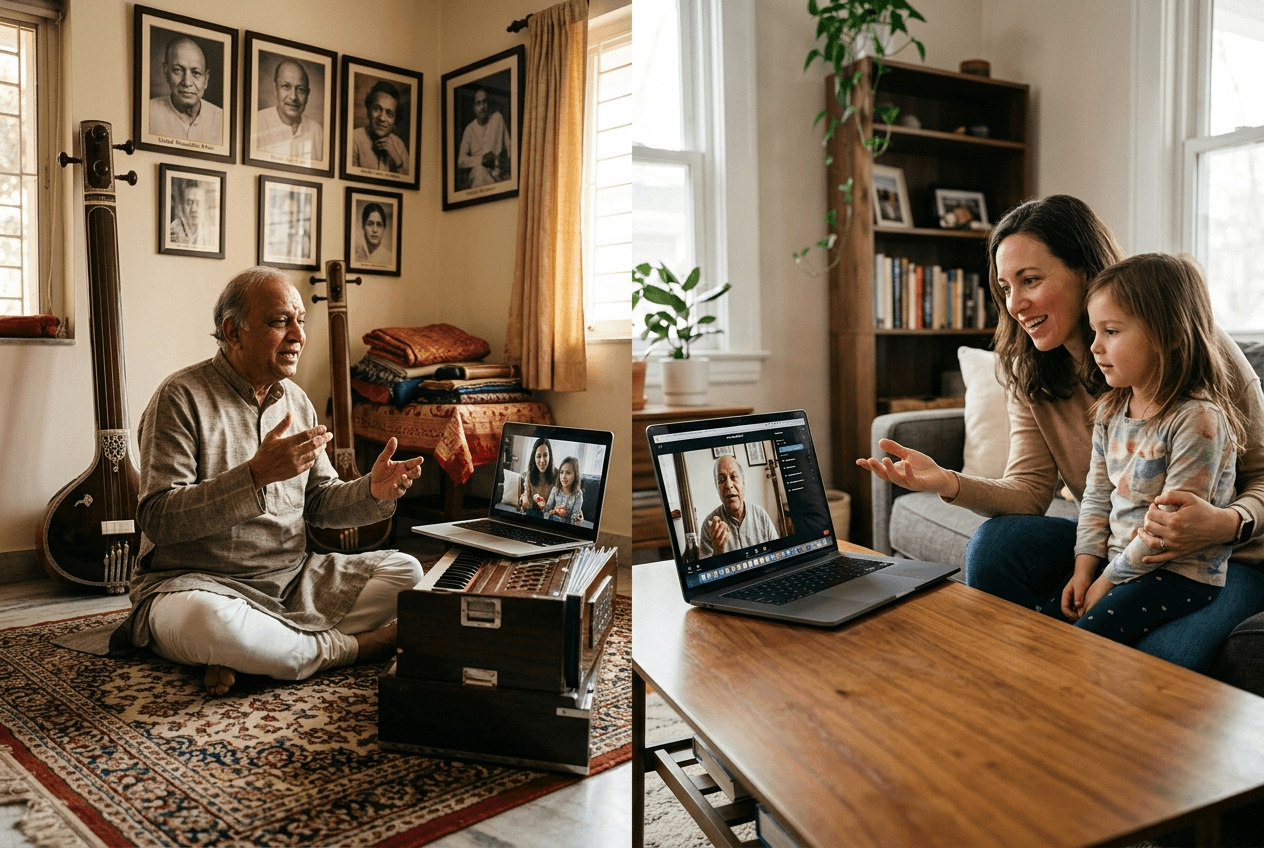 Reviewers and platforms with the most extensive direct experience evaluating this space consistently flag the same warning sign above all others. A teacher who describes themselves as self-taught without any apprenticeship, or who offers only vague descriptions like many years of experience rather than naming a specific guru and training institution, should be treated with serious caution. If a prospective teacher cannot name their guru or explain their lineage clearly and specifically when asked directly, that vagueness itself is the warning sign, not a detail to politely overlook.
What a Good Testimonial Actually Looks Like
 Generic praise like amazing teacher or highly recommend tells a US parent or adult learner essentially nothing useful. Specific, concrete testimonials carry far more evaluative weight: accounts describing exactly what a student achieved and in what timeframe, naming a specific raga learned, a specific milestone reached, a specific performance given. When evaluating any teacher or platform, look past star ratings and generic praise toward this kind of specific, verifiable detail in what other students actually say about their concrete experience. Our piece on top 10 singing tips for beginners reflects exactly this kind of specific, actionable guidance rather than vague encouragement, which is itself a useful benchmark for what quality instruction sounds like.
US Time Zone Coverage: A Practical, Concrete Filter
 A genuinely useful practical filter for US families: look specifically for schools offering sessions across Eastern, Central, Mountain and Pacific US time, not simply a claim of global availability that turns out, on closer inspection, to mean early morning or very late evening slots only. Several established providers schedule primarily around Indian Standard Time, technically offering US access but in practice requiring a 4am or 11pm commitment that few US students can sustain consistently over months or years. Confirm specific, concrete time slots during your initial inquiry, before assuming flexible scheduling claims translate to genuinely convenient options for your specific US time zone.
Live Instruction Versus Pre-Recorded: Why This Distinction Is Non-Negotiable for Beginners
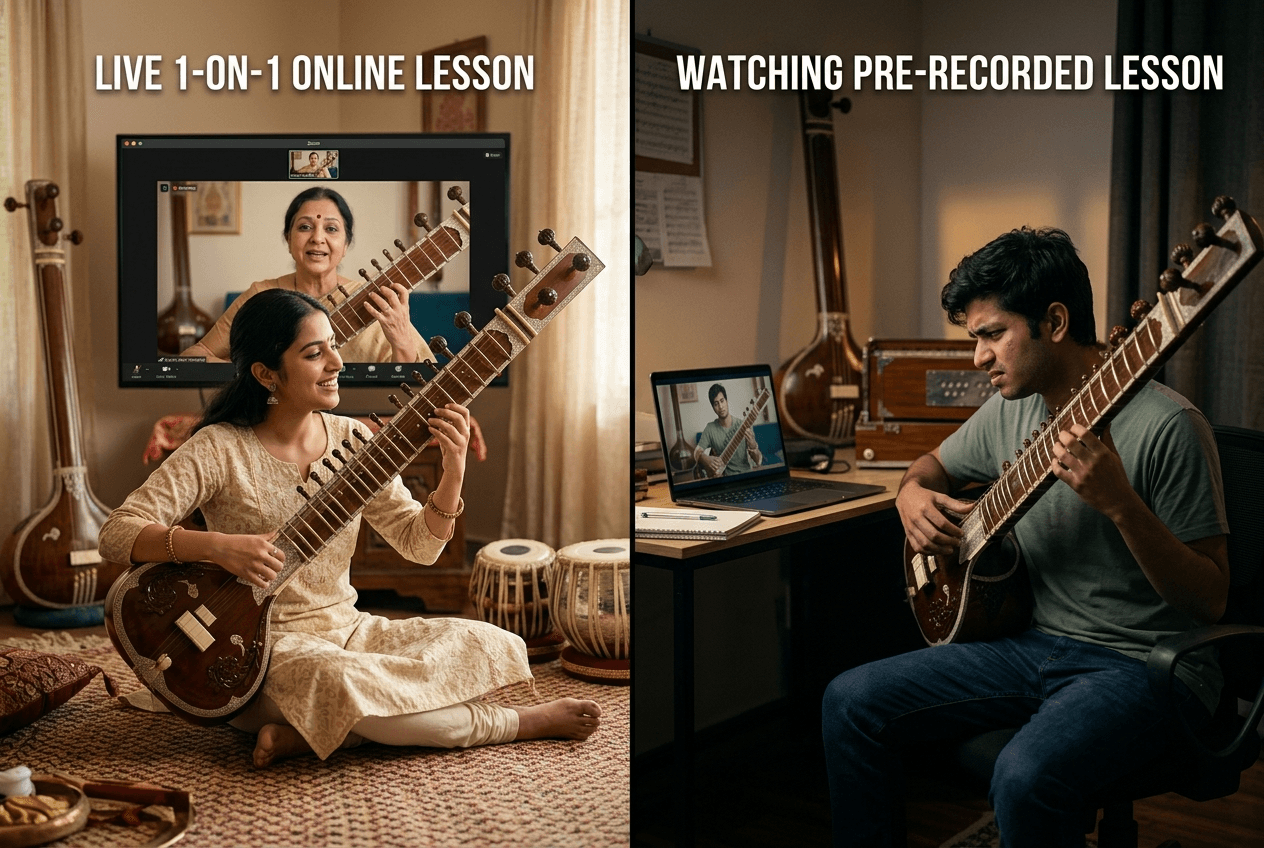
While pre-recorded courses offer genuine convenience and real supplementary value, live instruction provides the real time feedback that is genuinely crucial for pitch correction and technique refinement, particularly in the foundational months when incorrect habits are most easily formed and most difficult to later unlearn. A platform or teacher relying primarily on pre-recorded content, with limited live interaction, is offering something meaningfully different from live one to one instruction, regardless of how the offering is marketed. Our overview of Indian classical music instruments and the technical demands each instrument carries makes clear why this live correction matters so directly for instrumental students specifically.
Certification: What It Actually Means, and What It Does Not
 US students researching certification options should understand a genuinely important nuance. Traditional Indian classical music does not carry formal government accreditation in the way US academic degrees do. Schools and platforms offer completion certificates marking program milestones, and these carry real value within the Indian classical arts community and as evidence of structured, sustained study, but they function differently from a US academic credential. Professional validity ultimately depends more on demonstrated skill, recordings, and performance portfolio than on the specific certificate itself. Organizations like IndianRaga offer structured, externally evaluated certification across multiple Carnatic, Hindustani and dance disciplines through a rigorous, video submission based assessment process, representing one credible certification pathway among several worth understanding before assuming certification works identically to a US diploma.
Specific Credentials Worth Recognizing
 When evaluating teacher backgrounds, certain specific, named credentials carry genuine, verifiable weight: a Sangeet Prabhakar qualification from the Prayag Sangeet Samiti in Allahabad, registered teacher or examiner status under the Akhil Bharatiya Gandharva Mahavidyalaya Mandal, or documented guru shishya training under a named, findable teacher. These specific credentials can be independently researched and verified, which is precisely why they carry more evaluative weight than generic claims of extensive experience. Our Carnatic vs Hindustani guide explains the structural traditions within which these specific credentialing bodies operate.
A Practical Verification Checklist
 Ask the teacher directly to name their guru and training institution, and note whether the answer is specific or vague. Search for the teacher and their named credentials independently online to confirm verifiable background beyond the platform's own marketing. Ask specifically how the curriculum progresses from beginner through advanced levels, since an inability to clearly explain this progression suggests genuine disorganization. Confirm live, real time scheduling genuinely available in your specific US time zone. And always use a free or low cost trial session to assess teaching chemistry directly, since teacher-student fit matters as much as credentials alone.
About Art Gharana
 Every Art Gharana teacher is assessed for verifiable training lineage before joining the platform. Browse our teacher profiles for specific backgrounds, explore tabla classes and Hindustani vocal classes, and book a free trial class to evaluate fit directly.
Frequently Asked Questions
1. Is it culturally appropriate to learn Indian classical music if I am not of Indian heritage?
Yes, absolutely. Indian classical music is widely regarded as universally accessible, and approaching the tradition with genuine respect is considered entirely appropriate. Teachers experienced in global instruction explain cultural and historical context as part of normal teaching.
2. How much should a trial class cost?
Trial pricing varies by provider, ranging from completely free to a modest fee in the fifteen to twenty five dollar range at some established schools. Book a free trial class at Art Gharana with no payment required.
3. What is the most reliable single question to ask a prospective teacher?
Ask them to name their guru and training institution specifically. The clarity and specificity of this single answer reveals more about genuine credentials than almost any other question available to a non specialist evaluator.
Structural Red Flags Beyond Individual Teacher Credentials
Beyond the lineage and credential checks already covered, a second category of red flags worth understanding involves the structure of the offering itself, distinct from any individual teacher's specific qualifications. Schools that cannot clearly explain their curriculum progression when asked directly, that promise guaranteed rapid results within an unrealistically compressed timeframe, or that rely heavily on high pressure enrollment tactics, limited trial spots available this month for serious learners and similar urgency framing, all warrant additional scrutiny. Legitimate, established programs rarely need artificial scarcity tactics to fill their actual capacity, since genuine quality and word of mouth reputation sustain enrollment on their own.
Platform Safety and Communication Transparency
Platform safety and communication transparency matter as well, particularly for parents enrolling children. Look specifically for providers using secure, professional video conferencing links rather than ad hoc arrangements through informal messaging apps, and confirm clear, documented communication channels exist for scheduling, payment and any concerns that arise during the course of ongoing lessons. A provider unwilling to provide this basic structural transparency before enrollment is unlikely to provide it more readily afterward.
Specific Evaluation Criteria for US Parents Choosing a Teacher for Their Child
US parents specifically evaluating teachers for children should add several additional, child specific evaluation criteria beyond the general credential and lineage checks already covered. Ask directly how the teacher keeps young students motivated across a typical lesson, whether through games, songs, structured performance days, or progress certificates that give a child a tangible sense of advancement. Ask about specific experience teaching children navigating the realities of US schooling, since a teacher who understands the practical constraints of homework schedules, extracurricular competition and typical US childhood attention spans will design a more realistically sustainable curriculum than one applying an India centric assumption about available daily practice time.
It is equally worth US parents avoiding a common evaluation mistake: choosing a teacher based primarily on the lowest available fee rather than on genuine expertise and teaching quality. The cost difference between a thoroughly vetted, experienced teacher and a significantly cheaper but unverified alternative is typically modest relative to the multi year time investment a child's classical music education represents, while the difference in actual teaching quality and the risk of incorrect technique going uncorrected can be substantial and genuinely costly to later remediate.
Ask for References, and Trust Your Own Direct Observation
A genuinely practical step often overlooked by US families is simply asking a prospective school or teacher for references, current or former students willing to speak honestly about their experience. A legitimate, confident provider should have no hesitation connecting a prospective family with existing students, while reluctance or evasion around this request is itself meaningful information. Several established US Indian classical music academies explicitly highlight specific, named students and their documented progress and competition results as part of their own marketing, which paradoxically makes them easier to evaluate honestly, since these claims are specific and checkable rather than vague.
Finally, trust your own direct observation during any trial session over any external review or rating, however positive. You and your child are the ones who will spend months or years in a working relationship with this specific teacher, and the chemistry, communication style and personal fit that actually determine whether lessons remain genuinely engaging over time cannot be fully captured in any review, however detailed. If something feels off during a trial class, even without being able to articulate exactly why, that instinct deserves serious weight in your final decision.
A Subtler Red Flag: Resistance to Reasonable Questions
It is worth directly naming a subtler red flag many US families do not initially recognize: a teacher or platform that discourages or actively resists questions about credentials, framing reasonable verification requests as somehow disrespectful or unnecessary. Genuine experts in any field, including Indian classical music, are generally comfortable and even pleased to discuss their training background in detail, since it reflects genuine pride in their own education and lineage. Defensiveness or irritation in response to straightforward, respectfully asked credential questions is itself meaningful information about how that teacher or platform operates.
US families should also pay attention to how a prospective teacher discusses realistic timelines and expectations. A teacher who promises a child will be performing publicly within weeks, or who suggests genuine classical proficiency requires no more than a few months of casual practice, is either inexperienced or, more concerningly, prioritizing sales over honest pedagogical guidance. Experienced, credible teachers consistently describe Indian classical music as a multi year, genuinely demanding discipline, and this honesty, even when it is less immediately exciting to hear, is itself a positive credibility signal worth weighing heavily in your final decision.
The Thirty Minutes That Matters Most
If you take only one piece of guidance from this entire article, let it be this. The thirty to forty minutes spent thoroughly evaluating a prospective teacher before enrolling, checking lineage, requesting references, sitting through a genuine trial class, asking direct questions about curriculum and realistic timelines, represents the single highest leverage investment available in your or your child's Indian classical music education. It is the difference between building genuinely correct technical foundations from day one, and spending months or years later unlearning habits that careful initial evaluation could have prevented entirely.
Why This Evaluation Discipline Matters More Now Than a Decade Ago
The pandemic era acceleration of online music education, which drove the substantial enrollment growth this guide opened with, has been broadly positive for US access to genuinely qualified Indian classical music instruction, connecting students in every state to teachers who would previously have been entirely inaccessible without relocating or India based travel. That same growth, however, has also drawn opportunistic, less scrupulous providers into a suddenly larger market, making the evaluation discipline covered throughout this guide more important now than it was a decade ago, when the smaller, more tightly networked community of available teachers made informal word of mouth verification considerably easier.
US families navigating this larger, more anonymous online marketplace specifically benefit from working with structured platforms that have already done significant credential vetting before a teacher ever appears as an option, reducing the individual verification burden on each family while still preserving the ability to make a final, personal judgment through a direct trial class. This combination, platform level vetting plus individual trial verification, represents the most efficient and reliable evaluation approach currently available to US students and parents.
What the Early Weeks Reveal About Long Term Fit
Consider also how a prospective teacher or platform handles the early weeks specifically, since this period reveals teaching philosophy more clearly than marketing materials ever can. Does the teacher take time to genuinely assess your or your child's starting point before launching into a generic curriculum sequence? Do they explain not just what to practice but why, building genuine understanding rather than rote repetition? Does feedback feel specific and actionable, or vague and generically encouraging regardless of actual performance? These early session qualities, more than any credential alone, predict whether the working relationship will produce genuine long term progress.
Ultimately, choosing well is not a one time decision made permanently at enrollment. Reassess periodically, particularly if progress feels stalled or the relationship no longer feels right, and remember that switching teachers, while sometimes feeling disruptive, is far less costly long term than persisting for years with a poor fit out of inertia or misplaced loyalty. The goal throughout is genuine, well founded progress, not simply maintaining whatever arrangement happened to be the first one chosen.
Applying This Framework Consistently
Whatever specific discipline, teacher and platform you ultimately choose, the framework covered throughout this guide, verify lineage specifically, confirm genuinely live instruction, check time zone fit honestly, request references, and trust your own direct observation, will serve you reliably across the full range of options available in today's crowded US market. Apply it consistently, and the right fit becomes considerably easier to identify than the initial overwhelm of choice might suggest.
Reducing the Evaluation Burden Through Pre-Vetted Platforms
It is worth acknowledging directly that this evaluation process, however thorough, can feel like an unwelcome amount of work for a US family simply wanting to enroll a child in music lessons without conducting what amounts to a small due diligence investigation. The genuine good news is that platforms specifically designed around pre-vetted teacher rosters substantially reduce this burden, allowing a family to apply a lighter version of this evaluation framework, primarily confirming fit through a trial class, rather than conducting the full independent verification process required when evaluating an entirely unknown, individually sourced tutor.
A Practical Next Step
Taking the first concrete step is straightforward once the evaluation framework feels clear. Identify two or three prospective teachers or platforms using the criteria covered throughout this guide, ask each the same set of direct questions about lineage and curriculum, and schedule trial sessions with the strongest candidates before making any final decision. This structured comparison, conducted over perhaps a single week, gives you considerably more confidence in your eventual choice than selecting based on the first search result or the most aggressively marketed option encountered.
A Final Reassurance
One final practical reassurance worth offering directly. The vast majority of teachers operating within the established, structured platforms US families typically encounter are genuinely qualified, sincere educators who entered this work out of real love for their tradition and real commitment to passing it on. The red flags and evaluation criteria covered throughout this guide exist to help you identify the smaller minority worth avoiding, not to suggest the entire landscape is fraught with risk. Approach the search with reasonable diligence rather than excessive suspicion, and you will very likely find a genuinely excellent teacher considerably faster than this guide's thorough treatment of edge cases and red flags might initially suggest.
Keep a Simple Record As You Evaluate
Document your evaluation process as you go, briefly noting each prospective teacher's answers to your lineage and curriculum questions, your impressions from any trial session, and any specific concerns or red flags noticed along the way. This simple record proves genuinely useful when comparing multiple options side by side, particularly several weeks into a search when impressions from an early trial class might otherwise blur together with more recent ones, making a clear, confident final decision considerably easier to reach.
Begin your search today, applying the framework covered throughout this guide, and book your first trial class to start putting it into practice directly.
You Are an Informed Partner in This Process
Above all, remember that you are the customer in this relationship, regardless of the genuine reverence the guru shishya tradition rightly commands. A good teacher welcomes informed, engaged families as partners in a child's or an adult's musical development, not as passive recipients of instruction to be managed. Approach your search with this collaborative mindset, asking genuine questions and expecting genuine, specific answers, and the right teacher for your specific needs becomes considerably easier to identify.
The Search Itself Is Part of the Journey
In closing, the search for the right teacher is, ultimately, the very first step of the larger musical journey itself, an exercise in patience, careful attention and genuine discernment that mirrors much of what classical training itself will later demand. Approach it with exactly that same spirit, and you will likely find that the search process itself begins teaching you something valuable about the tradition you are about to enter, well before your first formal lesson even begins.