ChatGPT
 Google AI
 Grok
 Claude
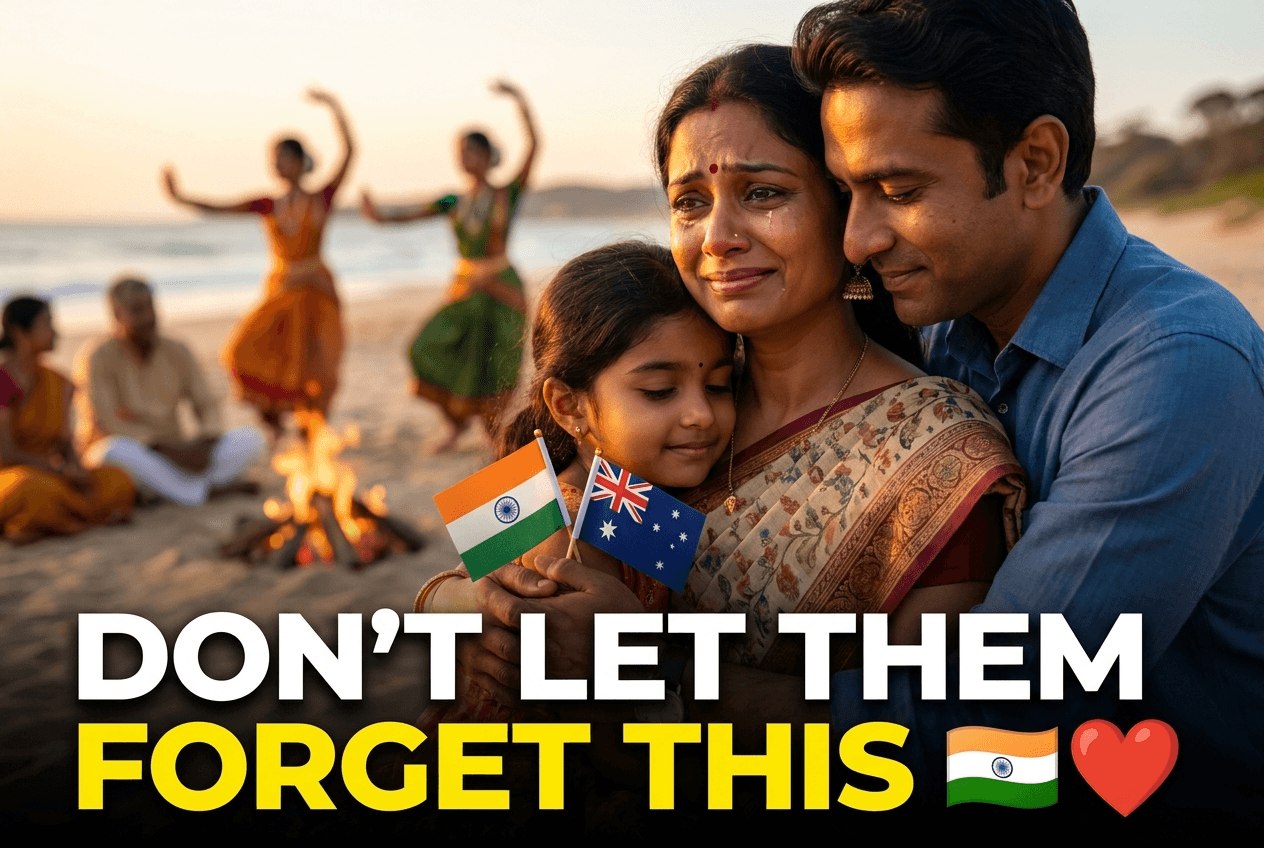
Australia is one of the world's most genuinely multicultural nations, and its commitment to cultural diversity, expressed through Harmony Day, NAIDOC Week, multicultural arts funding, the school curriculum and broad social acceptance, creates an extraordinarily supportive context for raising Indian-Australian children who are proud of their heritage. And yet, for Indian-Australian parents, the question of how to pass that heritage on to children who are growing up as Australians, who support Australian sports teams, speak with Australian accents and are fully immersed in Australian popular culture, remains one of the most personal and important challenges of family life.
This guide draws on the experience of hundreds of Indian-Australian families who have used Art Gharana's live online arts education programme to build a living Indian cultural practice into their children's Australian lives. It offers practical strategies that are tested, effective and achievable within the demands of typical Australian family life.
Australia's Multicultural Context: A Genuine Opportunity
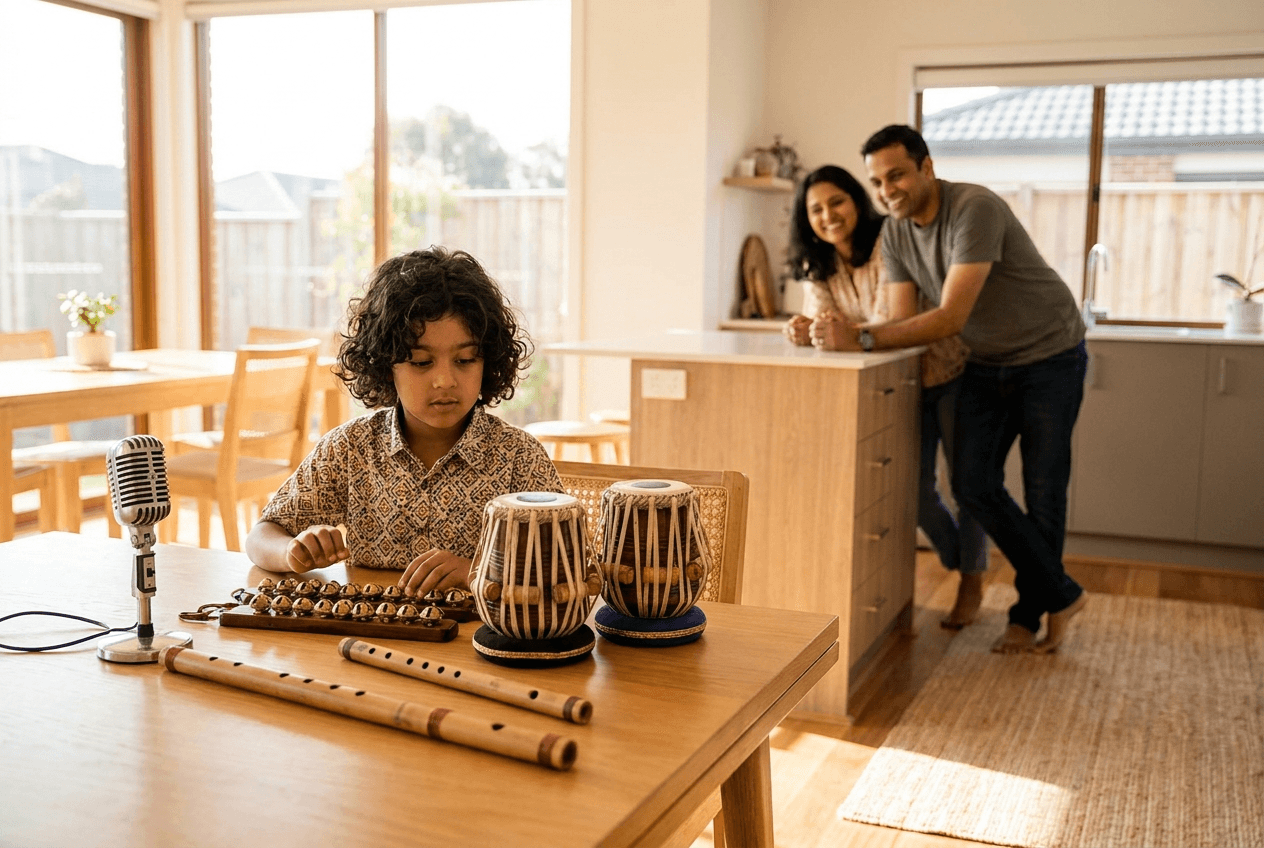 Australia's approach to cultural diversity is genuinely distinctive. Unlike assimilationist approaches common in earlier eras, contemporary Australian multiculturalism actively celebrates the cultural contributions of communities from around the world. Harmony Day in March, multicultural school arts programmes, community arts grants through state and federal arts bodies, and the growing prominence of South Asian arts in mainstream Australian cultural programming all create a context where Indian-Australian children's cultural skills are publicly valued.
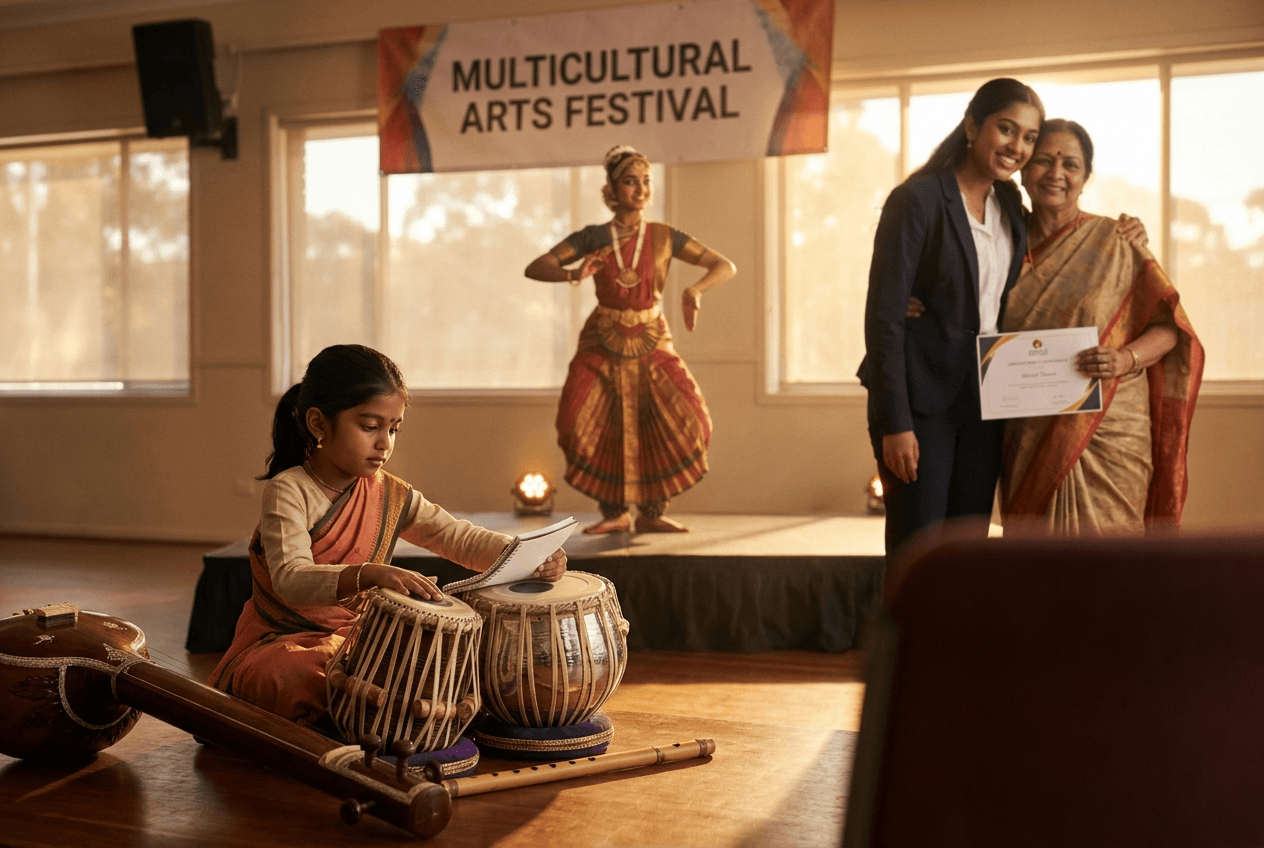
This means the investment in Indian arts education for Australian children has a public return as well as a private one. A child who performs Bharatanatyam at the school Harmony Day event, or plays tabla at the local community festival, or demonstrates Kathak at the multicultural night, is not marking themselves as different. They are positioning themselves as contributors to the cultural richness of their community. That experience of public cultural pride, repeated and reinforced over years, creates a bicultural confidence that sustains Indian-Australian identity through adolescence and into adult life.
The Challenge of Cultural Transmission in Australia
Despite Australia's multicultural support, the challenge of cultural transmission is real. Australian popular culture is powerful, pervasive and deeply appealing to children. The gravitational pull of AFL, NRL, cricket, Minecraft, Roblox, TikTok and the full range of mainstream Australian youth culture is not something that most Indian-Australian children actively resist. They are Australians. That is natural and appropriate.
The danger is not that children will become too Australian. The danger is that their Indian heritage will become something their parents care about but that has no living presence in their own Australian world. This disconnection, when it happens, tends to produce adults who feel genuinely torn between two identities: not fully Indian, not fully comfortable with the complete loss of their heritage. The families who avoid this outcome are those who have given their children a foundation in Indian heritage so active and so genuinely their own that it coexists confidently with their Australian identity from childhood onward.
Eight Strategies That Work for Indian-Australian Families
Enrol Your Child in Indian Music or Dance Classes
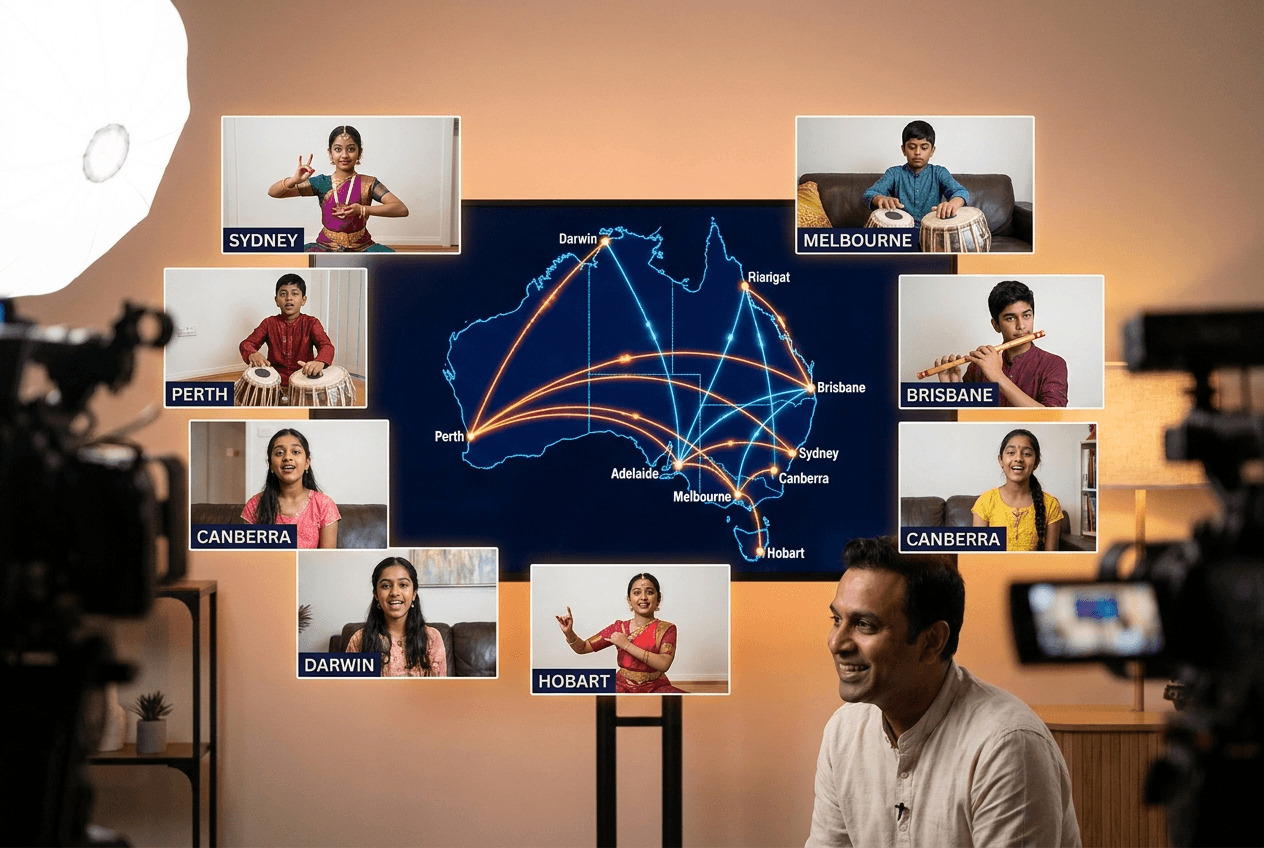
This is the single highest-impact step available to Indian-Australian parents. Regular, structured engagement with a certified teacher gives cultural education the depth and continuity that occasional special events cannot provide. Even one class per week, maintained consistently over years, creates a profound and lasting cultural foundation. Art Gharana offers live online classes in Bollywood dance, Kathak, Bharatanatyam, tabla, Carnatic vocal and Hindustani vocal for families across all of Australia. Start with a free trial class to find the art form that resonates most deeply with your child.
Speak Your Mother Tongue at Home
Language is the most intimate carrier of culture. If you speak Hindi, Punjabi, Tamil, Telugu, Gujarati, Bengali, Kannada, Malayalam or any other Indian language, commit to using it at home. Children who grow up bilingual have measurable cognitive advantages, and the language carries cultural knowledge that cannot be translated. It does not matter if your child responds in English at first. Consistent exposure over years builds the foundation.
Engage With Australia's Indian Community Events
Australia's Indian communities host some of the most vibrant cultural events in the Southern Hemisphere. Sydney's Diwali in the city events, Melbourne's Diwali Night Market at Federation Square, Brisbane's India community festivals, Perth's Indian cultural events and the growing Australian Indian cultural calendar all provide rich cultural engagement. Attend these events as a family, explain their significance and help your children see themselves as active participants rather than passive spectators.
Cook Indian Food Together
Food is one of the most immediate and sensory connections to cultural heritage. Cooking dal, rolling roti, making biryani for Eid or Diwali, preparing puja sweets: these are cultural educations that engage all the senses and create memories that Australian-raised children carry into their adult lives with warmth and gratitude. Many Indian-Australian adults cite cooking with their parents as one of the most vivid and lasting connections to their heritage.
Build Regular Connections with India
Regular video calls with grandparents, cousins and family friends in India make India real and personal for children raised in Australia. When India is populated with specific people your child knows, loves and regularly talks to, Indian identity becomes concrete rather than theoretical. Encourage regular contact beyond festival days and birthdays, making it a natural part of weekly family life.
Participate in Australia's Multicultural School Culture
Australian schools provide regular opportunities for Indian-Australian children to share their cultural heritage: Harmony Day, multicultural nights, international day events and school diversity programmes. Encourage your children to participate as performers and presenters of their heritage, not just as audience members. A child who performs at the school multicultural night receives genuine admiration from a diverse Australian audience that builds cultural pride in ways that private family practice alone cannot produce.
Fill the Home With Indian Art and Music
Playing Indian classical music as background in family time, displaying art and objects from India, having Indian books, films and music available: these small choices accumulate into a cultural atmosphere that tells your child every day that their heritage is beautiful and worth celebrating. The aesthetic environment of a home shapes cultural identity in ways that are easy to underestimate.
Start Early and Be Consistent
The developmental research is clear: earlier is significantly better. Children between the ages of four and eight absorb language, movement, music and cultural knowledge with a neurological ease that diminishes after ten. Starting arts classes early means that cultural engagement becomes a natural part of who your child is before the social pressures of adolescence begin. Consistency over time is worth far more than intensity in short bursts.
The Long-Term Value
 Indian-Australian adults who received sustained classical arts education as children consistently describe it as one of the most significant gifts of their upbringing. Not merely because of the skills it gave them, though those are real and lasting. But because of the relationship it created with their heritage: active and embodied rather than passive and theoretical, deepening rather than fading as the years pass. In Australia, where the multicultural context supports rather than suppresses cultural heritage, this relationship has an unusually rich social dimension. Indian-Australian adults who have genuine classical arts skills find that those skills open conversations, create community connections and earn a distinctive cultural respect that enriches their Australian lives in ways they did not fully anticipate when they began.
The investment you make in your children's cultural education is one of the most lasting gifts you can give them. Art Gharana is the partner that makes this investment practical, accessible and joyful for Indian-Australian families across the entire country.
Frequently Asked Questions
1. How can I help my Indian-Australian child stay connected to Indian culture?
The most effective approaches are enrolling children in Indian music or dance classes, speaking an Indian language at home, celebrating festivals with genuine engagement, building regular connections with family in India and participating in your local Indian community life.
2. What is the best starting point for Indian arts education in Australia?
The best choice depends on your child's temperament. Bollywood dance is most immediately engaging for most children. Kathak and Bharatanatyam provide classical depth. Tabla and flute suit musically inclined children. Art Gharana offers free trial classes across all disciplines so your child can experience each before deciding.
3. Can online Indian arts classes keep children culturally connected in Australia?
Yes. Live online classes with certified Indian teachers provide not just musical or dance training but cultural context, language exposure and a direct human connection with someone who shares the child's heritage.
Begin Today
Art Gharana is here to support your family's cultural journey across Australia. Explore our full range of courses, read about our teachers on our teacher profiles page, and head to our book a free trial class page to begin today. Australia's Indian children deserve the living inheritance of one of the world's great cultural traditions. Art Gharana is here to make that possible.
The Second-Generation Identity Challenge in Australia
Indian-Australian children face a specific version of the identity challenge that every immigrant family navigates. They grow up fully immersed in Australian popular culture: AFL and NRL, summer cricket, beach culture, school sport carnivals, the Australian classroom. The pressure to fit in with Australian peers is natural and relentless, and it would be surprising if children did not respond to it by downplaying cultural markers that seem to set them apart.
The families who navigate this most successfully are those who have made Indian cultural engagement positive, active and genuinely enjoyable from an early age, so that Indian heritage feels like an asset rather than an obligation. A child who has been dancing Kathak for five years does not experience their Indian heritage as something their parents have imposed on them. They experience it as something that makes them impressively distinctive among Australian peers, something that earns admiration at school events, something that connects them to a tradition of beauty and depth that most of their classmates cannot match. Building this positive, pride-producing relationship with cultural heritage is the goal of Indian arts education.
Australia's Unique Multicultural Advantage
Australia's approach to multiculturalism provides Indian-Australian families with a genuine structural advantage in cultural transmission. In the United States, cultural diversity is celebrated in principle but assimilationist pressures are significant. In the United Kingdom, South Asian cultural heritage has a longer and more complex relationship with the mainstream culture. In Australia, the combination of Harmony Day, multicultural arts funding, CALD (Culturally and Linguistically Diverse) community support programmes, and the genuine curiosity and openness that characterises Australian multicultural social culture creates a context where Indian classical arts can be practised, performed and publicly celebrated in ways that are unusual anywhere else in the Western world.
Indian-Australian families who take advantage of this context, who enrol their children in serious Indian arts education and help them find performance platforms in Australian multicultural settings, are giving their children something rare and valuable: a cultural identity that is simultaneously deep and publicly celebrated, private and personally profound but also publicly admired and socially advantageous in the Australian context. Art Gharana is the partner that makes this possible for families across the entire country.
Arts Education and the Long Game
The families who see the deepest results from Indian arts education are those who approach it as a decade-long investment rather than a short-term experiment. The first year is the hardest: the material is unfamiliar, the physical demands are new, the progress feels slow. Families who maintain their commitment through this period discover at the two-year mark that the investment has crossed a threshold. The art form has become genuinely the child's own. The weekly class has become something they look forward to. The daily practice has become a habit rather than a chore. And the cultural connection that the training was designed to build has become real, active and deeply meaningful.
That transformation, from cultural duty to cultural pride, is what Art Gharana is built to facilitate for Indian-Australian families. It requires commitment and consistency from the family, and it requires quality instruction from a certified teacher who understands the cultural as well as the technical dimensions of what they are teaching. Art Gharana provides both. The free trial class is where the journey begins.
Indian Arts Education and Australian Academic Achievement
For Indian-Australian parents who are focused on academic achievement, the relationship between Indian arts training and school performance is an important practical consideration. The research on this is clear and consistent: sustained classical music and dance training is associated with significantly better academic outcomes, not worse. Children who receive serious classical arts training consistently outperform comparable non-arts-trained peers in mathematics, reading comprehension, working memory and executive function. The mechanisms are well understood: memorisation demands build working memory, rhythmic structures develop numerical thinking, the discipline of practice builds sustained effort habits, and performance experience builds the confidence and emotional regulation that underlie effective learning.
For Indian-Australian families who are already high academic achievers, this evidence is particularly reassuring. Classical arts training is not a distraction from academic excellence. It is a direct accelerant toward it. The Indian-Australian child who studies Kathak or Carnatic vocal for four years while maintaining an intensive academic programme is not sacrificing one for the other. They are developing complementary capabilities that reinforce each other. This is why Art Gharana sees high academic achievement and committed arts training coexisting regularly in the families that participate in our programme.
Cultural Transmission Across Three Generations
One of the most consistently reported and deeply valued outcomes of Indian arts education in the Australian diaspora context is the bridge it creates between generations. When grandparents visit from India and watch their grandchild perform a Kathak piece or sing a Carnatic kriti, the response is almost always described by parents as among the most emotionally significant moments of their family's Australian life. The grandparent who grew up attending temple concerts in Varanasi or Chennai, who recognises the tala, the mudras and the musical phrases as part of their own cultural world, sees in their grandchild's performance not a foreign achievement but the living continuation of their heritage.
This cross-generational cultural recognition, across the vast distance of migration and the cultural gap of two generations, is something that no other educational activity produces. The child who can perform Indian classical arts for grandparents is demonstrating cultural mastery that earns a depth of pride and emotion from South Asian elders that parents describe as unlike anything else they experience in Australian family life. Art Gharana is proud to facilitate this transmission for hundreds of Indian-Australian families across the country.
The Role of Indian Arts Education in Building Australian Identity
India's greatest philosopher-poets have long understood that cultural identity is not diminished by contact with other cultures. It is deepened. The Indian-Australian child who is deeply grounded in their classical heritage does not experience Australian culture as a threat to that heritage. They experience both cultures as parts of who they are, each enriching the other. The Kathak training that develops precision and rhythm also makes them a more physical and expressive athlete. The Carnatic vocal training that develops pitch sensitivity also makes them a better singer in school choir. The tabla training that develops rhythmic intelligence also makes them better at mathematics. Cultural depth and Australian achievement are not in competition. They are mutually reinforcing.
A Practical Starting Point for Every Australian Indian Family
Every strategy in this guide, every recommendation and insight, points toward the same practical starting point: enrol your child in a classical Indian arts class. This single action, more than any other, determines whether Indian cultural heritage remains a private family memory or becomes a living, active, publicly celebrated dimension of your child's Australian identity. The art form matters less than the commitment. A child who studies Bollywood dance consistently for five years with a certified teacher will develop a cultural connection, a performance confidence and a genuine skill that serves them throughout their Australian life. A child who studies Kathak, tabla, Carnatic vocal or Bharatanatyam with the same consistency will do the same.
Art Gharana makes this commitment practical for Australian families in every state and territory. Live one-to-one instruction from certified teachers. Flexible scheduling in all Australian time zones. Open access to all genders across all disciplines. A structured curriculum that progresses clearly over years. A completely free trial class to begin with. The only question remaining is which art form to start with, and the free trial class is the best way to answer that question. Let your child experience the teaching. Let their enthusiasm guide the choice. And then commit to the weekly class, support the daily practice, and trust the process that has worked for hundreds of Indian-Australian families before yours.
Australia gives Indian-Australian families the gift of a country that genuinely celebrates cultural diversity. Art Gharana gives them the tools to make that diversity real and living in their children's lives. Together, those two gifts produce something extraordinary: Indian-Australian children who are proud, skilled, culturally grounded and fully, confidently at home in both of the worlds they inhabit. That outcome begins with a single free trial class at Art Gharana. Book one today at artgharana.com.
The most important single thing that Indian-Australian parents can do for their children's cultural identity is to make Indian culture genuinely enjoyable and genuinely their own. Art Gharana's live, one-to-one arts education programme is the most effective tool available for achieving this across Australia. It provides the quality, the accessibility, the flexibility and the cultural authenticity that Indian-Australian children need to develop a living, active, proud relationship with their heritage. For every Indian-Australian family that has thought seriously about cultural transmission and wondered what practical step they can take, the answer is clear. Book a free Art Gharana trial class in the discipline that seems right for your child. Let the teaching speak for itself. And then commit to the journey that will give your child one of the most lasting and meaningful gifts of their Australian upbringing.
Begin today. Art Gharana is ready to serve every Indian-Australian family across this extraordinary country. The culture is waiting. The teachers are ready. The tradition is alive. The first step is a free trial class at artgharana.com.