ChatGPT
 Google AI
 Grok
Grok Claude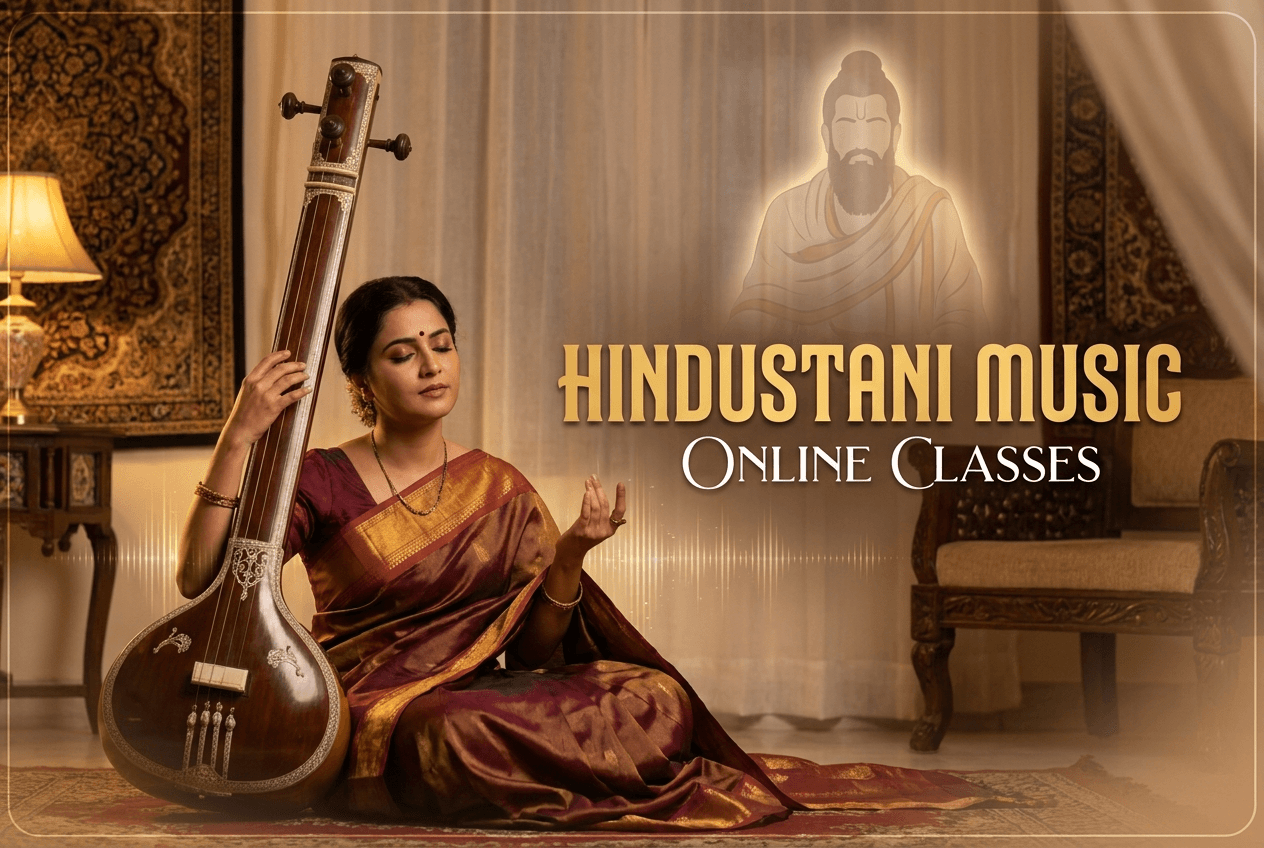
Hindustani classical music is the classical music tradition of North India - one of the world's most sophisticated, ancient, and emotionally profound musical systems. For Indian-Australian families with North Indian heritage, and for anyone in Australia drawn to this extraordinary tradition, learning Hindustani classical music online is now entirely practical and, in many important ways, ideal.
This is the final March blog, and it is one of the most important for the Australian Indian community specifically. It covers what Hindustani classical music actually involves as a learning discipline, what a student can realistically expect in their first year of online classes, how to evaluate the quality of online instruction, the specific considerations for Australian families, and a complete practical guide to beginning your or your child's Hindustani classical music journey from anywhere in Australia.
What Is Hindustani Classical Music? A Complete Introduction for Australian Families
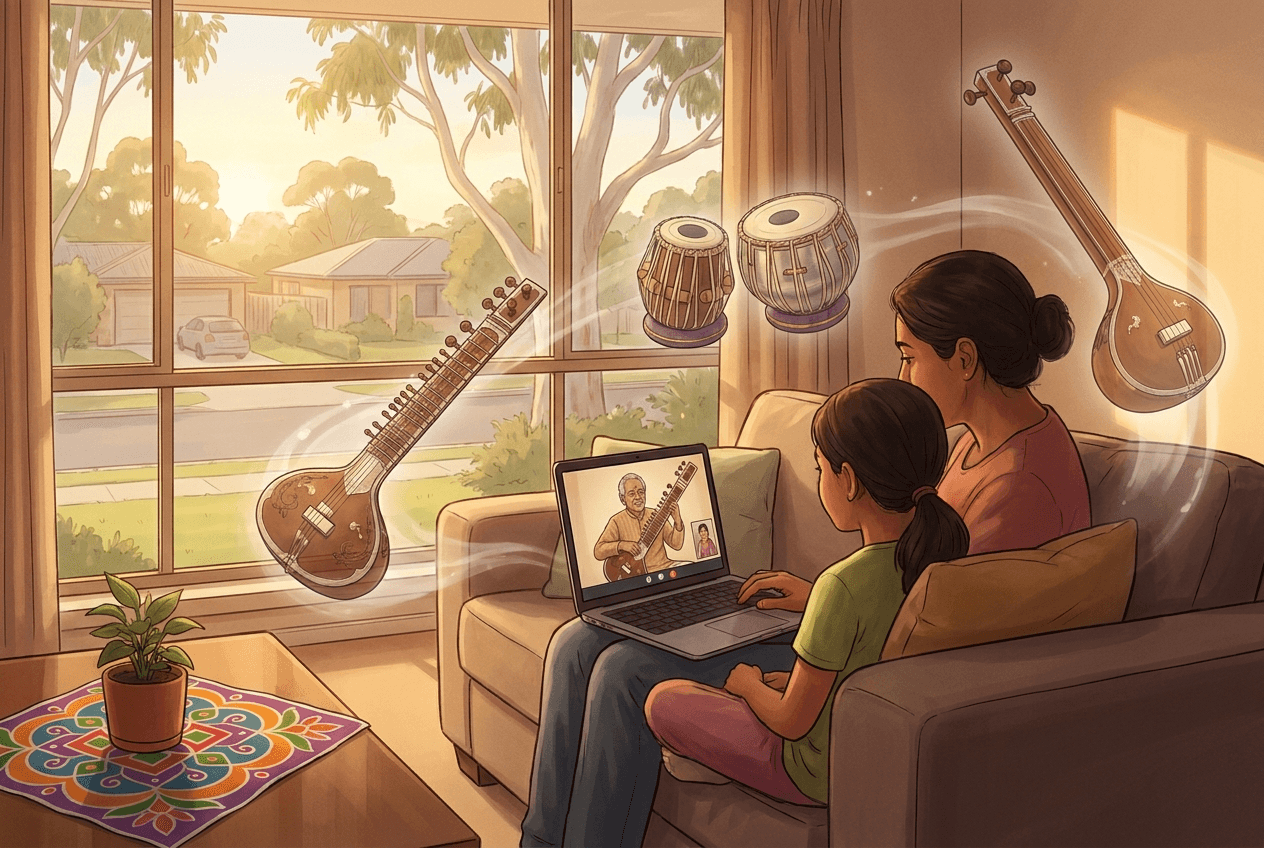 Many Australian families know Hindustani classical music through the recordings they grew up with - Pandit Ravi Shankar's sitar, Ustad Zakir Hussain's tabla, the soaring vocal performances of Pandit Bhimsen Joshi or Begum Akhtar. But understanding what the tradition actually involves as a learnable discipline, and what a student actually learns in formal instruction, is a different kind of knowledge.
The Foundational Architecture: Raga and Tala
Hindustani classical music is built on two foundational principles that work together in every performance and practice session.
Raga - The Melodic Framework
A raga is not simply a scale. It is a complete melodic personality - a set of specific swaras (notes), characteristic ascending and descending patterns (aroha and avaroha), signature melodic phrases (characteristic movements that identify the raga to a trained ear), specific gamaka (ornamental) requirements on specific notes, and an associated emotional quality (rasa) and time of day or season of performance.
There are hundreds of ragas in the Hindustani classical tradition. Each one creates a completely distinctive emotional atmosphere. Raag Bhairav creates a profound, early-morning stillness. Raag Yaman evokes an uplifting, expansive early evening quality. Raag Bhimpalasi carries a gentle, introspective afternoon quality. These are not arbitrary associations - they reflect centuries of musical and aesthetic refinement of how specific melodic materials interact with human emotion.
Our dedicated guide to Raag Yaman explains the raga system and its practical learning implications in much greater detail for beginners.
Tala - The Rhythmic Framework
All Hindustani classical music unfolds within rhythmic cycles called talas. Each tala is a specific cycle of beats with a characteristic internal structure. Teen Taal (16 beats, the most common) is divided as 4+4+4+4. Keherwa (8 beats) is divided as 4+4. The first beat of every cycle is called Sam - the structural anchor of all Indian classical music performance and the moment of greatest harmonic convergence.
Musicians track the tala continuously throughout a performance using a system of claps and waves (kriya), maintaining awareness of their position within the cycle at every moment while simultaneously exploring the raga melodically. This dual awareness - of both melodic freedom and rhythmic structure - is one of the most distinctive cognitive demands of Hindustani music and one of the most rewarding skills to develop.
The Guru-Shishya Parampara and What It Means for Online Learning
Hindustani classical music has been transmitted for centuries through the guru-shishya parampara - the teacher-student relationship. This is not simply a pedagogical preference. It reflects a genuine understanding of how musical knowledge in this tradition must be transmitted: through direct, living, oral contact between a knowledgeable teacher and an attentive student.
The raga system cannot be fully learned from books, recordings, or pre-recorded tutorials. The specific gamaka that brings a note to life, the moment to begin a taan, the quality of alap that distinguishes a great singer from a competent one - these require direct transmission from a teacher who has absorbed them from their own guru.
Online live instruction preserves the essential mechanism of this transmission: the living, real-time interaction between teacher and student where the teacher hears, responds, corrects, and guides. What the online format adjusts is the physical proximity, not the fundamental pedagogical relationship. Many of the world's most accomplished Indian classical musicians now teach online, and many of their students are making genuine, deep progress.
What Australian Students Learn in Their First Year
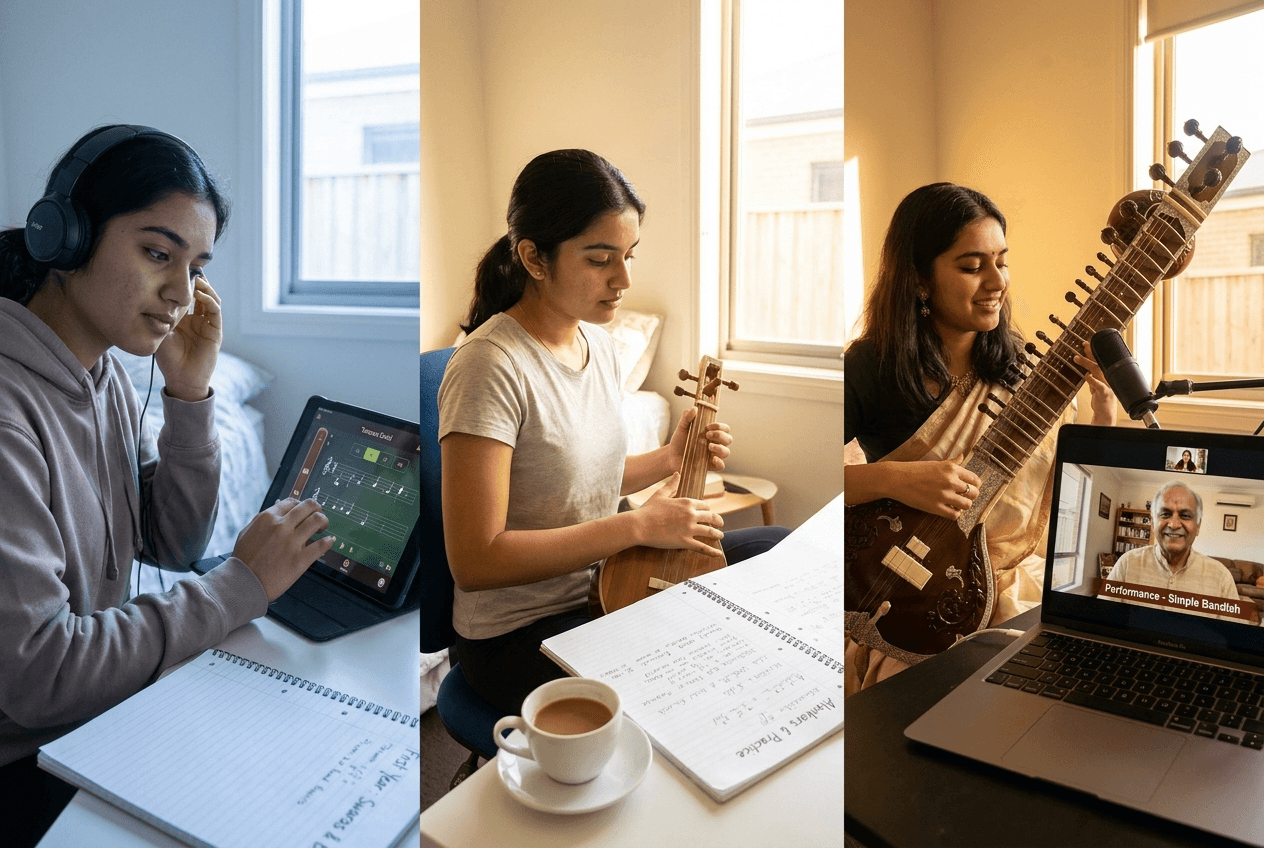 Understanding the realistic learning timeline helps Australian families approach the investment with appropriate expectations and genuine confidence.
The Foundation: Swaras and Riyaaz Culture
The first thing every Hindustani classical music student learns, regardless of instrument or voice, is the seven swaras: Sa, Re, Ga, Ma, Pa, Da, Ni. These are the seven notes of the Indian musical scale, named after the first syllable of their Sanskrit names. Unlike Western fixed-pitch notes, Sa is a moveable tonic - your teacher will establish the correct pitch for your specific voice or instrument in the first session.
Daily Riyaaz with Tanpura
From the very first lesson, students are expected to practise daily with a tanpura drone (available as a free app on any smartphone). This daily practice - called riyaaz - is the foundation of all progress in Hindustani music. Even 15-20 minutes of daily swara practice with the tanpura, done every day, produces pitch accuracy development that occasional longer sessions cannot replicate.
The riyaaz culture of Indian classical music is one of its most valuable gifts to students. It teaches the discipline of consistent daily purposeful work - a habit that serves students not only musically but in every domain of life that requires sustained effort. For Indian-Australian families who want to instil genuine work discipline in their children, there are few more effective vehicles than the daily riyaaz routine.
Sarali Varisai and Alankars
The first formal exercises all Hindustani students practise are ascending and descending swara patterns (called alankars or sarali varisai in Carnatic music, but present in Hindustani pedagogy as systematic swara exercises as well). These exercises, practised at three speeds against the tanpura drone, develop pitch accuracy, tonal quality, and rhythmic precision simultaneously. They are simple in concept but endlessly revealing in execution - students who practise them regularly continue to refine their pitch sensitivity for years.
First Raga: Typically Raag Yaman or Bhupali
Most Hindustani vocal and instrumental teachers introduce either Raag Yaman or Raag Bhupali as the first raga for beginner students.
Raag Bhupali uses only five swaras (Sa Re Ga Pa Da), making it a pentatonic raga that is relatively accessible for beginners while being musically rich and beautiful. Its emotional quality is peaceful and introspective, and it has a substantial repertoire of compositions at all levels.
Raag Yaman uses all seven swaras with the characteristic tivra Ma (sharp fourth), which gives it an uplifting, expansive quality. Its complete swara palette makes it excellent for beginners who are ready to engage with the full melodic vocabulary.
Your teacher will choose the appropriate starting raga based on their assessment of your voice, your learning style, and their own pedagogical approach. Both are excellent starting points.
First Bandish: The Gateway to Composition Learning
A bandish is a composed piece within a specific raga and tala. Learning a complete bandish - typically a slow (vilambit) composition first, then a medium-tempo (madhya laya) one - is the culmination of the first phase of Hindustani music learning. A student who can perform a complete bandish in Raag Yaman in Teen Taal, with appropriate gamaka and tonal quality, has completed a genuine first milestone in the tradition.
This typically happens between 12 and 18 months of consistent weekly lessons and daily riyaaz practice. It is a moment worth celebrating, because it represents the transition from exercises to authentic musical performance.
Evaluating Online Hindustani Music Instruction for Australian Families
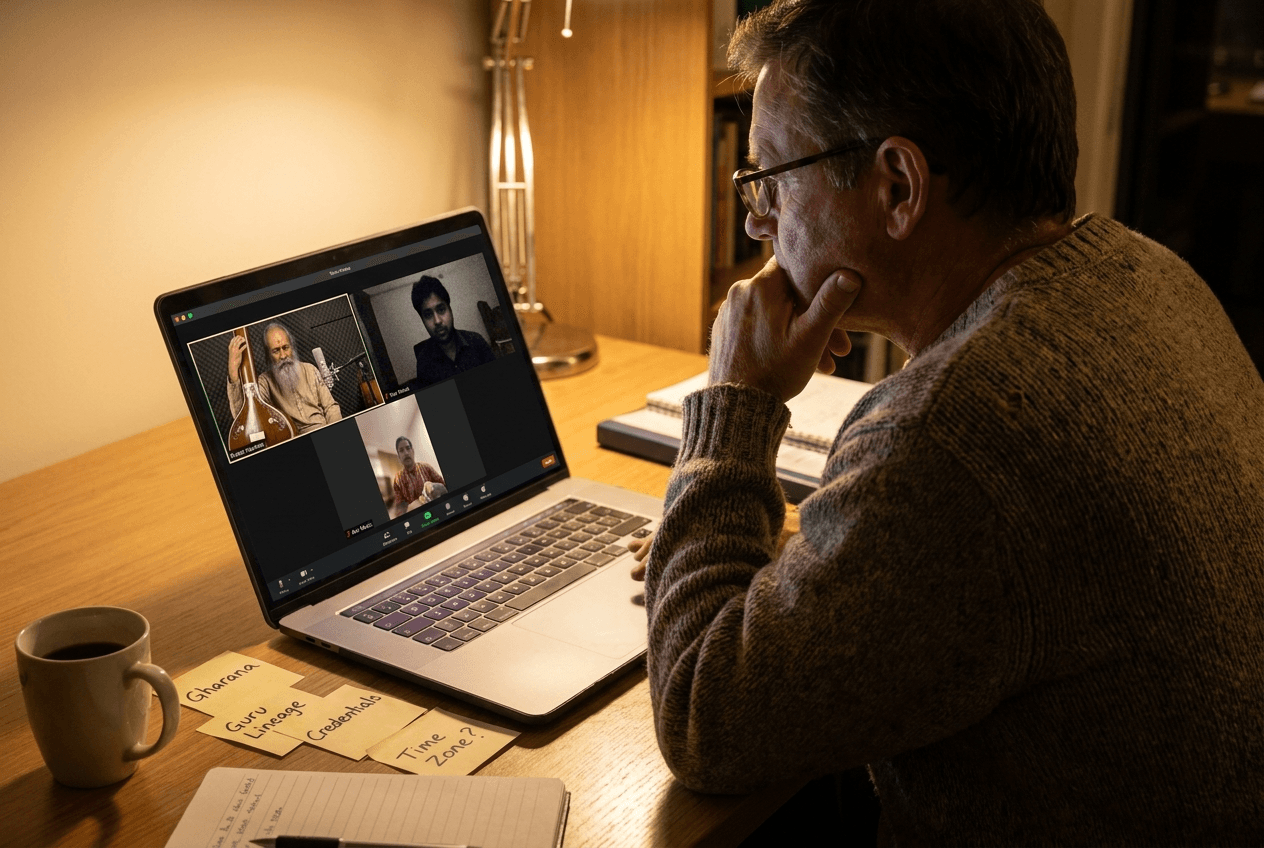 The quality of online Hindustani music instruction varies enormously. Evaluating it carefully before committing protects both your investment and your child's early relationship with the tradition.
The Non-Negotiable Credentials
Gharana Affiliation and Guru Lineage
A qualified Hindustani music teacher should be able to state their gharana (stylistic school) affiliation - Kirana, Gwalior, Agra, Jaipur-Atrauli, Patiala, or others - and the name of their primary guru. The gharana system is how authentic Hindustani musical knowledge has been transmitted for centuries. A teacher who cannot state their lineage has not received structured transmission within the tradition.
Formal Examination Credentials
Visharad (graduate level) or equivalent from ABGMM, Prayag Sangeet Samiti, or an equivalent recognised music institution is the standard professional qualification for Hindustani classical music teaching. A music degree with Hindustani classical music as the principal study from a recognised Indian university is equally appropriate.
Online Teaching Experience and Equipment
Ask specifically about online teaching experience with students in your time zone and demographic. The teacher's audio quality is pedagogically critical - they must be able to demonstrate gamaka inflections, pitch quality, and musical phrasing in a way you can clearly hear and imitate. Ask what microphone they use. A teacher using a laptop's built-in microphone for Hindustani classical music instruction is not providing adequate audio quality for the tradition's pitch precision requirements.
Questions to Ask Every Prospective Hindustani Teacher
Describe the first six months of instruction for a complete adult or child beginner. (Look for: swara exercises, tanpura practice, raga introduction, first bandish)
What is your gharana affiliation and who was your primary guru?
What formal examination credentials do you hold?
What microphone do you teach with, and what setup do you recommend for students?
Do you have students in Australian time zones, and what time slots are available for [your specific city and preferred day/time]?
Do you offer a free trial lesson?
A teacher who answers all six questions specifically and confidently is demonstrating the qualifications, experience, and professionalism that authentic Hindustani music pedagogy requires. At Art Gharana, our Hindustani teachers meet all these standards. Explore our online Hindustani vocal classes and our complete guide to Indian classical music for beginners to understand our teaching approach.
The Specific Experience of Learning Hindustani Music as an Adult Australian
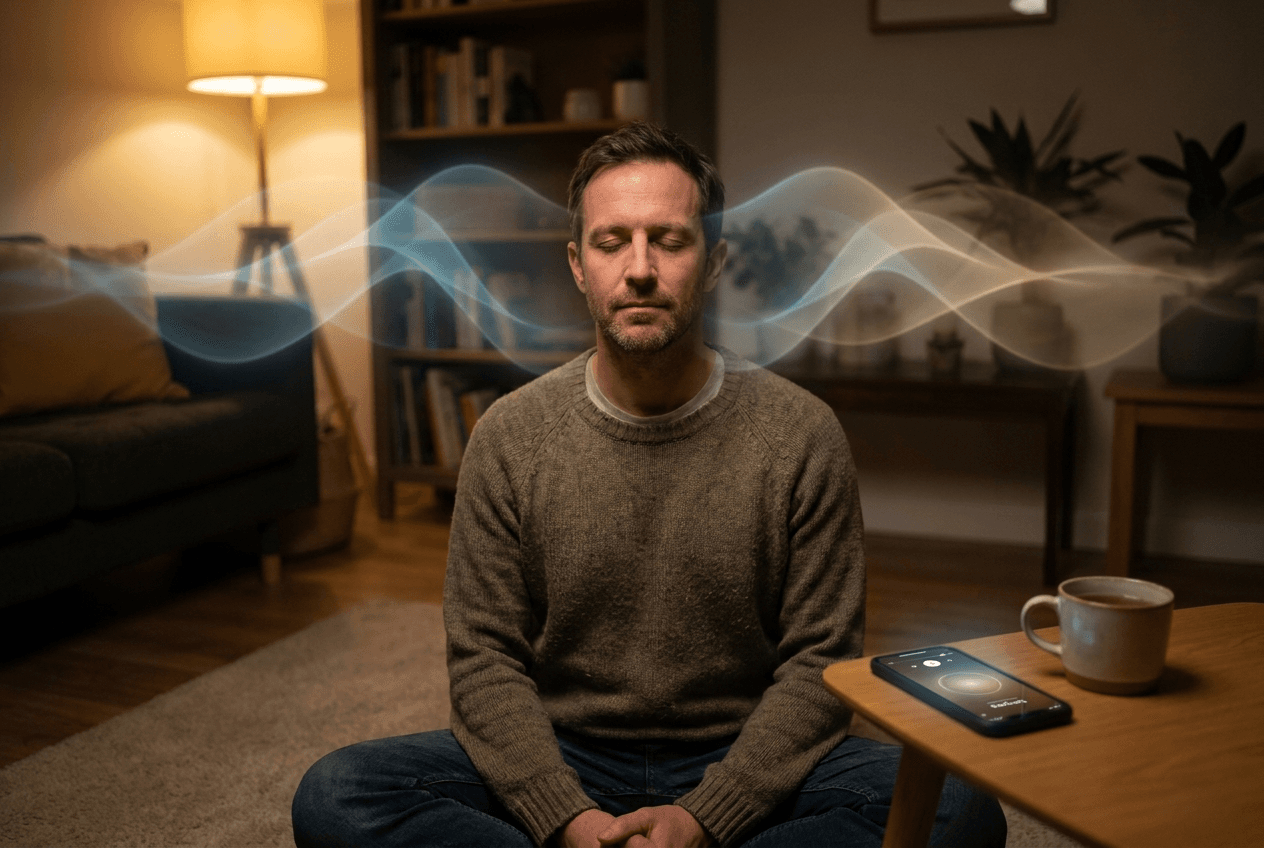 Many Australian adults approach Hindustani music learning with specific hopes and specific anxieties. Understanding what the adult learning experience in this tradition actually involves helps set realistic expectations.
What Adults Find Most Rewarding
Adult learners consistently describe certain aspects of Hindustani music learning as particularly rewarding in ways they didn't anticipate.
The tanpura drone practice is frequently described as the most immediately calming and centering aspect of the learning experience. Sitting with the drone sounding and exploring swaras against it has a meditative quality that adult learners - many of whom come from busy professional lives - find deeply restorative. The absence of notation, the purely aural nature of the practice, and the focus on pitch quality over technical performance create a completely different type of musical engagement from any Western music practice most adults have encountered.
The Raga System as Intellectual Engagement
For analytically minded Australian adults - and many are, given the professional backgrounds of the Indian-Australian community - the raga system provides an intellectually fascinating musical framework. Understanding why a specific raga evokes a specific emotional quality, how the vadi and samvadi notes create the raga's harmonic identity, and how the same seven swaras configured differently create completely different emotional universes is genuinely intellectually stimulating alongside being musically rewarding.
What Adults Find Most Challenging
The most common challenge for adult Hindustani learners is developing genuine pitch accuracy for the gamaka inflections that make Carnatic and Hindustani notes come alive. Most adults have spent their lives hearing and producing Western-tempered pitches. The Indian classical system's microtonal nuances - the subtle differences in how the same note is approached and shaped in different ragas - require sustained ear development that takes consistent practice over many months.
The good news is that this development is continuous and cumulative. Every month of daily riyaaz with tanpura produces measurably better pitch discrimination. The ear that heard nothing special in the difference between Chatusruti Ri and Shatsruti Ri in month one will hear the distinction clearly in month six, and will hear it as deeply meaningful in month twelve. The patience required for this development is well compensated by what it produces.
Hindustani Classical Music in the Australian Indian Community
 Australia's Indian classical music community is smaller and less developed than the UK's, Canada's, or the USA's, reflecting Australia's smaller Indian-origin population. However, it is growing, and the cultural infrastructure exists in the major cities to support students who are actively developing their skills.
Community Organisations and Performance Opportunities
Melbourne and Sydney both have South Asian performing arts organisations that include Hindustani classical music in their programming. Some Australian temples regularly host classical music events. The Australia India Institute supports cultural exchange that includes Indian classical arts. As a student develops, your teacher will be able to connect you with performance and community opportunities appropriate to your level and goals.
The Growing Online Sabha Culture
One of the genuinely positive developments in Indian classical music globally has been the growth of online music appreciation and performance communities - sometimes called online sabhas. These virtual events, where musicians perform for engaged audiences across multiple countries simultaneously, have made participation in the global Hindustani classical music community accessible from anywhere in Australia.
Conclusion
Hindustani classical music offers Australian learners - children and adults alike - one of the most complete, deep, and rewarding musical journeys available anywhere in the world. Its combination of melodic sophistication, rhythmic complexity, cultural depth, and personal meditative quality creates an educational experience that no other musical tradition replicates.
Three things to take away. First, daily riyaaz with tanpura from the very first week is the single most important habit a Hindustani music student can build. Second, teacher credentials - gharana affiliation, guru lineage, formal examination qualifications - are non-negotiable indicators of authentic transmission. Third, patient, consistent practice over months and years produces results that cannot be shortcut - and those results are worth every hour invested.
Art Gharana offers live 1:1 online Hindustani classical music classes for students across Australia, taught by certified, experienced instructors who understand both the depth of the tradition and the specific needs of Australian diaspora learners. Book a free trial class today through our complete course catalogue and take the first step into this extraordinary tradition.
Frequently Asked Questions
1. How long does it take to learn basic Hindustani classical music in Australia?
With consistent weekly lessons and daily riyaaz of 15-20 minutes, most adult students develop a confident foundation in swara practice and one or two ragas within 12-18 months. Completing a beginner bandish in Raag Yaman in Teen Taal typically takes 12-18 months. Developing genuine improvisational ability in multiple ragas is the work of several years of dedicated practice.
2. Can children learn Hindustani classical music online from Australia?
Yes, completely. Many qualified Hindustani teachers offer Australian-compatible lesson times and have extensive experience teaching diaspora children. The format works well for children who have developed the attention span for structured 30-minute sessions - typically from around ages six to seven.
3. What is the difference between Hindustani and Carnatic music for Australian families choosing between them?
Hindustani music is the North Indian classical tradition, associated with raga improvisation, alaap development, and a North Indian cultural heritage. Carnatic music is the South Indian classical tradition, more composition-centric with complex tala structures. For North Indian families (Punjabi, Hindi-speaking, UP, Delhi, Gujarat origin), Hindustani is typically the natural cultural connection. For South Indian families (Tamil, Telugu, Kannada, Malayalam), Carnatic is more culturally immediate.
4. Are there Hindustani music competitions or events for Australian students?
Several South Asian cultural organisations across Australia organise music events that include Hindustani classical music. The specific availability varies by city - Melbourne and Sydney have more active Indian classical music communities than smaller cities. Your teacher should be able to connect you with appropriate performance and community opportunities as you develop.
5. Do I need to buy a tanpura instrument to learn Hindustani music online?
No. A digital tanpura app (iTablaPro, Shruti Box Pro, or similar, available free on iOS and Android) provides entirely sufficient drone reference for daily practice and lessons. A physical tanpura is a beautiful instrument but represents a significant investment and is not necessary for beginner or intermediate learning.