ChatGPT
 Google AI
 Grok
Grok Claude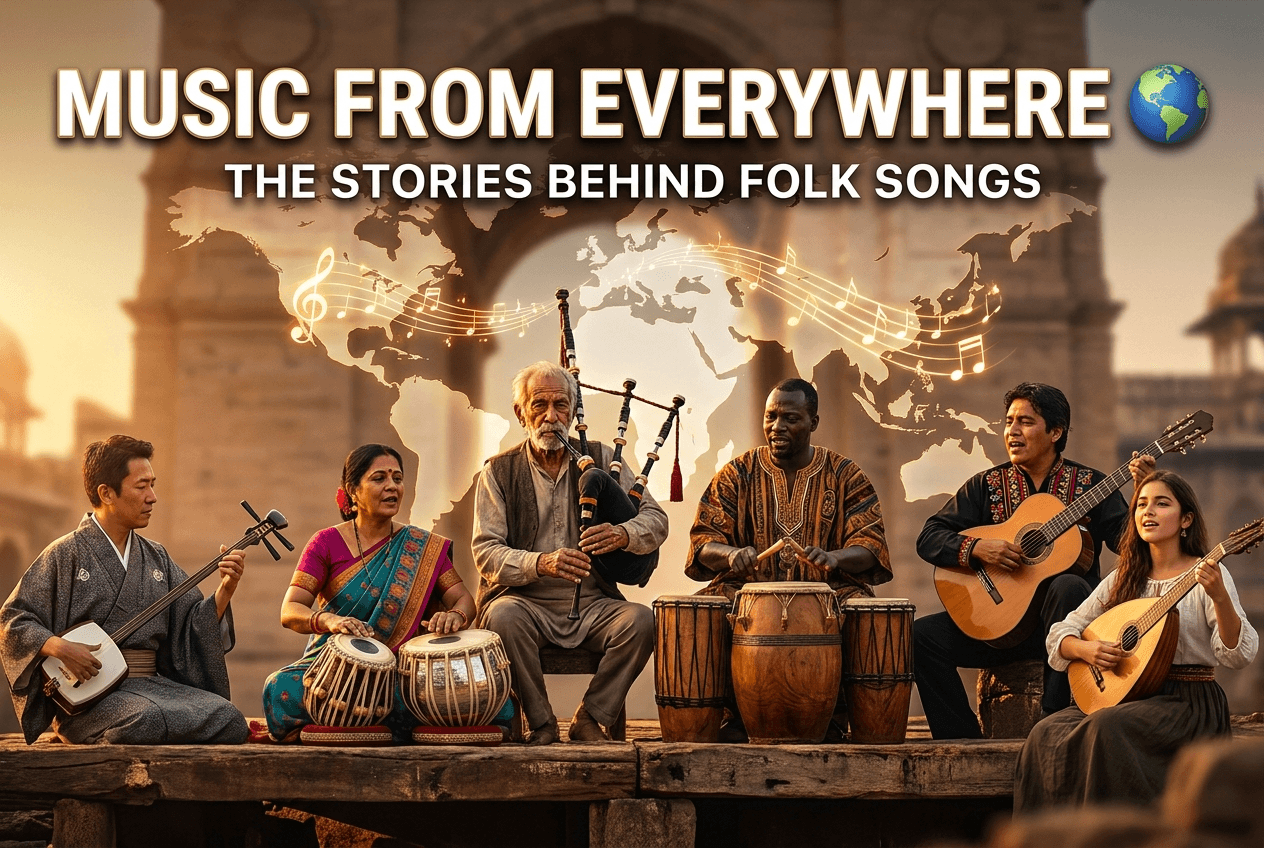
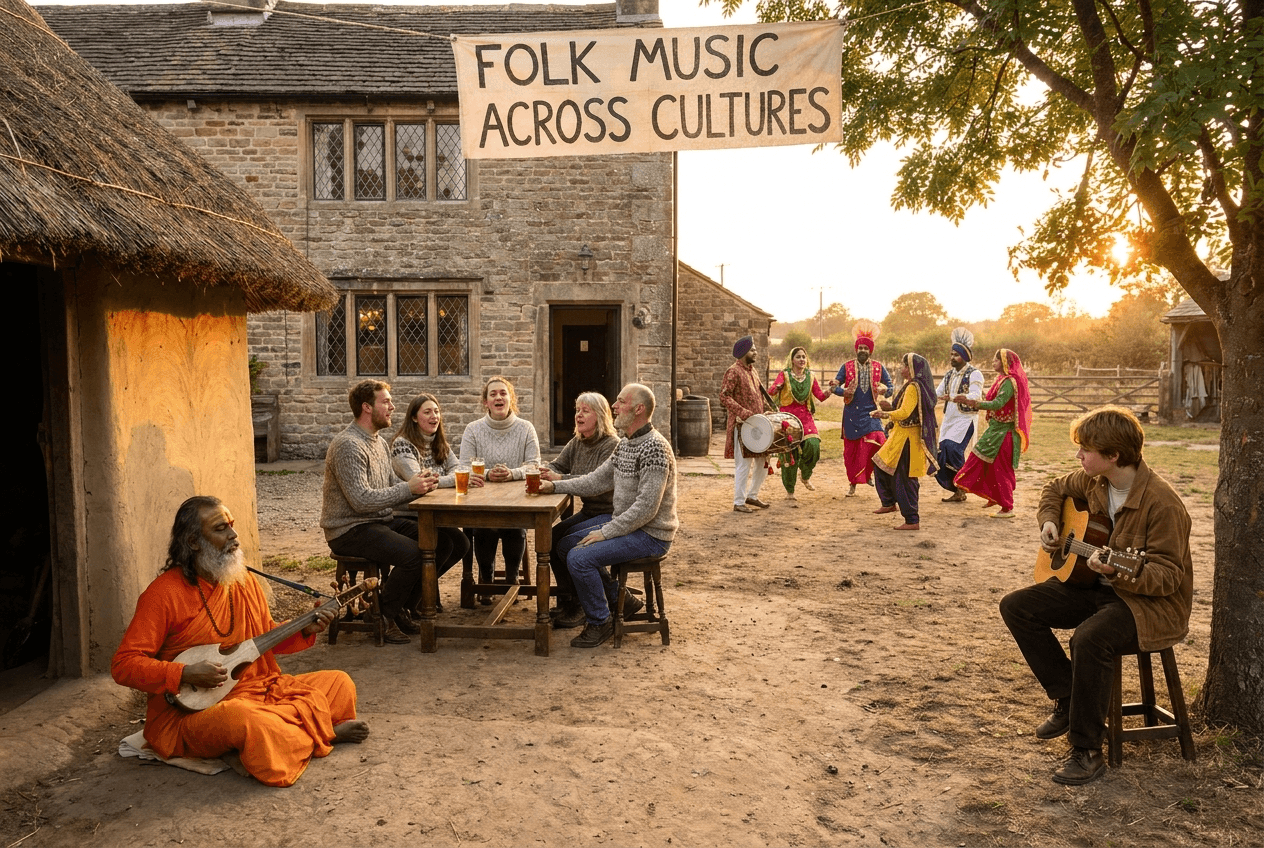
The word folk is doing a great deal of work and most guides never examine it. It covers a Bengali mystic singing alone with a single-stringed instrument, a room of people in a Yorkshire pub singing unaccompanied, a Punjabi harvest dance with drums, and a singer-songwriter with an acoustic guitar in 1963. Whether all of those are the same thing is a genuine question, and this guide takes it seriously rather than listing folk songs and moving on. For the wider musical landscape, the guide to Indian classical music instruments covers many of the instruments involved.
What follows sets out what actually defines the category, covers the major traditions of Britain and Ireland, America, and India in genuine depth rather than as a footnote, examines why the boundary with classical music is blurrier than it looks, and addresses whether folk music is still being made.
What Defines Folk Music?
 Folk music, and the folk songs within it, is traditionally defined as music transmitted orally within a community rather than through written composition, typically of anonymous or communal authorship, evolving through variation as it passes between performers, and connected to the everyday life of the people who make it rather than to a professional or courtly institution. In modern usage the term has widened considerably and now also covers written songs in a traditional style.
The four traditional criteria
Oral transmission means the music passes by ear and memory rather than through notation, which is why the same song exists in many versions and why nobody can say which is correct. Communal authorship means the composer is unknown or has ceased to matter, and the song belongs to the community rather than to a person. Variation means the song changes as it travels, absorbing local names, places and details. And function means it was attached to something, whether work, worship, courtship, celebration, mourning or the raising of children.
Why the definition has broken down
Every one of those criteria has weakened. Recording froze versions that would otherwise have kept changing. Collection and publication turned oral material into written material. And from the twentieth century, professional musicians began writing new songs in the style, with known authors and copyright, which are called folk songs by everyone including the people who dislike the usage.
The honest position is that folk now describes at least two things: a body of traditional material with the old characteristics, and a contemporary genre defined by acoustic instrumentation, narrative lyrics and a particular aesthetic. Both usages are established, and confusing them is the source of most arguments on the subject.
The Major Traditions Tradition Characteristic forms Typical instruments England Ballads, sea shanties, work songs, morris and country dance tunes Melodeon, concertina, fiddle, unaccompanied voice Scotland Ballads, waulking songs, puirt à beul, strathspeys and reels Fiddle, bagpipes, clarsach, accordion Ireland Sean-nós singing, jigs, reels, hornpipes, slow airs Fiddle, uilleann pipes, flute, bodhrán, tin whistle Wales Penillion, hymns and choral tradition, harp repertoire Triple harp, voice, fiddle Appalachian America Ballads descended from British originals, fiddle tunes Banjo, fiddle, dulcimer, guitar Blues and African American tradition Field hollers, spirituals, blues forms Voice, guitar, harmonica North India Bhangra, giddha, Rajasthani folk, Braj and Bhojpuri song Dhol, algoza, kartal, harmonium, ektara Bengal Baul songs, bhatiali, jhumur Ektara, dotara, khol, dubki Maharashtra Lavani, powada, abhang Dholki, tuntuna, manjira South India Villupattu, Kannada bhavageete, Kerala folk forms Villu, chenda, thudi, voice
Britain and Ireland
The ballad tradition
The backbone of English and Scottish folk songs, consisting of narrative songs telling a story across many verses, frequently concerning love, murder, supernatural encounter, shipwreck or war. Many are very old and exist in dozens of variants across Britain, Ireland and North America, and the same story turns up with different names and places attached depending on where it was collected.
The collection of these songs in the nineteenth and early twentieth centuries, most famously through the work of Francis James Child and later Cecil Sharp, preserved an enormous body of material that would otherwise have disappeared. It also fixed versions in print that had previously been fluid, which is a genuine gain and a genuine loss at once.
Work songs and sea shanties
Songs with a job to do, and among the clearest demonstrations of what folk music was for. Shanties coordinated the physical effort of a crew hauling ropes or turning a capstan, with the rhythm set by the work rather than by musical preference, and a call and response structure allowing one person to lead while everyone else pulled on the beat.
Similar songs existed for weaving, harvesting, milling and waulking cloth, the last of these producing a substantial Gaelic repertoire in the Scottish islands. When the work stopped, the songs largely stopped with it, and what survives does so because it was collected or because it moved into recreational singing.
India has the direct equivalent and it is still functioning in places. Songs for transplanting rice, for grinding grain, for drawing water and for spinning exist across many regions, sung by the people doing the work and paced by it. Where the work has mechanised the songs have followed the same trajectory as the British ones, surviving in performance rather than in use, and where it has not they remain genuinely functional.
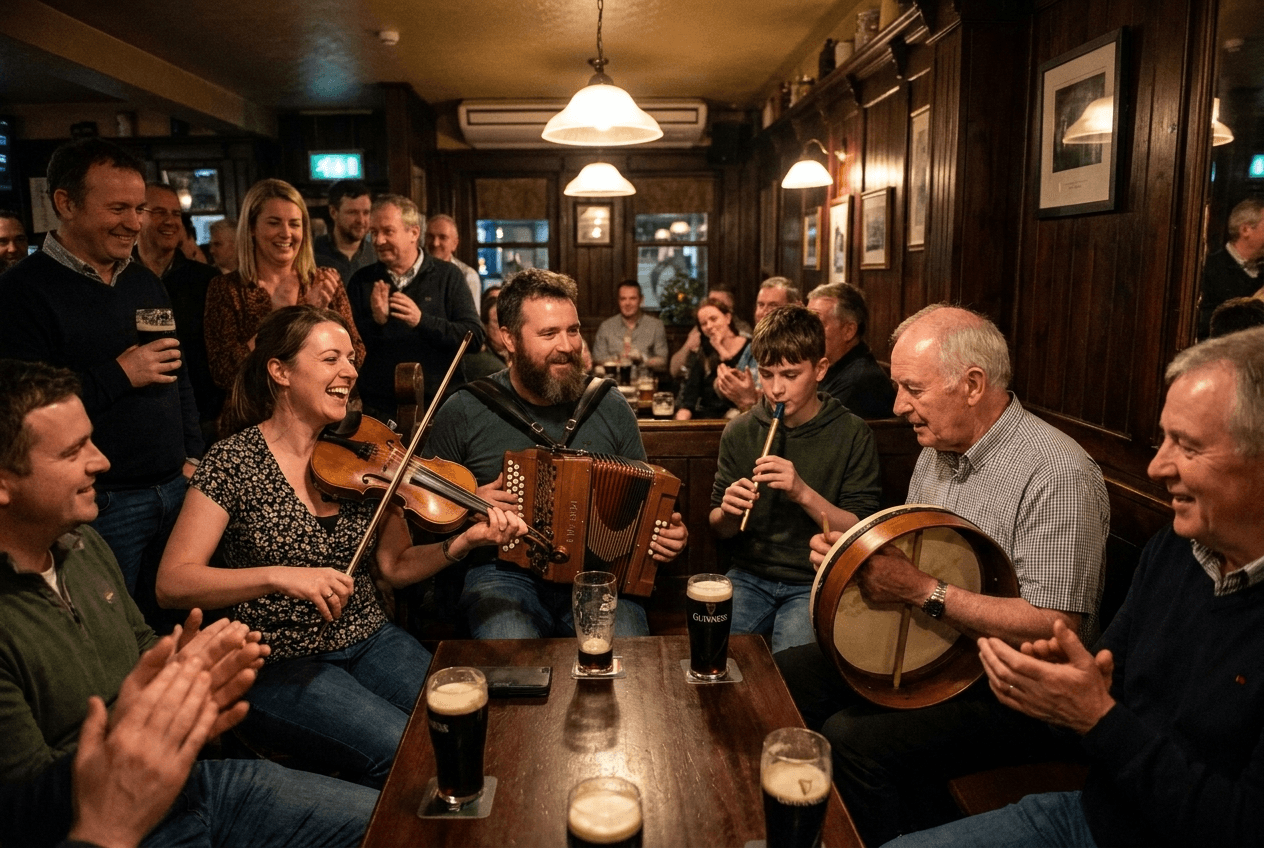
The Irish session
A living institution rather than a historical one. Musicians gather informally, usually in a pub, and play tunes from a shared repertoire that everyone is expected to know, with no rehearsal, no conductor and no fixed programme. Tunes are strung together in sets, someone starts and others join when they recognise it, and the whole thing runs on unspoken convention.
The conventions are worth knowing before attending one, because they are real and unwritten. Listen before playing. Do not start a tune unless you know it well enough to lead it. Match the volume of the room rather than projecting over it. And accept that the repertoire is shared property, meaning nobody owns a tune and nobody is showing off, which is a different social contract from almost every other musical setting a newcomer will have encountered.
It is worth understanding because it represents a mode of music-making that is neither performance nor rehearsal. There is no audience in the formal sense, participation is the point, and the standard is nonetheless high. Sessions exist throughout Britain and Ireland and in cities worldwide, and they remain the primary route by which the repertoire is transmitted.
The folk revivals
Britain has had two significant revivals, the first in the early twentieth century driven by collectors, and the second from the 1950s driven by performers and recording. The second produced the folk club circuit, brought traditional material to a wide audience, and generated the singer-songwriter usage of the word folk that now dominates popular understanding.
Both revivals involved a degree of selection and reshaping, and traditional music as widely known today is partly a construction of the people who collected and popularised it. That is not a criticism so much as an observation that applies to almost every revived tradition, including several Indian classical dance forms.
Indian Folk Music
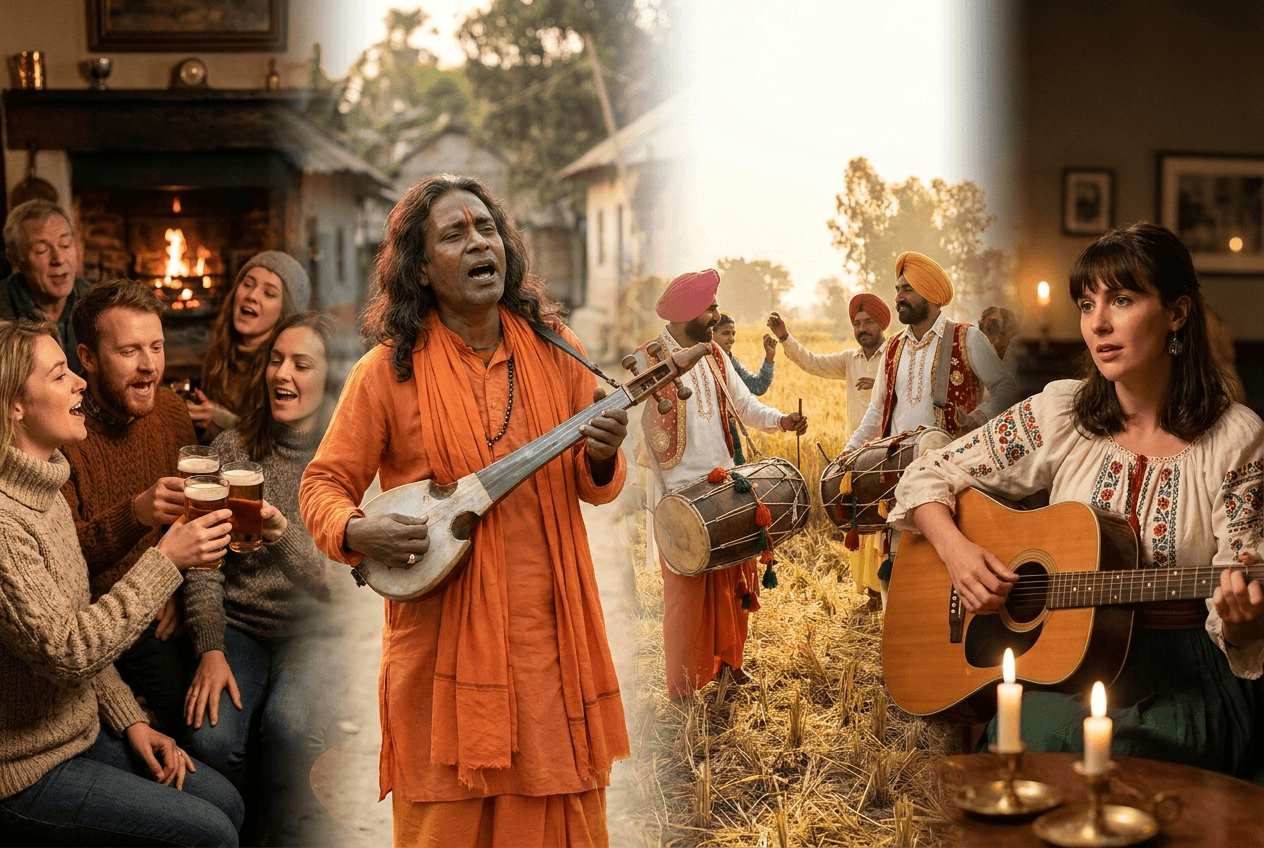 Indian folk songs are an enormous field frequently reduced to a paragraph in guides of this kind, and it deserves considerably more, because India's folk traditions are among the most extensive anywhere.
The Baul tradition of Bengal
Wandering mystic minstrels with a philosophy of their own, drawing on Vaishnava, Sufi and tantric strands and rejecting caste, ritual and religious orthodoxy. A Baul typically accompanies themselves on the ektara, a single-stringed instrument, with a dubki or khamak for rhythm, and sings about the body, the divine within it, and the futility of external observance.
The songs are philosophically dense rather than simple, and the tradition has influenced Bengali literature and music substantially, including Rabindranath Tagore, who acknowledged the debt. Baul music is a recognised intangible cultural heritage tradition and remains a living practice rather than a preserved one.
Punjab
Bhangra originated as a harvest dance of Punjab, associated with the wheat harvest and driven by the dhol, and giddha is its counterpart performed by women, built on boliyan, short sung couplets exchanged between participants. Both have travelled globally with the Punjabi diaspora, and bhangra in particular has become an international popular music form quite distinct from its agricultural origins, particularly in Britain where the fusion with electronic and urban music produced an entire scene.
Rajasthan
Among the richest folk traditions in India, sustained by hereditary musician communities including the Manganiyar and Langa, who performed for patron families across generations. The repertoire spans devotional, ceremonial and narrative material, and the instruments include the kamaicha, the sarangi, the algoza double flute and the khartal. Rajasthani folk musicians have toured internationally for decades and the tradition is one of the better-documented ones.
Maharashtra
Lavani is the best known form, a vigorous song and dance tradition performed to the dholki with a distinctive rhythmic drive, historically associated with entertainment and social commentary and carrying a complicated history regarding the status of its performers. Powada is a separate narrative ballad tradition recounting historical and heroic events. The abhang tradition of the Varkari devotional movement sits alongside both.
Bengal, Assam and the east
Beyond the Bauls, Bengal carries bhatiali, the songs of boatmen on the rivers, characterised by long sustained lines suited to open water, and jhumur, associated with tea garden and tribal communities. Assam has bihu, tied to the agricultural calendar and to a major seasonal festival. Odisha, Jharkhand and the north-eastern states each carry substantial traditions with limited documentation outside their regions.
The south
Tamil Nadu has villupattu, a narrative form performed with a bow-shaped instrument, and a substantial body of work and ritual song. Karnataka has bhavageete, a form setting modern Kannada poetry to melody, which sits between folk and light classical. Kerala carries a large body of ritual, harvest and community song alongside its temple traditions. Andhra Pradesh and Telangana have their own extensive repertoires.
The relationship with classical music
Closer than either side sometimes admits. Several ragas have folk origins, the semi-classical forms including thumri, dadra, kajri and chaiti draw directly on regional folk material, and film music has borrowed continuously from folk traditions throughout its history. The traffic runs both ways, since folk musicians absorb classical material too. The framework is set out in the guide to Indian raga music, and the classical tradition itself in the beginner guide to Hindustani classical music.
Folk and Classical: What Actually Separates Them
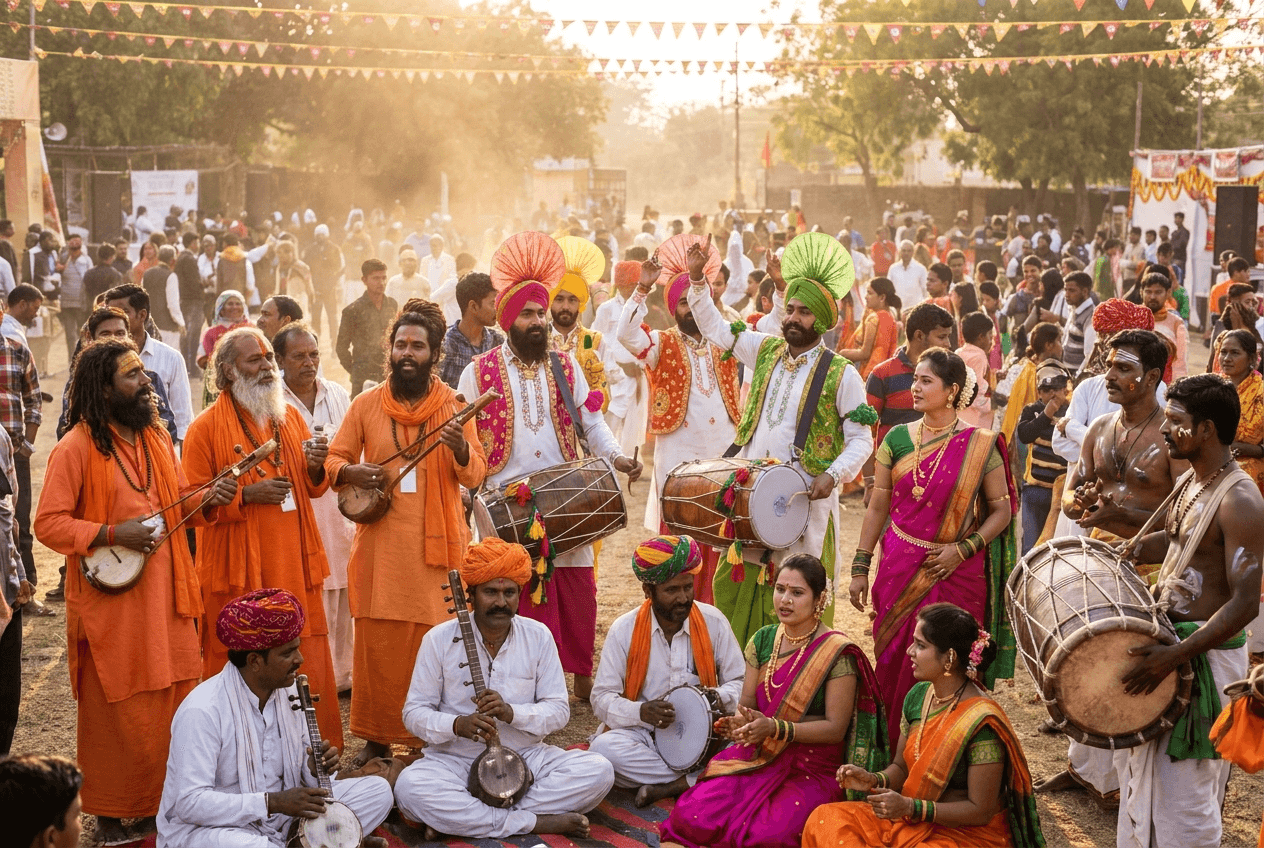 A question worth answering carefully, since the usual answers are wrong or incomplete.
It is not complexity. Baul songs are philosophically and musically sophisticated, Irish traditional ornamentation is intricate, and plenty of classical repertoire is simple. It is not skill, since folk musicians in hereditary traditions train for years and perform at extremely high standards. And it is not age, since both are old.
It is not notation either, which is the other answer people reach for. Plenty of classical traditions transmitted orally for centuries before anyone wrote them down, Indian classical music being the obvious case, and several folk traditions have been notated extensively by collectors. Writing something down does not change what it is.
What genuinely separates them is transmission and institution. Classical traditions have codified theory, formal teaching structures, written or systematised repertoire, and an institutional context whether court, temple or conservatoire. Folk traditions transmit by ear within a community, without a theoretical apparatus, and belong to a place and a way of life rather than to an institution.
Even that distinction leaks. Hereditary Rajasthani musicians have formal training and a transmitted repertoire. Irish traditional music now has graded examinations and university programmes. The boundary is real and it is a gradient rather than a line.
Is Folk Music Still Being Written?
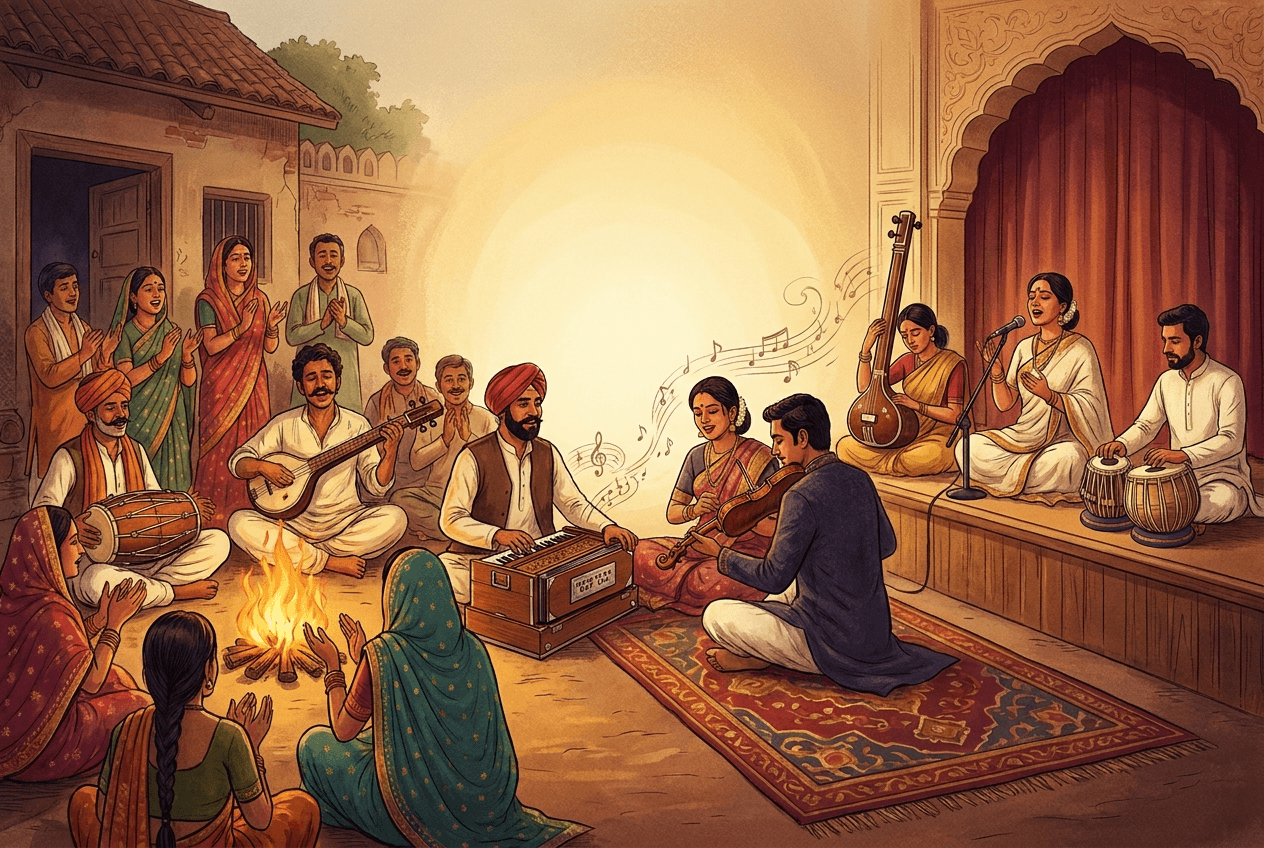 Yes, and the question exposes the definitional problem directly.
If folk means anonymous, orally transmitted, communally owned material, then very little new folk music is being created, because the conditions that produced it have largely gone. Recording, literacy, copyright and mass media all work against anonymous communal transmission.
If folk means music in a traditional idiom, connected to place and community, then a great deal is being written. Contemporary songwriters work in traditional forms across Britain, Ireland, India and everywhere else, and some of their songs enter the shared repertoire and get sung by people who do not know who wrote them, which is the old process operating in a new environment.
There is also a genuinely modern equivalent worth noticing. Songs that circulate widely, get altered by the people who sing them, and detach from their authors do exist, including football chants, protest songs, playground rhymes and material that spreads through social platforms. The mechanism is the same even where the technology is not.
Why Folk Music Is Good for Learners
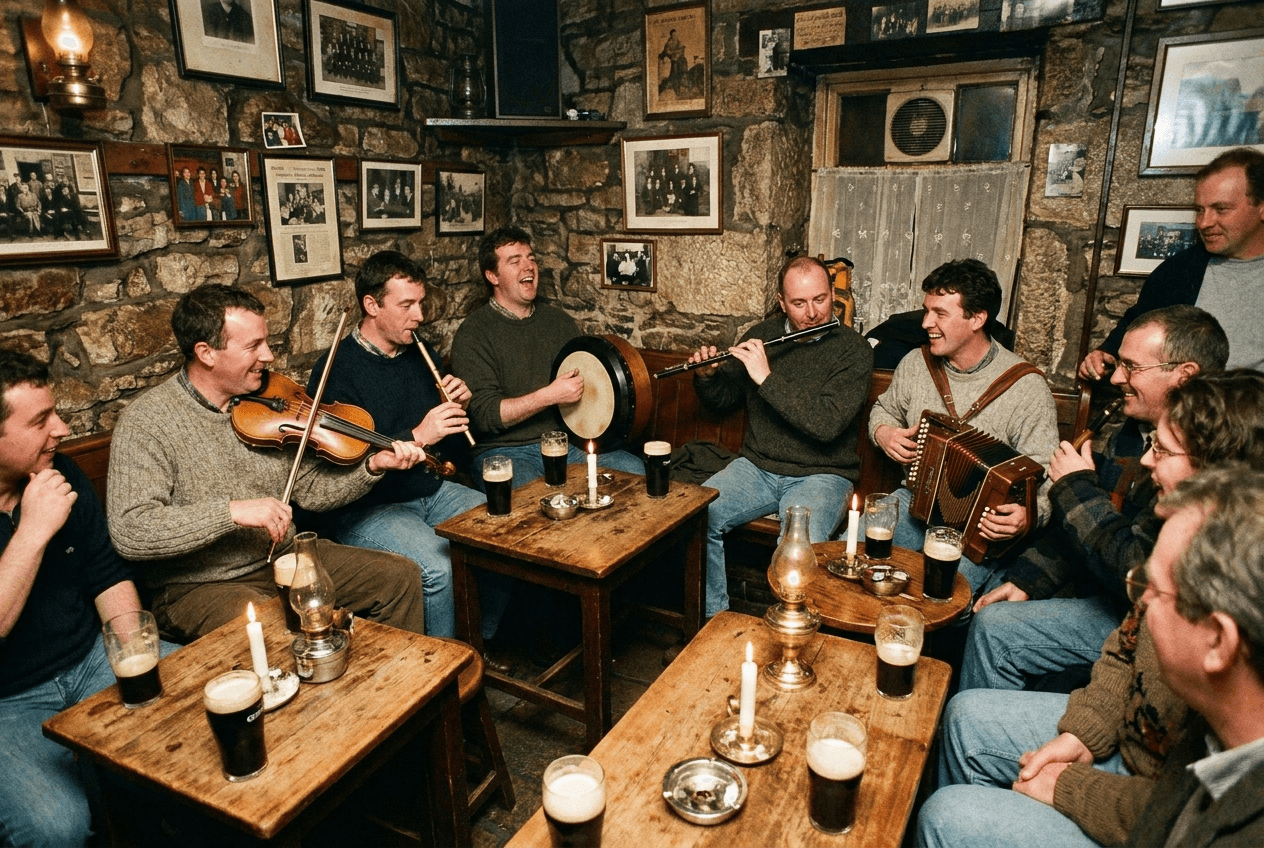 There is a practical case for learning folk songs, since this is a music school rather than a folklore journal.
It was written for untrained voices
Folk melodies sit in comfortable ranges, use short phrases, avoid dramatic leaps and repeat, because they were made to be sung by ordinary people at work or at a gathering rather than by professionals in a hall. That makes them among the best possible material for a beginner, and considerably better suited than the pop repertoire most learners reach for. The guide to easy songs for beginner singers covers how to choose material on those criteria.
It teaches by ear
Learning a song by listening rather than reading builds the ear directly, and ear training is the skill that separates musicians who can play from musicians who can play what is in front of them. Folk material is ideal for this because the melodies are memorable and the versions vary anyway, so approximation is not failure.
It is social by design
Sessions, singarounds, community events and family gatherings all provide low-stakes performance opportunities, which is the thing self-taught musicians most conspicuously lack. Playing with other people improves timing faster than any amount of solitary practice.
It connects a learner to somewhere
For a child in the diaspora particularly, folk material carries language, place and family history alongside the music. A Punjabi or Bengali or Gujarati folk song learned properly transmits vocabulary and cultural context without any of it being framed as a lesson, which is why so many families find that songs succeed where formal heritage language teaching has failed entirely.
Grandparents are the underused resource here. A great many older family members carry songs they learned in childhood and have not sung for decades, and asking them to teach a grandchild one usually produces both the song and a considerable amount besides. It is also the only remaining form of genuinely oral transmission most families have access to, and it disappears with the generation that holds it, usually without anyone noticing until it has gone.
Folk Music in Modern Britain
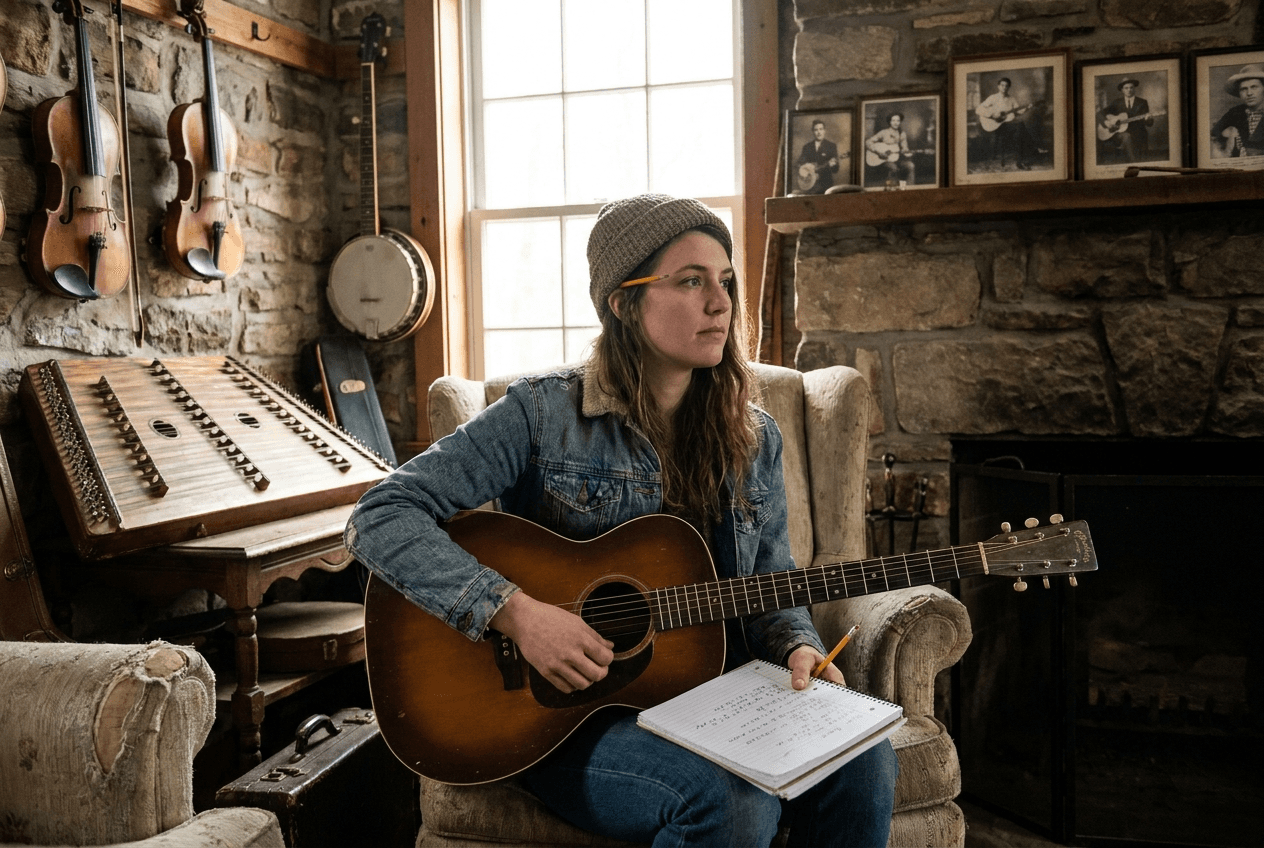 A living scene rather than a heritage exercise, and worth knowing about for anyone in the UK who wants to participate rather than only listen.
Sessions and singarounds
Regular informal gatherings run in pubs and community venues across the country, some instrumental and some for singing. Newcomers are generally welcome, the convention is to listen for a while before joining, and nobody is auditioning anyone. This is the most accessible live music participation available in Britain and a surprising number of people do not know it exists.
Folk clubs and festivals
The folk club circuit established during the mid-century revival continues, and Britain hosts a substantial number of folk festivals across the year, ranging from large multi-stage events to small local gatherings. Many run workshops alongside performances, which is a genuinely useful way to learn a tradition quickly from people who play it.
The South Asian folk scene
Runs in parallel and is equally substantial. Bhangra in Britain became a scene in its own right from the 1980s, producing a fusion with electronic and urban music that fed back into Indian popular music. Beyond that, community associations, cultural centres, gurdwaras, temples and mosques host folk performance regularly, and touring artists from India and Pakistan perform to large audiences in British cities.
For a family raising children here, both scenes are worth using. British folk sessions teach a child that music is something people do together rather than consume, and the South Asian folk circuit connects them to family heritage in a setting where other children are doing the same. Neither requires any prior ability, which is the whole point of the tradition.
Where to Start Listening
A short guided route through the world of folk songs, since the field is vast and unguided exploration usually stalls.
Begin with unaccompanied singing from any tradition, because it strips the music to melody and words and makes the differences between traditions immediately audible. English and Scottish ballad singing, Irish sean-nós, and Baul songs all work.
Then hear the same material in an ensemble setting, an Irish session recording or a Rajasthani group, and notice how much of the character comes from the instruments and how much from the melody itself.
Then go looking for a version. Take one well-known song, find three recordings by different singers from different decades, and listen to what changes. Variation is the defining characteristic of this music, and hearing three singers make different choices about the same song teaches more than any definition can.
And find something live. Sessions, folk clubs, community events and festivals exist across Britain in considerable numbers, and folk music in a room with people is a substantially different experience from folk music through speakers. The same applies to Indian folk forms, which appear at cultural association events and festivals throughout the year.
Instruments of Folk Traditions
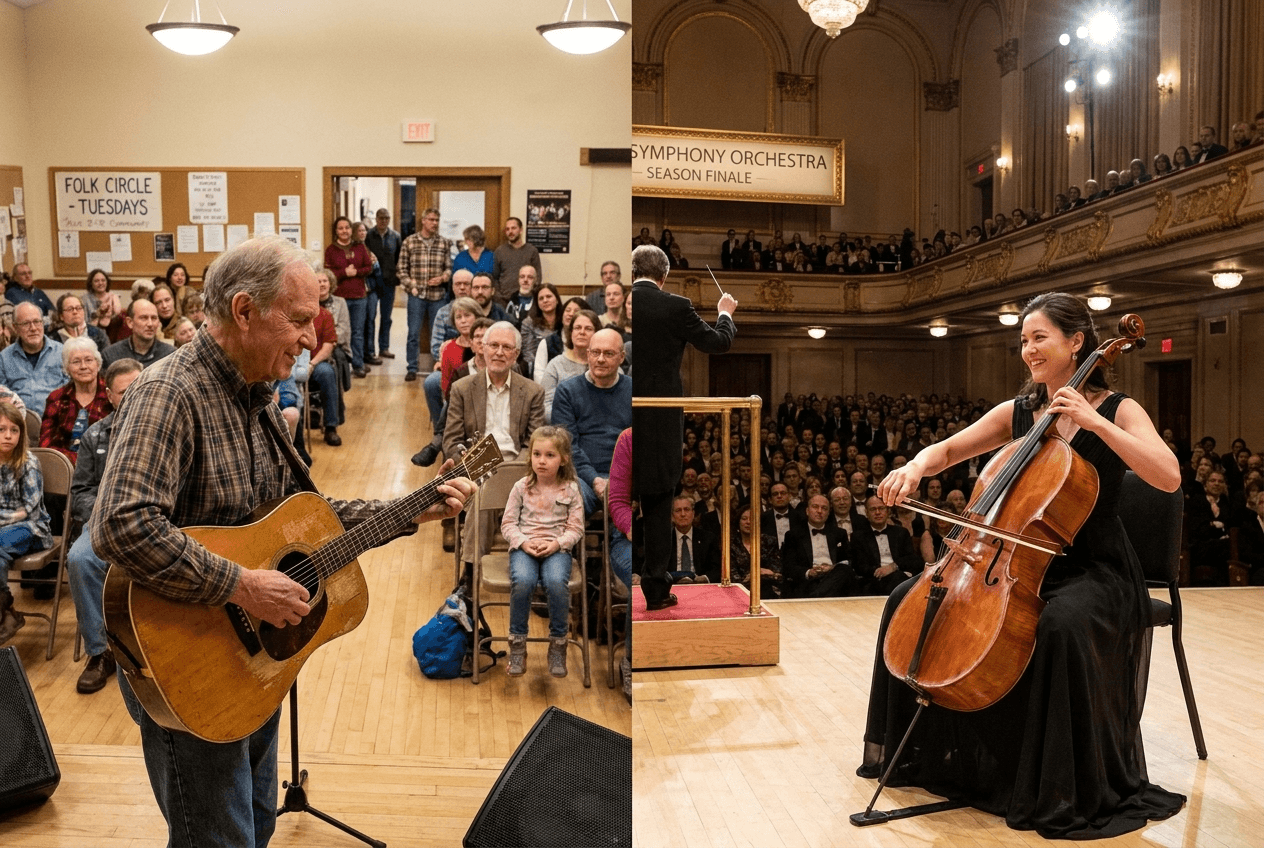 A brief survey, because the instruments frequently tell you more about a tradition than the melodies do.
What folk instruments have in common
They tend to be portable, affordable, durable and playable without formal training. A tradition sustained by working people cannot depend on an instrument requiring a workshop to maintain or a conservatoire to learn, and the instruments that survived are the ones that met those conditions.
They also tend to be loud relative to their size, because folk music was frequently played outdoors, over crowds, at weddings and processions and harvests. The dhol, the melodeon, the bagpipe and the fiddle all project far more than their dimensions suggest, and that is not accidental.
The drone principle
A feature appearing independently across an extraordinary range of traditions. The Indian tanpura and ektara, the Scottish and Irish bagpipe drones, the hurdy gurdy of continental Europe and the drone strings of various folk fiddles all do the same thing, which is to provide a continuous fixed pitch against which the melody moves.
That convergence is worth noticing, since it suggests something about how human ears respond to a fixed reference. It also means listeners familiar with one drone tradition find others considerably less strange than they expect, and the guide to the shruti box and drone instruments covers the Indian version.
Percussion made from what was available
Folk percussion is frequently improvised from domestic or agricultural objects, including the Indian ghatam which is an unmodified clay pot, the spoons of Irish and English tradition, the bones, the washboard, and the various pot and pitcher drums found across South Asia. An instrument that costs nothing and already exists in the kitchen is exactly what a folk tradition needs.
Frequently Asked Questions
What defines folk music?
Traditionally, music transmitted orally within a community rather than through written composition, with anonymous or communal authorship, evolving through variation as it passes between performers, and connected to everyday life rather than to a professional institution. Modern usage has widened to include written songs in a traditional style.
What are famous folk songs?
The traditional repertoire includes ballads collected across Britain, Ireland and North America, sea shanties, and regional work songs. In India, Baul songs of Bengal, Punjabi bhangra and giddha material, Rajasthani folk repertoire and Maharashtrian lavani are among the best known. Any list reflects what was collected and recorded rather than what was sung.
What is the difference between folk and classical music?
Not complexity or skill, since folk traditions contain both. The real distinction is transmission and institution. Classical traditions have codified theory, formal teaching, systematised repertoire and an institutional home. Folk traditions transmit by ear within a community without a theoretical apparatus. The boundary is a gradient rather than a line.
What are Indian folk songs?
An enormous body of regional traditions including Baul songs of Bengal, bhangra and giddha of Punjab, Rajasthani repertoire performed by hereditary Manganiyar and Langa communities, lavani and powada of Maharashtra, bihu of Assam, villupattu of Tamil Nadu and bhavageete of Karnataka, among many others.
Is folk music still being written?
If folk means anonymous, orally transmitted material, very little, since recording, literacy and copyright work against those conditions. If it means music in a traditional idiom connected to place and community, a great deal. Some contemporary songs also detach from their authors and circulate as shared property, which is the old mechanism in a new environment.
What is a sea shanty?
A work song used to coordinate physical effort aboard ship, with the rhythm set by the task rather than by musical preference and a call and response structure allowing one person to lead while the crew pulled on the beat. Different shanty types matched different jobs, and when the work disappeared most of the songs went with it.
What is Baul music?
The tradition of wandering mystic minstrels of Bengal, drawing on Vaishnava, Sufi and tantric strands and rejecting caste and religious orthodoxy. A Baul accompanies themselves on the single-stringed ektara with a dubki or khamak for rhythm, singing philosophically dense songs about the divine within the body. It influenced Tagore and remains a living tradition.
What is an Irish session?
An informal gathering, usually in a pub, where musicians play tunes from a shared repertoire with no rehearsal, no conductor and no set programme. Tunes are played in sets, someone starts and others join when they recognise it, and participation rather than performance is the point. Sessions remain the main route by which the repertoire is transmitted.
Why is folk music good for beginners?
Because it was written for untrained voices. Melodies sit in comfortable ranges, use short phrases, avoid dramatic leaps and repeat, since they were made to be sung by ordinary people rather than professionals. It also teaches by ear, provides low-stakes social performance opportunities, and carries language and cultural context alongside the music.
How is Indian folk music related to classical music?
Closely, and in both directions. Several ragas have folk origins, semi-classical forms including thumri, dadra, kajri and chaiti draw directly on regional folk material, and film music has borrowed from folk traditions throughout its history. Folk musicians absorb classical material in turn, so the influence is mutual rather than one-way.
Indian folk dance forms carry the same relationship with the classical dance traditions, drawing on and feeding into them continuously, and the guide to Indian classical dance roots sets out where the boundaries sit.
Final Thoughts
The most useful thing to take from a survey of folk songs is that the category describes a way music travels rather than a sound. Oral transmission, communal ownership and constant variation are the defining features, and once you look for those the connection between a Yorkshire ballad and a Baul song becomes obvious in a way that comparing their instrumentation never makes it.
If you sing at all, this is also the best repertoire available to you, because it was designed for exactly the voice you have. Learn one song by ear rather than from a page, sing it to somebody, and let it change slightly in the process. That is the tradition working as intended. Art Gharana teaches Indian classical, folk and contemporary music live and one-to-one, with a free first class.