ChatGPT
 Google AI
 Grok
 Claude
A 2023 academic study published in the Journal of Community and Applied Social Psychology interviewed British Indian classical dance practitioners and identified a consistent pattern. Indian classical dance was repeatedly described as one of the most effective practical tools available for navigating the dual identity challenge that many British Indians experience, the genuine tension between feeling fully British and remaining authentically connected to Indian heritage. This guide draws on that research and on the practical experience of UK families to explore how music and dance can function as a deliberate, structured approach to cultural continuity for the next generation.
The Dual Identity Challenge, Named Plainly
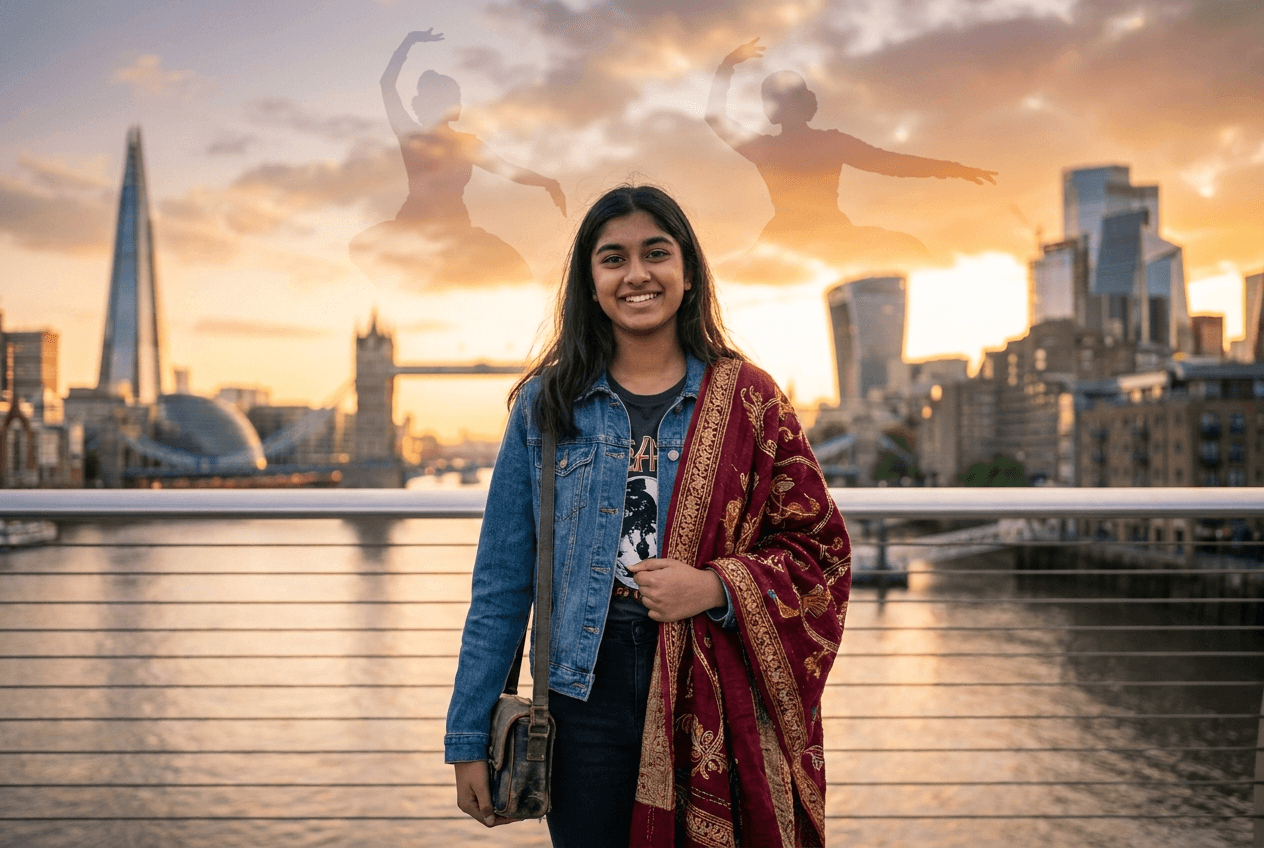 Researchers studying British Indian identity describe a recurring early life experience among second and third generation British Indians, a period of confusion or even isolation around cultural identity, sometimes compounded by experiences of racism or stereotyping in wider British society. What the same research found, encouragingly, is that this initial difficulty very often resolves into a confident, embraced dual identity later in life, and that parental influence and exposure to Indian cultural practice during childhood is a significant factor in how smoothly that resolution happens.
This is not a vague cultural sentiment. It is a specific, researched pattern, and it gives UK parents a genuinely evidence informed reason to consider classical music or dance training as more than an extracurricular hobby choice.
Why Classical Arts Specifically, Rather Than Language Alone
Language classes, festival attendance and family visits to India are all valuable and commonly used approaches among UK Indian families. Classical music and dance offer something additional, an embodied, actively practised skill that a child owns personally rather than simply inherits passively. Research describes this as allowing British Indians to express cultural identity in a genuinely practical, demonstrable way, with a direct connection to Indian religion and history built into the practice itself. Our guide to Indian dance styles gives an overview of how this embodied connection works across different traditions.
The Institutional Recognition Already in Place
 It is worth UK parents knowing that Indian classical dance is not a niche or informal pursuit within British cultural infrastructure. Bharatanatyam and Kathak are both included in the examined syllabus of the Imperial Society of Teachers of Dancing, a mainstream UK dance examining body, placing Indian classical dance within the same formal, systematic Western examination structure used for ballet and other established dance forms. Organisations such as Akademi, South Asian Dance UK, actively employ young British Indians and run major initiatives supporting the art form's continued presence and economic viability in Britain. South Asian Heritage Month and the BBC Young Dancer competition's South Asian category further reflect how embedded this practice has become within mainstream UK cultural life, not as a separate or marginal activity but as a recognised part of British arts education.
##What This Looks Like in Practice for a UK Family
Starting Young, Without Pressure
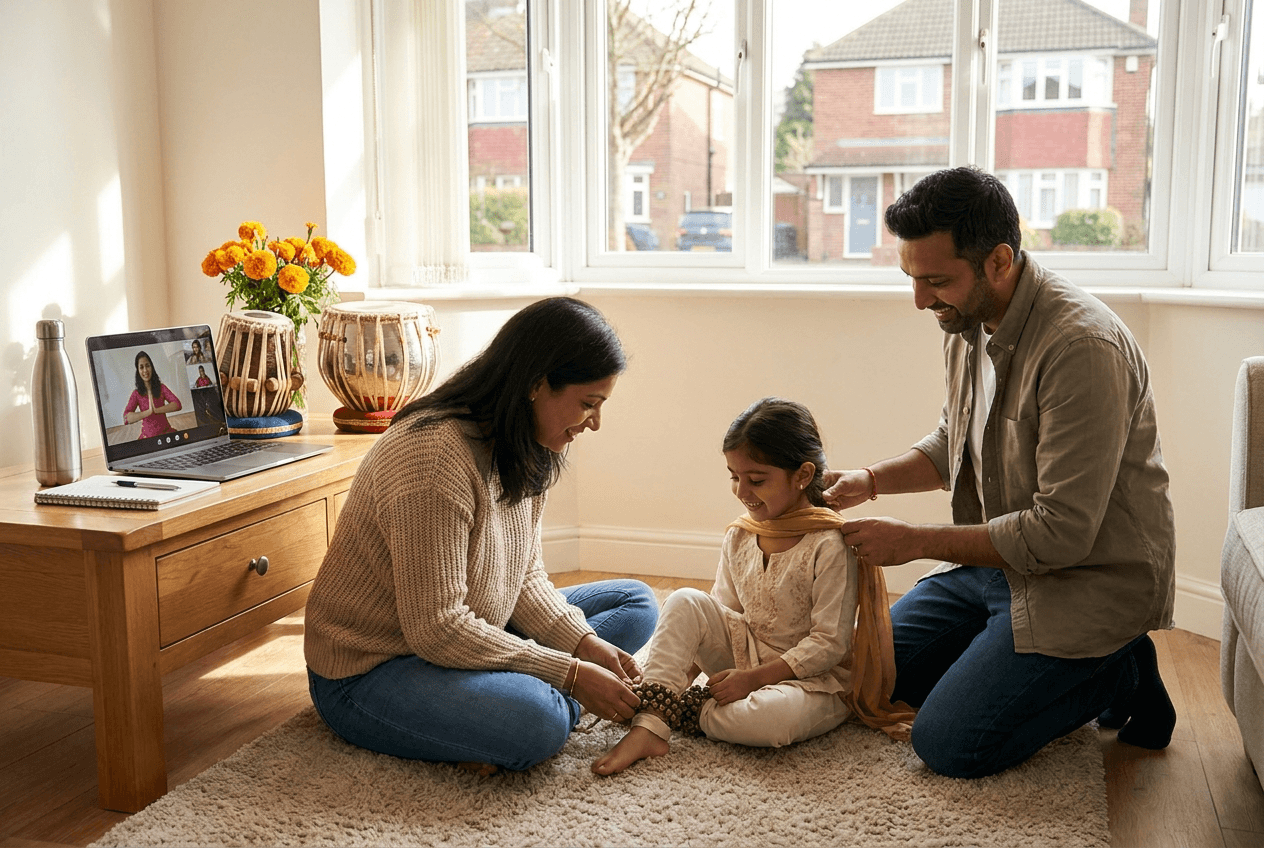
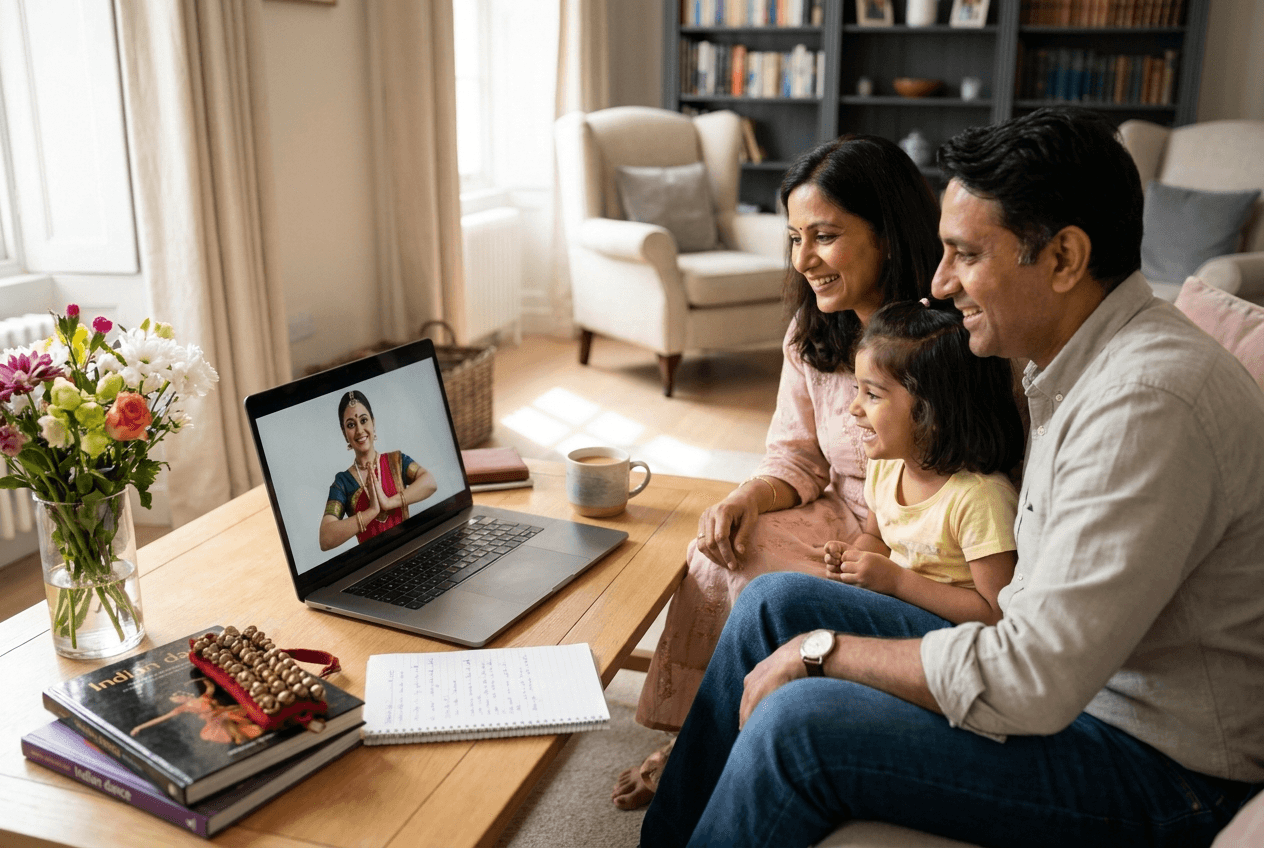
Research on first generation Indian immigrant parents found they placed particularly high value on traditional dance and music specifically as a vehicle for expressing and transmitting cultural and religious identity to children growing up outside India. For many UK families, this translates practically into starting children in classical dance or music from a relatively young age, often five to seven, not with an expectation of professional achievement but as a deliberate, structured form of cultural exposure woven into normal childhood activity. Our overview of south Indian dance forms and the broader landscape of Indian dance traditions can help families decide which specific discipline fits their own regional and cultural background.
Connecting Practice to Community Performance
One specific mechanism that recurs across British Indian family accounts is the role of community performance, organisations and cultural associations that bring families together around annual showcases, festival celebrations and rehearsal periods. One British Indian dancer interviewed in research on this topic described how preparing for an annual community arts programme became something genuinely anticipated each year, a context where children were getting into dance or music rehearsals together and parents encouraged language practice alongside the artistic preparation, describing the whole experience as a lovely way to grow up. This kind of community embedded practice, rather than isolated private lessons, appears to be a particularly effective version of this strategy.
Embracing Rather Than Resolving the Dual Identity
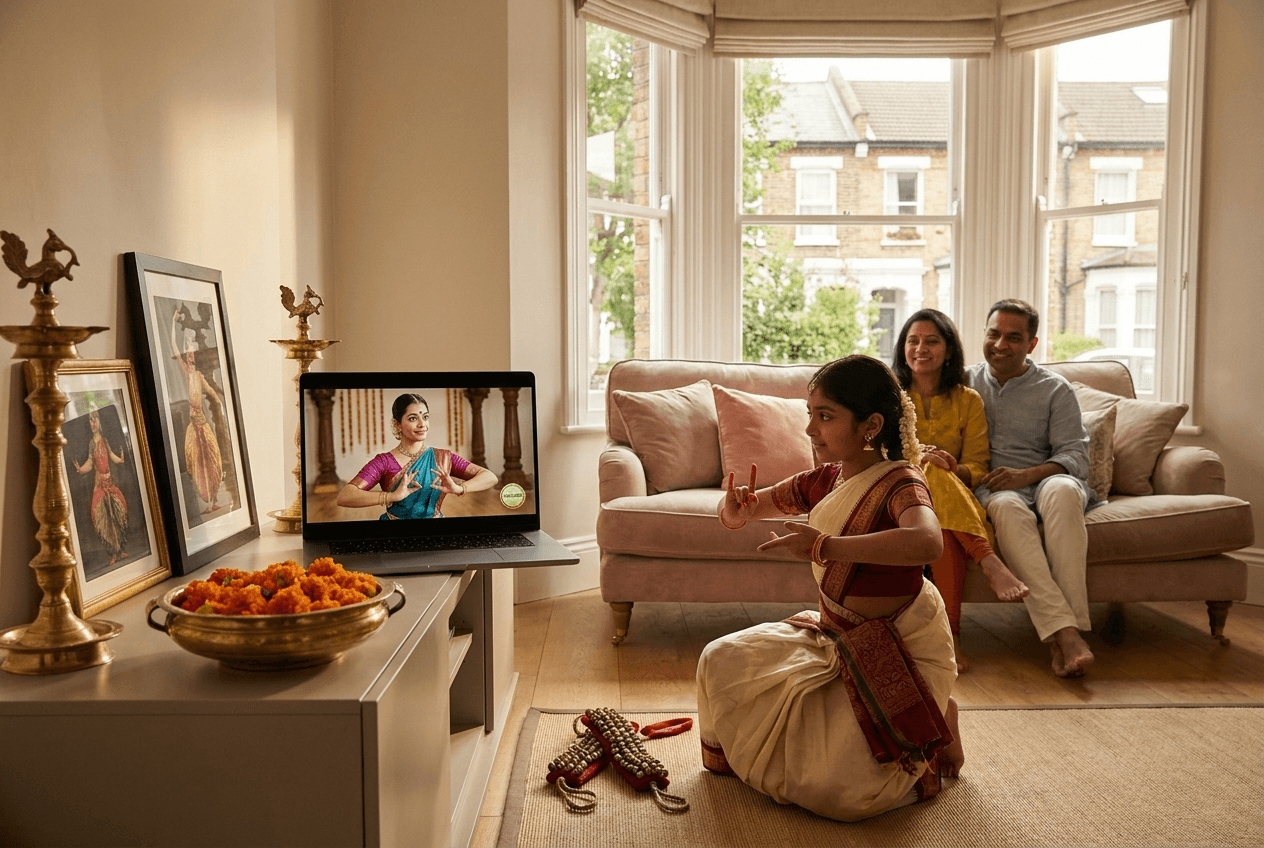 It is worth being clear that the research in this area does not describe classical arts training as eliminating the dual identity challenge entirely. Rather, the pattern described is one of growth with age and embracing dual identity over time, with classical arts practice functioning as one significant contributing factor among several, alongside the impact of a genuinely diverse community and ongoing parental support and modelling. UK parents considering this path should understand it as a meaningful, evidence supported contribution to their child's eventual confident sense of self, not a single intervention that resolves identity questions on its own.
Practical Starting Points for UK Parents
Choose Based on Regional Heritage First
North Indian families often find the strongest resonance in Kathak, tabla or Hindustani vocal, given the shared North Indian cultural and linguistic roots. South Indian families typically connect most directly through Bharatanatyam or Carnatic vocal. Our piece on why women should learn Kathak explores this specific tradition's cultural and personal significance in more depth if Kathak is under consideration.
Build in Performance Opportunities
Actively seek out or create performance contexts, whether through a local temple, cultural association, school multicultural event, or South Asian Heritage Month activities each July. A child who only ever practises privately misses the community and identity affirming dimension that research identifies as particularly powerful. Explore Bollywood dance classes or Kathak classes with this performance goal explicitly in mind from the outset.
Stay Involved as a Parent, Not Just as a Chauffeur
The research consistently highlights parental influence and active encouragement as a meaningful factor, not simply enrolment and logistics. Attending performances, showing genuine interest in what is being learned, and connecting lessons to broader family stories and heritage all appear to deepen the identity benefit beyond what the lessons alone would provide.
About Art Gharana
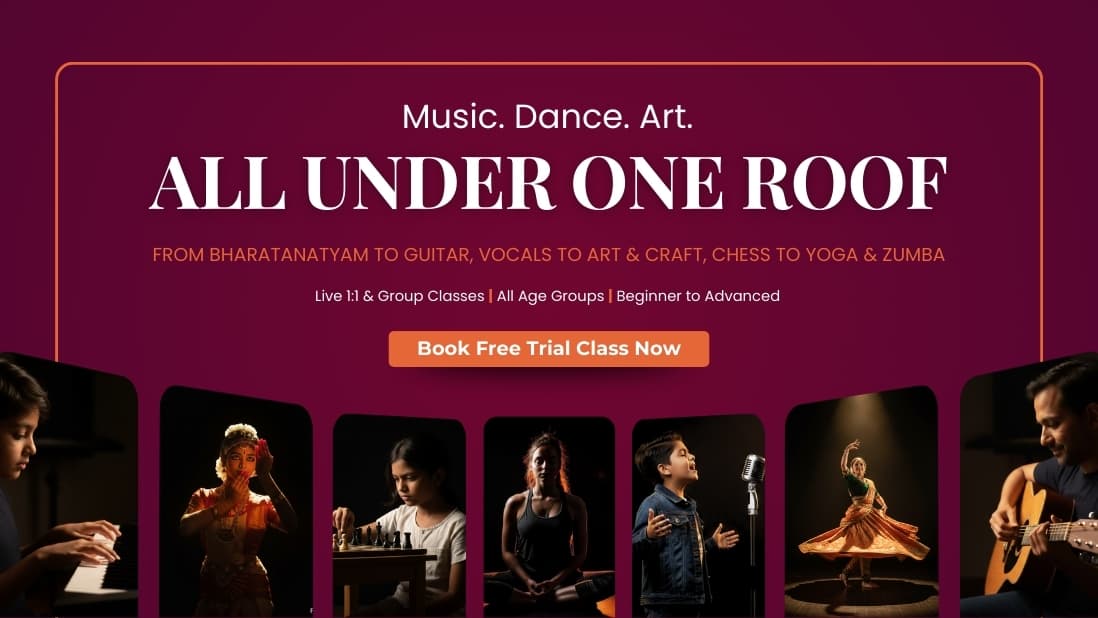
 Art Gharana offers live 1-on-1 Indian classical arts instruction for British Indian families across the UK, covering Bharatanatyam classes and the full range of classical disciplines. Review our teacher profiles and book a free trial class to begin.
Frequently Asked Questions
1. Is there UK research supporting Indian classical dance for cultural identity?
Yes. A 2023 study published in the Journal of Community and Applied Social Psychology specifically examined British Indians' use of Indian classical dance for cultural continuity and identity, based on interviews with UK based practitioners.
2. Are Bharatanatyam and Kathak recognised within UK dance education?
Yes. Both are included in the examined syllabus of the Imperial Society of Teachers of Dancing, a mainstream UK dance examining body, alongside more traditionally recognised Western dance forms.
3. What age should a British Indian child start learning Indian classical music or dance?
Most families begin between ages five and seven, though there is no fixed correct age. The key factor research highlights is sustained, encouraged practice over time rather than the specific starting age.
What Researchers Found When They Asked British Indians Directly
The 2023 study referenced throughout this guide conducted semi structured interviews with ten UK based Indian classical dance artists and analysed their responses using thematic analysis, a recognised qualitative research method for identifying recurring patterns across personal accounts. The four major themes that emerged were dual identity struggle, parental influence, embracing dual identity, and the benefits that classical dance practice provided across the participants' lives. Within the dual identity struggle theme, two specific sub themes appeared repeatedly, confusion and isolation in early life, and direct experiences of racism and stereotyping from wider British society.
What makes this research particularly relevant for UK parents today is not simply that these challenges exist, which many British Indian families already know from lived experience, but that the same research identified a consistent pathway through which these challenges were navigated successfully, with classical dance practice and supportive parental involvement appearing repeatedly as significant contributing factors in participants' eventual confident embrace of their dual identity.
Code Switching and Cultural Fluency
One researcher cited within this body of work draws a comparison between how bilingual individuals move fluently between languages depending on context, a phenomenon known as code switching, and a similar mechanism that appears to operate for British Indians navigating between British and Indian cultural contexts. Indian classical dance, in this framing, functions as one of the cultural vocabularies a British Indian person can fluently access, alongside their fluency in mainstream British cultural life, rather than requiring a choice between the two.
This framing is useful for UK parents because it reframes the goal away from choosing between British and Indian identity, an impossible and ultimately unhelpful binary, and toward building genuine fluency in both, with classical arts training serving as one concrete, practical mechanism for developing that Indian cultural fluency alongside the British cultural fluency a child develops simply through growing up and attending school in the UK.
Why Some Families Hesitate, and Why It Is Worth Reconsidering
Several common hesitations recur among UK Indian parents considering this path for their children. A common concern is that a child will resist or resent lessons that feel imposed rather than chosen, particularly as children grow into the more independence seeking pre teen years. Research and practical experience both suggest that the framing matters considerably here. Lessons introduced young, with genuine enjoyment built into the early experience, and connected to community and performance rather than presented purely as solitary technical training, are considerably more likely to be experienced as a positive and freely embraced part of a child's life rather than an imposed obligation.
Another common hesitation is uncertainty about which specific discipline to choose, particularly among families with mixed regional heritage or those who themselves did not grow up with strong exposure to any single classical tradition. There is no wrong starting point here. Bollywood dance, accessible and immediately enjoyable, is a perfectly reasonable entry point for any family uncertain where to begin, with the option to move toward a more specifically classical discipline once a child's own interests and aptitudes become clearer.
The Long Game: What This Looks Like a Decade Later
UK based British Indian adults who grew up with sustained classical arts training, whether they continued into adulthood or set the practice aside after childhood, consistently describe the experience as formative to their eventual sense of cultural confidence, even when they do not maintain active practice as adults. The skill itself, the ability to perform a Kathak piece or sing a Carnatic composition, is one tangible outcome. The less tangible but arguably more significant outcome is a settled, confident relationship with a dual cultural identity that many British Indians without this kind of structured childhood cultural exposure report taking considerably longer, and sometimes more difficulty, to reach on their own.
South Asian Heritage Month and Public Recognition
South Asian Heritage Month, observed each July across the UK, has become a significant annual touchpoint for British Indian families to publicly celebrate and share cultural practice with the wider community. Schools, local councils and cultural organisations across the country now mark the month with events that frequently feature classical dance and music performances from young British Indian students. For families whose children have been training consistently, this provides a genuine, recurring, low pressure opportunity to perform publicly and to see their cultural practice recognised and celebrated within mainstream British civic life, not as a separate or hidden activity but as a valued part of the national cultural calendar.
Looking to the Next Generation of British Asian Artists
The growing visibility of British Asian artists across UK television, theatre and contemporary dance, figures whose classical training in childhood provided the technical foundation for genuinely significant creative careers, offers UK parents a useful long view. Several prominent British Asian choreographers and performers working in contemporary British dance and theatre today began with exactly the kind of childhood classical training this guide describes, later channelling that foundation into work that speaks to both their Indian heritage and their lived British experience simultaneously, rather than having to choose between the two as separate, competing identities.
A Two Way Relationship Across Generations
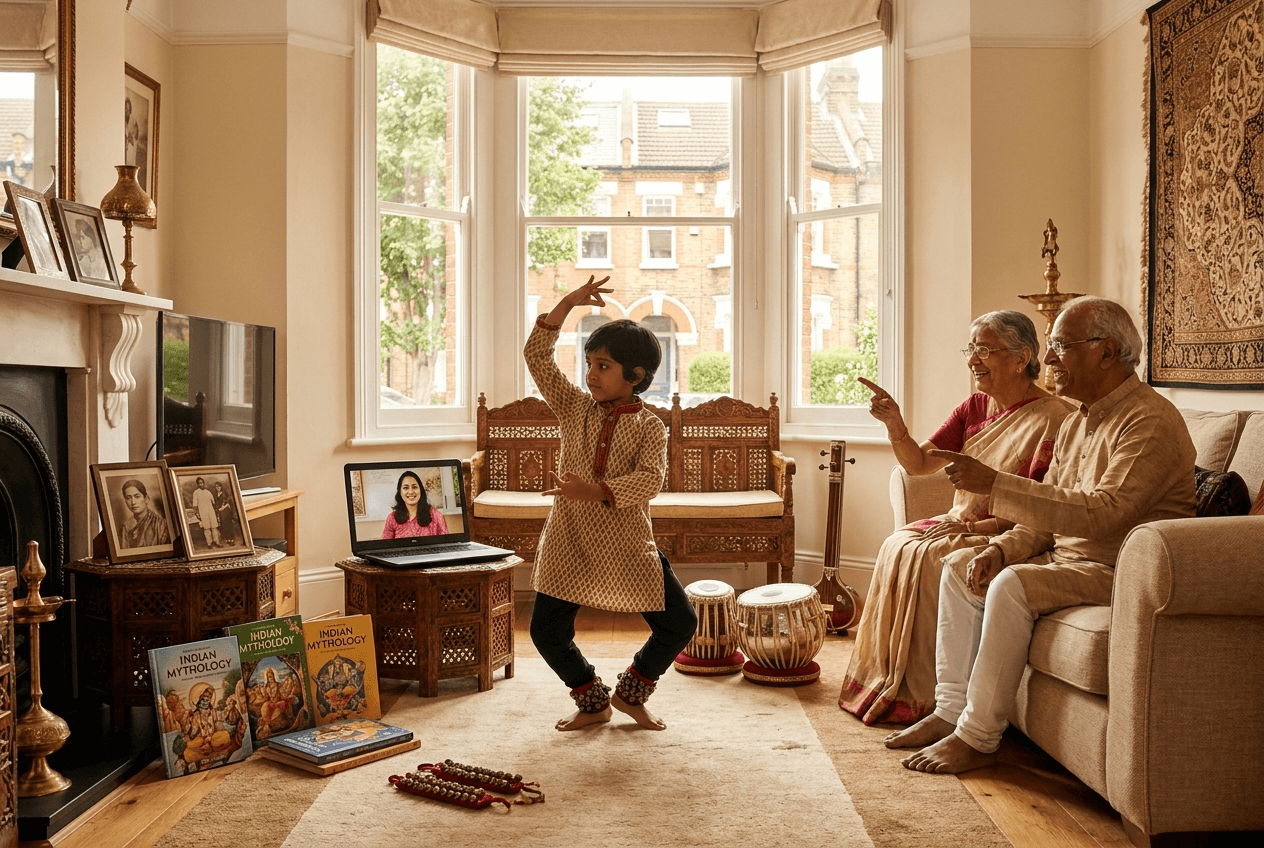
It is worth UK parents understanding that this is not a static, one way transmission from parent to child. Several British Indian dance practitioners interviewed in published research describe the relationship as genuinely reciprocal, with their own developing understanding and pride in the tradition, as they grew older and more technically accomplished, in turn deepening their parents' own connection to and pride in their heritage. Classical arts training within a family, in other words, frequently strengthens cultural connection across generations in both directions, not simply from older to younger family members.
Starting Fresh Even Without Your Own Childhood Training
For UK parents who did not themselves receive classical arts training as children, perhaps because such opportunities were limited in their own UK childhood or because their parents prioritised other forms of cultural transmission, there is no need to feel any sense of having missed an opportunity that cannot now be provided. The infrastructure available to UK families today, including live online instruction connecting directly with certified teachers regardless of local community size, did not exist in the same form even a decade ago. Starting this tradition fresh with the current generation of children is entirely valid and increasingly common across UK Indian families.
On Comparison Between Cousins and Peers
A final practical note worth raising directly. Some UK parents worry that introducing classical arts training will create comparison or competition with cousins or peers already further along in their own training, particularly within close knit extended family networks. The most constructive framing, supported by how Art Gharana's one to one teaching model works in practice, is that each child's classical arts journey is genuinely individual, paced to their own development rather than measured against any other child's timeline. A cousin's more advanced progress is simply evidence of a head start in time, not a reflection of relative ability, and teachers are specifically trained to keep this framing central to how progress is discussed with both children and parents.
A Viable Path for Those Who Want to Go Further
The economic dimension of this cultural infrastructure deserves brief mention. Organisations such as Akademi have specifically worked to build sustainable career and employment pathways for young British Asian artists within Indian classical and contemporary dance, meaning the path from childhood lessons through to potential professional or semi professional involvement in adulthood is more viable in the UK today than it has been in previous generations. While the overwhelming majority of children who begin classical arts training will not pursue it professionally, and that is entirely fine, the existence of this viable pathway for those who do discover genuine passion and aptitude adds a dimension of legitimacy and possibility that simply did not exist as robustly even one generation ago.
Part of a Larger British Cultural Story
UK parents researching this topic will also encounter the broader story of Indian cultural influence on mainstream British life, from Bollywood's lasting impact on British entertainment and the cultural crossover moments of the 1990s through to contemporary British Asian musicians and visual artists who have woven Indian aesthetic and musical influences into work celebrated across British culture more broadly. This wider context matters because it positions a child's classical arts training not as an isolated private family practice but as participation in a living, ongoing, and increasingly visible British cultural conversation, one in which British Indian voices and traditions are recognised contributors rather than separate from the national story.
A Modest, Achievable Goal
None of this requires a UK parent to have grand ambitions for their child's classical arts journey. The research and the lived accounts gathered across this guide point to a much simpler and more achievable truth: consistent, supported, enjoyable practice of Indian classical music or dance during childhood appears to meaningfully support the kind of confident, settled dual identity that many British Indian adults describe taking considerably longer to reach without it. That is a modest, achievable, and genuinely worthwhile goal for any UK family to pursue, regardless of whether a child eventually becomes a serious performer or simply carries a quiet, confident cultural fluency into adulthood.
Taking the First Step
Taking the first step does not require a long term plan or a clear sense of exactly where this will lead. It requires only a willingness to introduce a child to a tradition that has supported cultural confidence and identity for generations of families before this one, in whatever modest, consistent form fits realistically into your family's UK life. The research, the published accounts of British Indian artists and practitioners, and the simple lived experience of thousands of UK families who have already taken this step all point toward the same conclusion, that this is a genuinely worthwhile investment in a child's eventual sense of self, regardless of how far the artistic journey itself ultimately goes.
Where to Begin
If this guide has resonated with your own experience or hopes for your children, the most useful next step is a direct conversation with a certified teacher about your specific family background and what you hope this practice might offer your child. A free trial class provides exactly this opportunity, with no obligation attached, simply a starting point from which your own family's version of this story can begin.
Whatever your family's specific heritage and circumstances, the door to this tradition remains genuinely open, and the next generation is ready to walk through it with you.
A Note on Early Resistance
A small but telling detail from the research deserves mention. Several participants described how their own initial reluctance or ambivalence toward classical training as young children gradually transformed into genuine pride and enthusiasm as they grew older and became more technically capable, suggesting that early resistance, where it occurs, should not necessarily be read as a sign the activity is fundamentally wrong for a child. Persistence through an initial adjustment period, balanced always against genuine wellbeing and never tipping into coercion, appears to be a normal and survivable part of many successful long term classical arts journeys within British Indian families.
Trust the process, stay engaged as a parent, and give it genuine time before drawing conclusions either way.