ChatGPT
 Google AI
 Grok
Grok Claude
Finding the right music class for your child in Australia has never been easier, and it has never been more important. Australia's Indian-origin community has grown dramatically - the 2021 Census recorded approximately 783,000 people of Indian ancestry across the country, concentrated in Melbourne, Sydney, Brisbane, and Perth. For these families, and for any Australian family drawn to Indian classical music and dance, live online classes have removed every geographic barrier that once made quality instruction so difficult to access.
This is your complete guide. It covers what makes an online music class genuinely excellent, the practical setup requirements for Australian homes, how time zones work between Australia and India, what to look for specifically in teachers for Indian classical music and Western instruments, and a step-by-step plan for getting your child started. Whether you live in inner-city Melbourne or regional Queensland, a world-class music education for your child is now well within reach.
The Australian Context for Children's Online Music Education
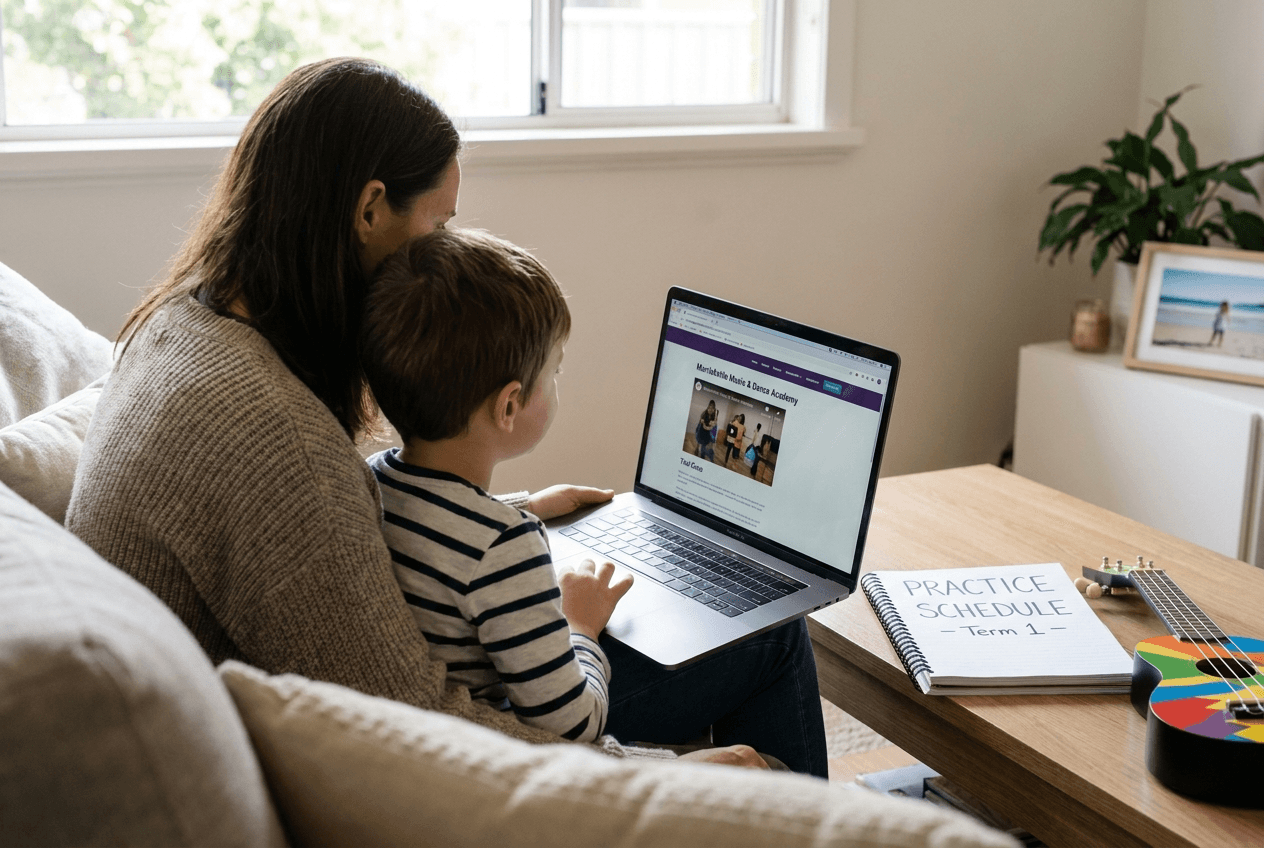 Australia has a unique set of characteristics that make online music education particularly well-suited to its families. Understanding this context helps parents make the investment with confidence.
Why Geography Makes Online Learning Essential for Many Australian Families
Australia is the world's sixth-largest country by land area. Even within individual states, significant distances separate major cities from regional and rural communities. Sydney to Brisbane is 900 kilometres. Melbourne to Adelaide is 730 kilometres. Perth is separated from every other major Australian city by thousands of kilometres of continent.
This geographic spread has historically been one of the most significant challenges in Australian education, and one of the reasons Australia pioneered distance education through programmes like the School of the Air as early as the 1950s. For Indian classical music specifically - where qualified teachers are concentrated in Melbourne, Sydney, and occasionally Brisbane - families in regional New South Wales, Queensland, South Australia, or Western Australia have historically had no access at all to qualified Hindustani vocal, Carnatic music, Bharatanatyam, or tabla instruction.
Online learning eliminates this barrier entirely. A family in Toowoomba, Ballarat, or Bunbury can now access exactly the same quality of Indian classical music instruction as a family in Toorak or Parramatta. This is not an incremental improvement. It is a transformation.
Australia's AMEB Framework and Where Indian Classical Music Fits
For Australian families pursuing Western music education, the Australian Music Examinations Board (AMEB) is the primary music examination body. According to the AMEB, it provides graded examinations across piano, violin, guitar, voice, woodwind, brass, and other Western instruments. AMEB grades are widely recognised across Australian schools, conservatoires, and universities, and contribute meaningfully to ATAR calculations through state-specific pathways in some states.
For Indian classical music, the AMEB has no equivalent pathway. Australian families pursuing Indian classical music examinations must access international examination bodies - primarily the Akhila Bharata Gandharva Mahavidyalaya Mandal (ABGMM) or Prayag Sangeet Samiti - through affiliated teachers. These qualifications carry significant recognition within Australia's South Asian community and are accepted as evidence of musical achievement by Indian cultural organisations nationwide. As Ofqual-accredited Indian music qualifications develop in the UK and potentially in Australia, this formal recognition gap is expected to narrow.
The South Indian Community in Australia
Melbourne and Sydney host significant Tamil, Telugu, and Kannada communities. Carnatic music sabhas (cultural organisations dedicated to South Indian classical music) in Melbourne and Sydney organise concerts, workshops, and youth competitions that provide Australian students with community context and performance opportunities alongside their online instruction. Indian classical dance competitions, Bharatanatyam arangetrams, and Carnatic music competitions are regular events in Australia's major South Asian community hubs.
What Makes an Online Music Class Genuinely Excellent for Australian Children
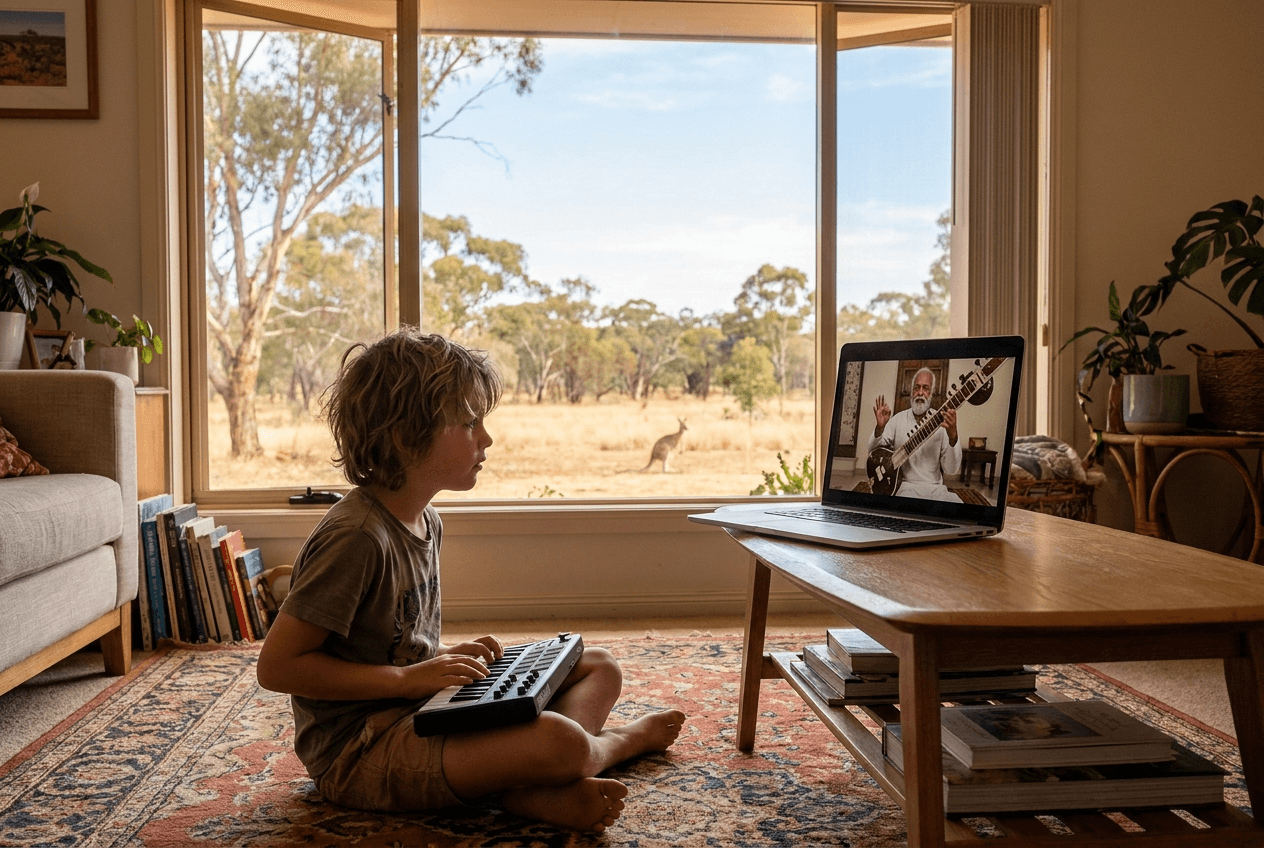 Not all online music classes are equal. The explosion of digital learning platforms since 2020 has created significant variation in quality, from genuinely excellent live instruction with certified teachers to pre-recorded video libraries that are marketed as courses but cannot provide anything resembling real music education. Here is how to evaluate the difference.
Live Instruction Is Non-Negotiable
The most important distinction in online music education is between live and pre-recorded instruction. Pre-recorded video tutorials are widely available on YouTube, Coursera, and dozens of music platforms. They represent a useful supplementary resource for reference and inspiration. They are not music lessons.
Real music education requires a teacher who can hear the student in real time, assess what is happening right now, and respond with specific, personalised guidance. A pre-recorded video cannot hear your child sing and tell them their Ga is slightly flat. It cannot see that your child is holding their fingers incorrectly and is about to develop a habit that will take months to correct. It cannot adapt its tempo, vocabulary, or emotional approach to how your child is feeling on a specific day. Live instruction - a qualified, attentive human teacher engaging with your specific child in real time - is what produces musical learning. Everything else is supplementary.
Teacher Credentials and Verifiable Qualifications
For Indian Classical Music
A qualified Indian classical music teacher should be able to state their formal examination credentials, their guru's name, and where they trained. For Carnatic music, look for Visharad-level credentials or equivalent from a recognised institution. For Hindustani music, similar credentials from ABGMM, Prayag Sangeet Samiti, or equivalent bodies. For Bharatanatyam, formal training credentials from Kalakshetra or equivalent, with clear gharana/bani lineage stated.
Any teacher who cannot answer these questions specifically has not received the type of structured, examined training that authentic Indian classical arts instruction requires. This is not pedantic - the quality difference between a teacher who trained rigorously under a recognised guru and one who is self-taught is substantial.
For Western Instruments
For piano, violin, guitar, or other Western instruments, look for AMEB Grade 8 or equivalent ABRSM credential as minimum, ideally alongside a music degree from an Australian or international university. For AMEB examination preparation specifically, ask about the teacher's direct experience with the AMEB syllabus rather than simply assuming a UK ABRSM-trained teacher will be familiar with Australian examination requirements.
Structured, Progressive Curriculum
A school that cannot clearly describe what your child will learn in the first six months of instruction has not built a thoughtful curriculum. Every excellent music programme can outline a progressive sequence of skills: for Carnatic music, this is sarali varisai through geethams through varnams; for Bharatanatyam, this is adavus through alarippu through jatiswaram; for piano, this is note reading and hand position through five-finger pieces through hands-together playing.
Ask specifically: "Can you describe what my child will learn in the first year of instruction?" A specific, confident, structured answer reflects genuine pedagogical thinking. A vague answer suggests the school is improvising its curriculum rather than delivering a planned one.
Age-Appropriate Teaching for Young Children
Teaching a six-year-old online requires genuinely different skills from teaching adults. Young children have shorter attention spans, different motivational systems, less developed metacognitive awareness, and different responses to correction. A teacher who excels with adult learners may be entirely unsuited to teaching young children - and this distinction is not visible from a website profile.
Ask explicitly: how do you adapt your instruction for a child of [your child's specific age]? A teacher who works regularly with young children will immediately describe specific strategies - the games they use to explain rhythm, the way they give encouragement, the length and structure they use for sessions at different ages. A teacher who hasn't worked much with children will struggle to answer specifically.
Regular Communication With Parents
For Australian parents who may have limited personal background in Indian classical music, regular updates about lesson content and progress are especially valuable. A teacher who sends a brief weekly note - "Today we worked on the third variation of tatta adavu, and your child should practise it 10 minutes each day this week" - is providing the parental partnership that makes home practice productive rather than aimless.
A Free Trial Class
Without exception, trial before committing financially. One live session is worth more than any number of profile descriptions or website testimonials. At Art Gharana, we offer free trial lessons for all our programmes. Explore our Bharatanatyam dance classes and our full course catalogue to find the right fit for your child's interests.
Time Zone Logistics for Australian Families
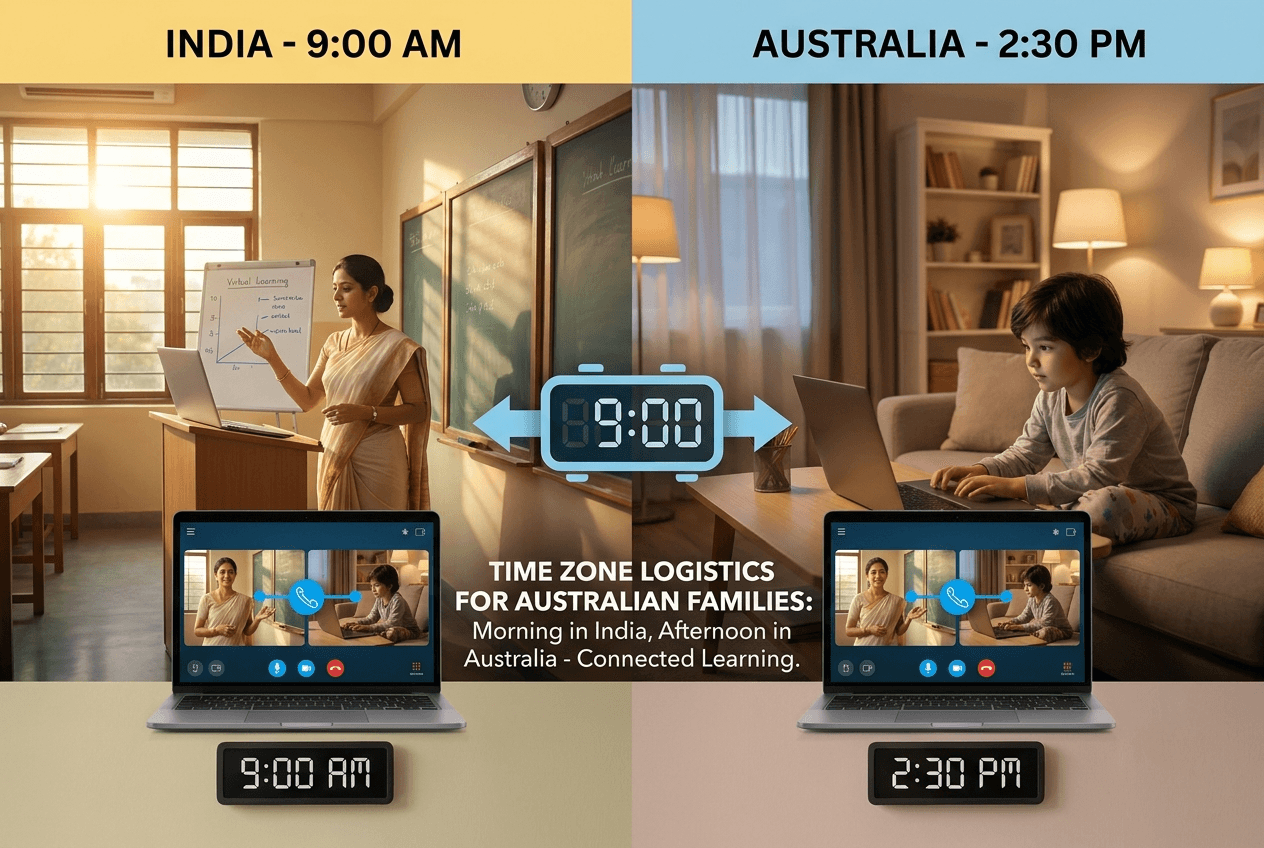 One of the practical questions Australian families most frequently ask is how to manage the time difference between Australia and India when the teacher is IST-based. This is entirely manageable with clear planning.
Understanding the Australia-India Time Difference
Eastern Australia
Australian Eastern Standard Time (AEST) is UTC+10. India Standard Time (IST) is UTC+5:30. This means AEST is 4.5 hours ahead of IST. Daylight saving in the eastern states shifts this to AEDT (UTC+11), making it 5.5 hours ahead of IST during summer months.
Practical implication: A teacher's morning slot in India - say, 7:30 AM IST - corresponds to 12:00 PM AEST (noon) in Sydney, Melbourne, or Brisbane. An India-based teacher's afternoon slot of 4:00 PM IST corresponds to 8:30 PM AEST, which is a workable early evening for Australian families after school and dinner.
Western Australia
Western Australian Standard Time (AWST) is UTC+8, making it only 2.5 hours ahead of IST. A 10:00 AM IST lesson slot corresponds to 12:30 PM AWST - ideal for afternoon weekend classes or after-school weekday lessons.
South Australia and the Northern Territory
South Australian Central Standard Time (ACST) is UTC+9:30. A 7:30 AM IST slot corresponds to 1:00 PM ACST, making afternoon weekend slots very workable.
Best Times for Australian Families
For most Australian families, the most workable lesson times are Saturday and Sunday afternoon (Australian time), which correspond to Saturday and Sunday morning Indian time. This aligns well with most teachers' weekend availability and does not conflict with Australian school schedules. After-school weekday lessons at 4:00-7:00 PM AEST (corresponding to 10:30 AM - 1:30 PM IST) are also entirely workable for India-based teachers who are willing to take late morning or early afternoon IST slots.
Always confirm specific time availability with the teacher before enrolling. The best teachers serving Australian families have explicitly identified Australian-compatible lesson slots and may already teach several Australian students regularly.
Setting Up Your Home for Online Music Classes in Australia
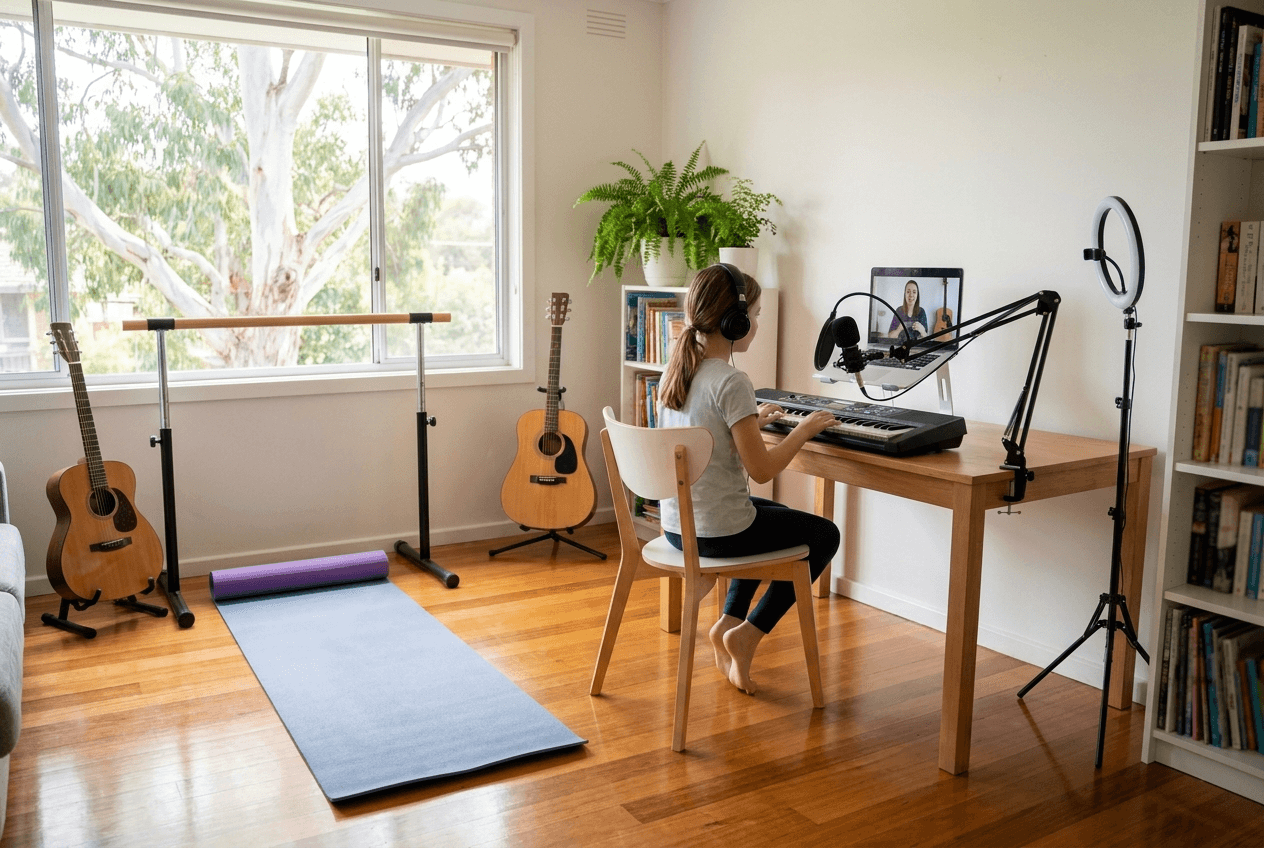 Australian homes vary considerably in their acoustic and technical characteristics. A few practical steps ensure that your child's lessons are as productive as possible from day one.
Internet Connectivity
Australia's National Broadband Network (NBN) provides sufficient connection speeds for video call music lessons in the majority of urban and suburban locations. Most modern NBN plans offer speeds of 25-100 Mbps, which is more than adequate for a single video call running simultaneously with normal household internet use.
For families in regional or rural areas, connection reliability is more important than raw speed. A 10 Mbps connection that is stable and consistent is better for live online lessons than a 50 Mbps connection that occasionally drops out. If your internet reliability is a concern, consider plugging directly into the router via ethernet cable for lesson times to eliminate WiFi variability.
Device and Camera Setup
For Music Lessons (Vocals, Piano, Instruments)
A laptop, tablet, or desktop computer with a front-facing camera is entirely sufficient. Position the device so the camera shows your child's hands, instrument, and upper body simultaneously. For piano lessons, a side-angle view showing both hands on the keyboard is most useful. For vocal lessons, a direct face-on view that shows the face clearly is ideal.
A simple external USB microphone - the Blue Snowball iCE ($70-100 AUD) or Audio-Technica AT2020USB ($120-150 AUD) - makes a significant difference to how clearly the teacher hears your child's voice or instrument tone. This is particularly important for Carnatic and Hindustani vocal instruction, where the teacher needs to assess microtonal pitch accuracy.
For Dance Lessons (Bharatanatyam, Kathak, Bollywood)
Dance lessons require the teacher to see your child's complete body from head to feet. Position the camera on a low side table or use a small tripod stand to achieve a full-body angle. Ensure there is sufficient floor space - at least 8 feet by 6 feet - for movement.
Hard flooring is strongly preferred for classical dance instruction. Thick carpet muffles the sound of footwork (essential for Bharatanatyam and Kathak), reduces proprioceptive feedback, and makes rhythmic precision harder to develop. If your practice space is carpeted, invest in a large hardwood-finish vinyl floor mat (available from Bunnings or online for $50-$120 AUD) to create an appropriate practice surface.
Acoustic Environment
Australian homes, particularly newer constructions with open-plan layouts, can have significant acoustic challenges. Hard surfaces (tiles, timber floors, plasterboard walls) create reverberant environments where background sounds are amplified rather than absorbed. This makes it harder for the teacher to hear your child clearly.
Choose a practice space with some soft furnishings - a couch, curtains, a bookshelf - that absorb some sound. Practising in a bedroom with carpet and fabric surfaces produces better audio quality than practising in a kitchen or open living area with hard surfaces everywhere. Closing doors and windows during lessons reduces external traffic and environmental noise.
Indian Classical Music Education for Indian-Australian Families
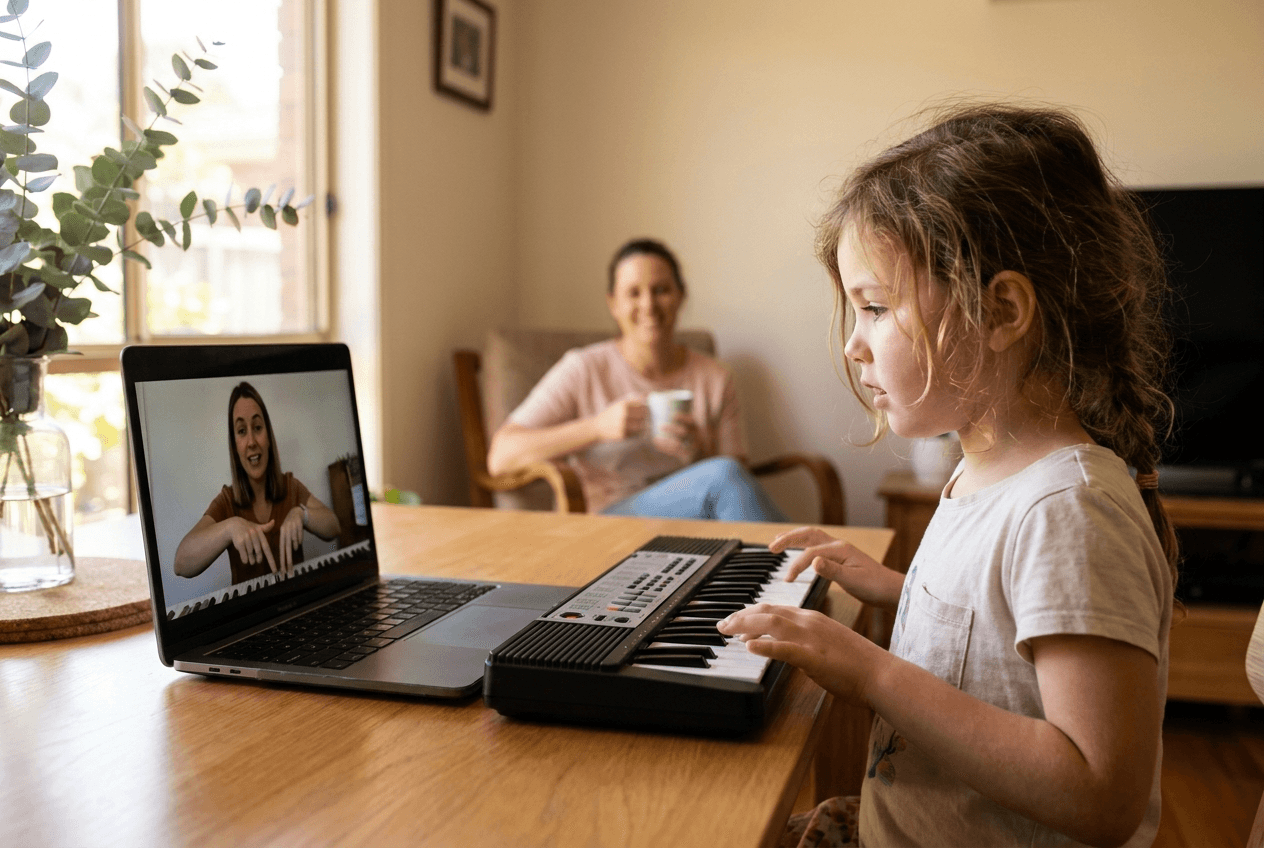 For Indian-Australian families, online music and dance classes serve purposes that go beyond musical skill development. They are one of the most powerful tools available for cultural preservation, identity formation, and intergenerational connection.
Cultural Identity for Second-Generation Indian-Australian Children
Research published in the International Social Science Journal confirms that active engagement with heritage cultural practices significantly strengthens ethnic identity in second-generation children of diaspora communities. The key word is active. Passive cultural familiarity - eating Indian food, watching Bollywood movies, attending Diwali events as a spectator - produces a different and weaker cultural identity effect than active cultural participation.
An Indian-Australian child who can perform Bharatanatyam at a cultural event, who can sing a Carnatic composition at a temple programme, who can demonstrate tabla bols for their classmates at school multicultural day - this child is a cultural practitioner, not merely a cultural spectator. This distinction is not subtle. Research on diaspora cultural identity consistently shows that genuine cultural competence produces more confident, stable, and positive cultural identity than passive cultural familiarity alone.
Intergenerational Connection Across the Distance to India
For Indian-Australian families with grandparents in India, classical arts education creates a specific and profound form of intergenerational connection that functions across 10,000 kilometres. Grandparents who receive a video message of their Australian grandchild performing Bharatanatyam, singing a Thyagaraja kriti, or demonstrating a tabla taal experience a specific recognition and pride that few other activities produce.
The child, for their part, develops a connection to their grandparents that is not merely sentimental but artistically and culturally substantive. They are learning the same tradition that their grandparents grew up within. That shared artistic heritage bridges distance in ways that video calls about daily life cannot.
Our Art Gharana Approach for Australian Families
At Art Gharana, we have worked with Indian-Australian families across Melbourne, Sydney, Brisbane, Perth, Adelaide, and regional communities for several years. Our teachers understand the specific cultural context of the Indian-Australian diaspora experience - the bicultural navigation, the time zone logistics, the community events where students perform, and the family expectations that shape how parents and children approach their musical education.
Read our blog on the benefits of Bharatanatyam for kids, which explores the developmental, cultural, and identity benefits of Indian classical dance education for diaspora children, or explore the roots of Indian classical dance in our dedicated guide.
Practical Getting-Started Guide for Australian Families
Step One - Identify the Art Form That Genuinely Excites Your Child
Sit with your child and watch short performances of the traditions you're considering. Watch a Bharatanatyam performance and a Kathak performance on YouTube. Listen to a Carnatic vocal concert. Watch a tabla demonstration. Then simply ask: which of these feels most exciting to you?
A child who chooses their own art form is significantly more motivated to practise consistently, persist through challenges, and ultimately achieve genuine competence. Children whose parents make the choice for them are working against an internal resistance that doesn't exist when the child chose for themselves.
Step Two - Book a Free Trial Class and Evaluate Carefully
Choose a platform offering live 1:1 instruction with certified teachers and a free trial. During the trial, observe specifically: Does the teacher engage warmly and specifically with your child, or do they teach generically? Do they explain concepts clearly? Does your child's interest and attention remain sustained throughout? These observations tell you more about teaching quality than any review.
Step Three - Set Up the Technical Environment
Before the first paid lesson, ensure the following are in place: stable internet tested at lesson time, appropriate device with camera positioned correctly for the art form, microphone quality assessed (upgrade if the teacher struggles to hear clearly), tanpura app for Indian classical music, and appropriate floor space for dance. Addressing these before lessons begin prevents the first few lessons being lost to technical troubleshooting.
Step Four - Build the Practice Habit from Week One
Establish a daily practice time in your family's schedule before the first lesson, not after several weeks of inconsistent practice. The specific time matters less than the consistency. Same time every day, same space, no competing devices. For children under eight, 15 minutes is entirely sufficient. For older children, 20-25 minutes is the target.
The practice habit formed in the first month is more predictive of long-term musical progress than almost any other factor. A child who practices consistently from week one will outperform a more talented child who practises sporadically, every time.
Conclusion
The best online music classes for Australian children in 2026 are genuinely excellent - well-qualified teachers, thoughtfully structured curricula, reliable technology, and cultural depth that physical geography could never previously have brought into regional and suburban Australian homes.
Three things to take away. First, live instruction is the only form of online music class worth paying for - pre-recorded content is a supplement, not a substitute. Second, verify teacher credentials specifically, including formal examination qualifications and teaching experience with children at your child's age. Third, set up the technical environment properly before lessons begin, including correct camera positioning, microphone quality, and an appropriate practice space.
Art Gharana offers live 1:1 online Indian classical music and dance classes for children and adults across Australia. Book a free trial class today through our complete course catalogue and give your child the musical and cultural education they deserve.
Frequently Asked Questions
1. What are the best online music classes for Indian-Australian children?
The best online music classes for Indian-Australian children are those offering live 1:1 instruction with certified teachers in Indian classical arts (Bharatanatyam, Carnatic music, Hindustani vocals, tabla, Kathak) combined with Western instrument options for AMEB examination preparation. Art Gharana offers both. Look for teachers with formal examination credentials, experience with diaspora learners, and Australian-compatible lesson times.
2. How does the time difference between Australia and India work for online music lessons?
Indian Standard Time (IST) is 4.5 hours behind Eastern Australian Standard Time (AEST). A teacher's afternoon lesson in India (4:00-6:00 PM IST) corresponds to evening in Sydney and Melbourne (8:30-10:30 PM AEST). Weekend morning sessions in India (8:00-10:00 AM IST) correspond to Australian early afternoon (12:30-2:30 PM AEST), which is the most practical window for most Australian families.
3. Can children in regional Australia access Indian classical music instruction online?
Yes, completely. Online instruction eliminates geographical barriers entirely. A child in Cairns, Alice Springs, or Geraldton has access to exactly the same quality of Indian classical music instruction as a child in inner Melbourne. The only requirements are a stable internet connection and proper home setup.
4. How long does it take for an Australian child to develop noticeable skill in Bharatanatyam or Carnatic music?
With consistent weekly lessons and daily practice of 15-20 minutes, most children show recognisable skill development within three to four months. After 12 months of consistent instruction, children typically demonstrate genuine cultural competence - the ability to perform a complete Alarippu (Bharatanatyam) or a set of sarali varisai and geethams (Carnatic music) - that can be proudly presented at community events.
5. What equipment do I need to set up for online music lessons at home in Australia?
For music lessons: a device with camera, stable internet (10 Mbps minimum), a quiet room, and a tanpura app for Indian classical music. For dance lessons: full-body camera position, hard flooring (or vinyl floor mat over carpet), and a space of at least 8 feet by 6 feet. An external USB microphone ($70-$150 AUD) significantly improves audio quality for vocal instruction.