ChatGPT
 Google AI
 Grok
 Claude
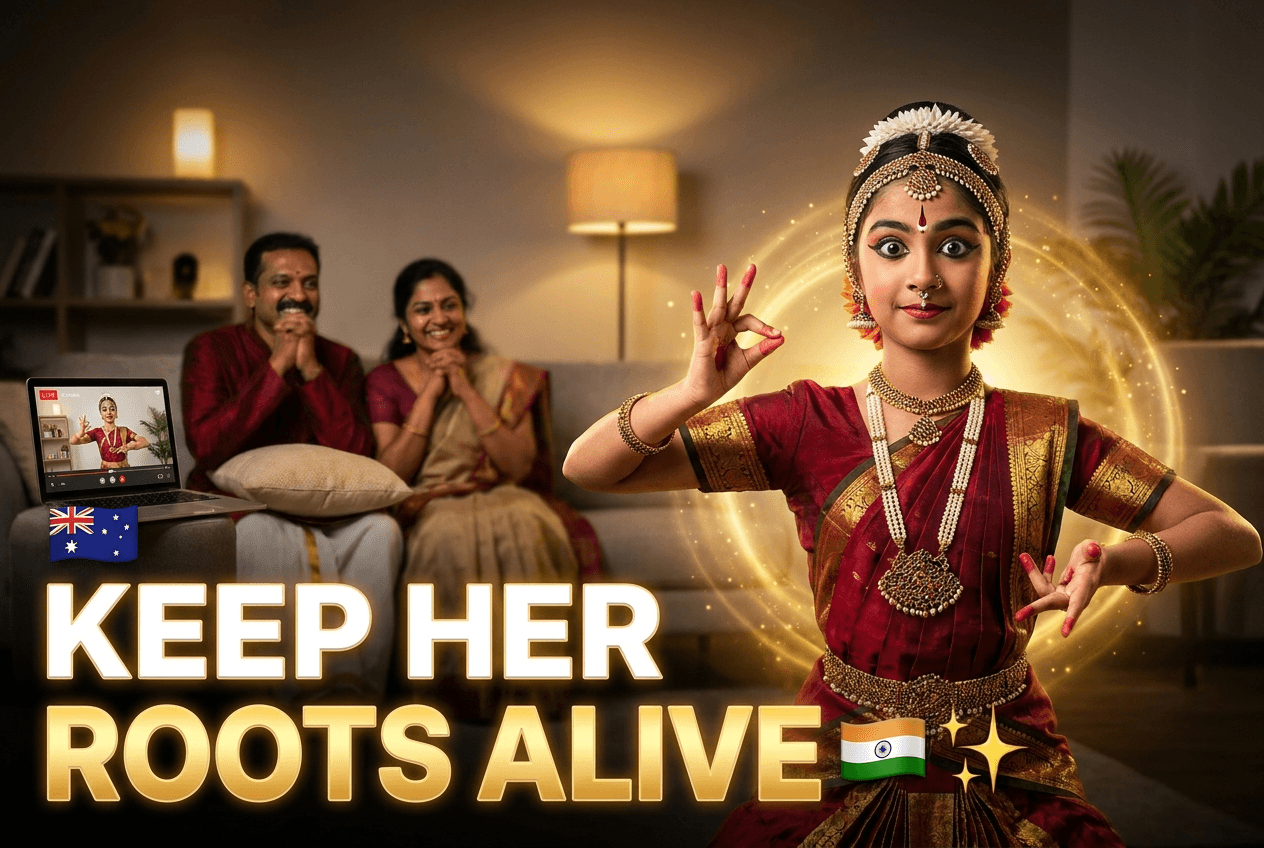
Bharatanatyam is the classical dance of South India and one of the most visually spectacular and culturally profound performing arts traditions in the world. For Tamil, Telugu, Kannada and Malayalam families across Australia, from Sydney's Parramatta-Blacktown Tamil community and Melbourne's Dandenong South Indian families to the Tamil diaspora in Brisbane, Perth and Adelaide, Bharatanatyam training is among the most meaningful cultural investments a family can make for their children.
The Australian Bharatanatyam teaching landscape is geographically fragmented. Sydney Nrityasagara in the Hills Shire offers Kalakshetra-style instruction with some online provision. Kaladhama Nrityashala in Blacktown offers group classes. Melbourne has multiple individual teachers in Dandenong, Wyndham Vale and other suburbs. All of these providers serve specific communities in specific suburbs. No provider offers live one-to-one Bharatanatyam classes for families across all of Australia in Australian time zones with open gender enrollment. Art Gharana does.
South Indian Communities Across Australia
Sydney: The Tamil and South Indian Heartland
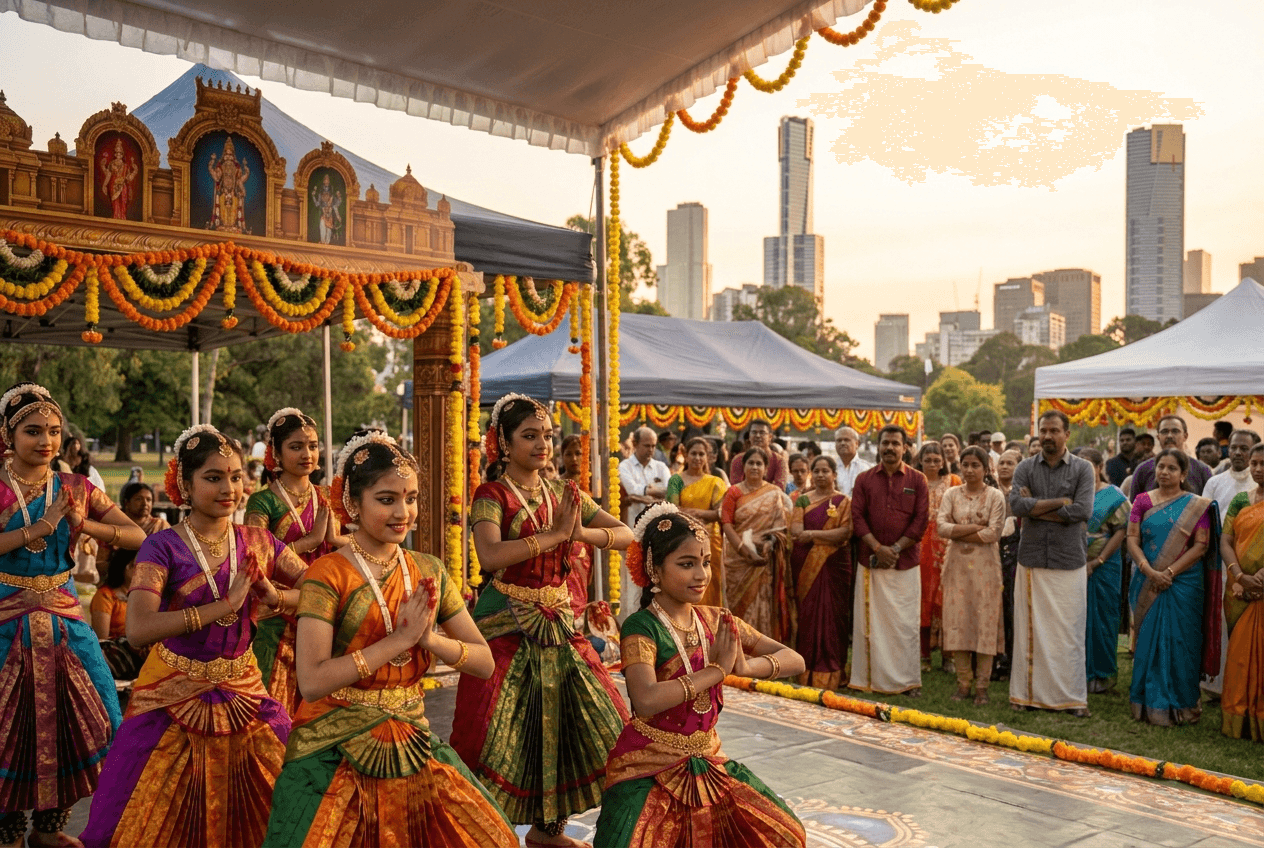
Sydney's Tamil and South Indian community is one of the most vibrant in the Southern Hemisphere. Concentrated in Parramatta, Blacktown, Seven Hills, Toongabbie, Westmead, Rouse Hill, Castle Hill and Cherrybrook, with a significant presence in southern suburbs including Strathfield, Homebush and Auburn, the community supports multiple South Indian temples, Tamil cultural associations and classical arts organisations. The Sri Murugan Temple in Parramatta, the Murugan temple at Westmead, and dozens of other South Indian temples host regular Bharatanatyam performances, arangetrams and cultural events throughout the year.
Melbourne: Dandenong, Wyndham Vale and Beyond
Melbourne's South Indian and Tamil community is concentrated in the southern and western suburbs, particularly Dandenong, Noble Park, Springvale, Wyndham Vale and Werribee. Multiple individual teachers and small studios serve these communities with in-person group classes on fixed weekend schedules. For families in Melbourne's northern growth corridors (Craigieburn, Roxburgh Park) or eastern suburbs (Box Hill, Doncaster), access to quality Bharatanatyam instruction requires either significant travel or acceptance of online instruction. Art Gharana's programme provides the latter at the highest quality level.
Brisbane, Perth, Adelaide and Nationwide
For Tamil and South Indian families in Brisbane's Logan corridor and southern suburbs, Perth's Indian community in Balga and Nollamara, Adelaide's Indian community in the northern and southern suburbs, and families in regional cities and towns across Australia, local Bharatanatyam instruction at a children's level with certified classical training is largely unavailable. Art Gharana serves all of these families with the same quality of live one-to-one instruction available to Sydney and Melbourne families.
The Benefits of Bharatanatyam for Indian-Australian Children
Physical Development
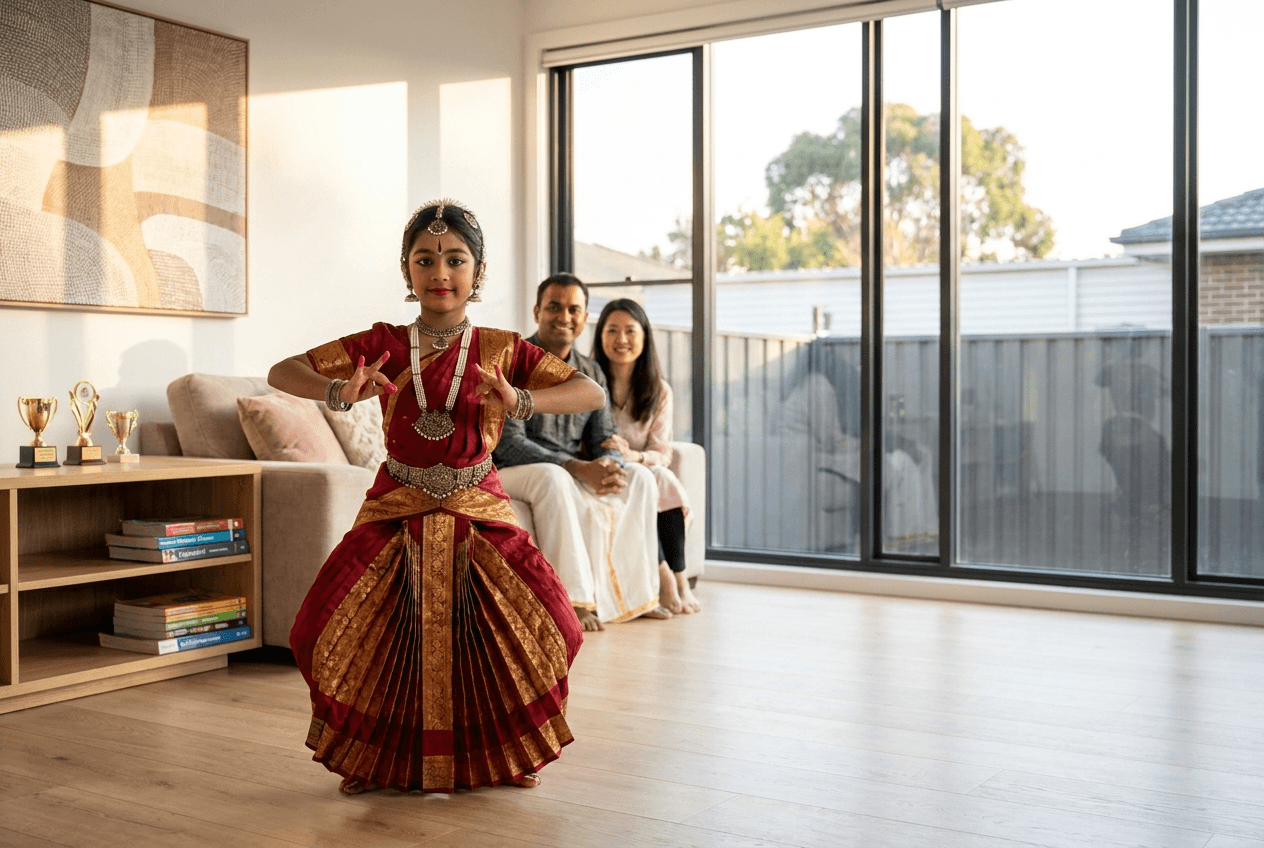
The aramandi, Bharatanatyam's characteristic deep bent-knee stance, develops leg strength and endurance that rivals dedicated athletic training. Maintaining this position through extended adavu sequences builds muscular capability directly applicable to every physical activity an Australian child participates in, from swimming and football to netball and athletics. The landing control developed through jump sequences builds explosive power and proprioceptive awareness that athletes at all levels seek. Children who train seriously in Bharatanatyam consistently develop a physical capability and grace that is visible across all areas of their physical life.
Cognitive Development
The memorisation demands of Bharatanatyam are genuinely extraordinary. Students must simultaneously hold choreographic sequences, musical phrases, rhythmic structures, hand gesture vocabulary and expressive narrative content in working memory. The neurological research is consistent: this multidimensional memorisation task develops working memory capacity, sustained attention and cognitive flexibility in ways that directly and measurably support academic performance in every subject. Several Art Gharana families in Australia have reported that beginning Bharatanatyam training coincided with significant improvements in their children's school performance.
Cultural Identity in Multicultural Australia
Australia's Harmony Day, multicultural school events and community arts programmes create a context where Indian-Australian children's classical arts skills are publicly celebrated rather than privately maintained. A child who can perform Bharatanatyam at the school Harmony Day event or the local temple festival is contributing something genuinely impressive to the cultural life of their community. That contribution earns admiration from Australian peers and teachers of all backgrounds, building the bicultural confidence and pride that sustains Indian-Australian identity throughout childhood and beyond.
The Curriculum: From Adavu to Arangetram
Foundation and Elementary Stages
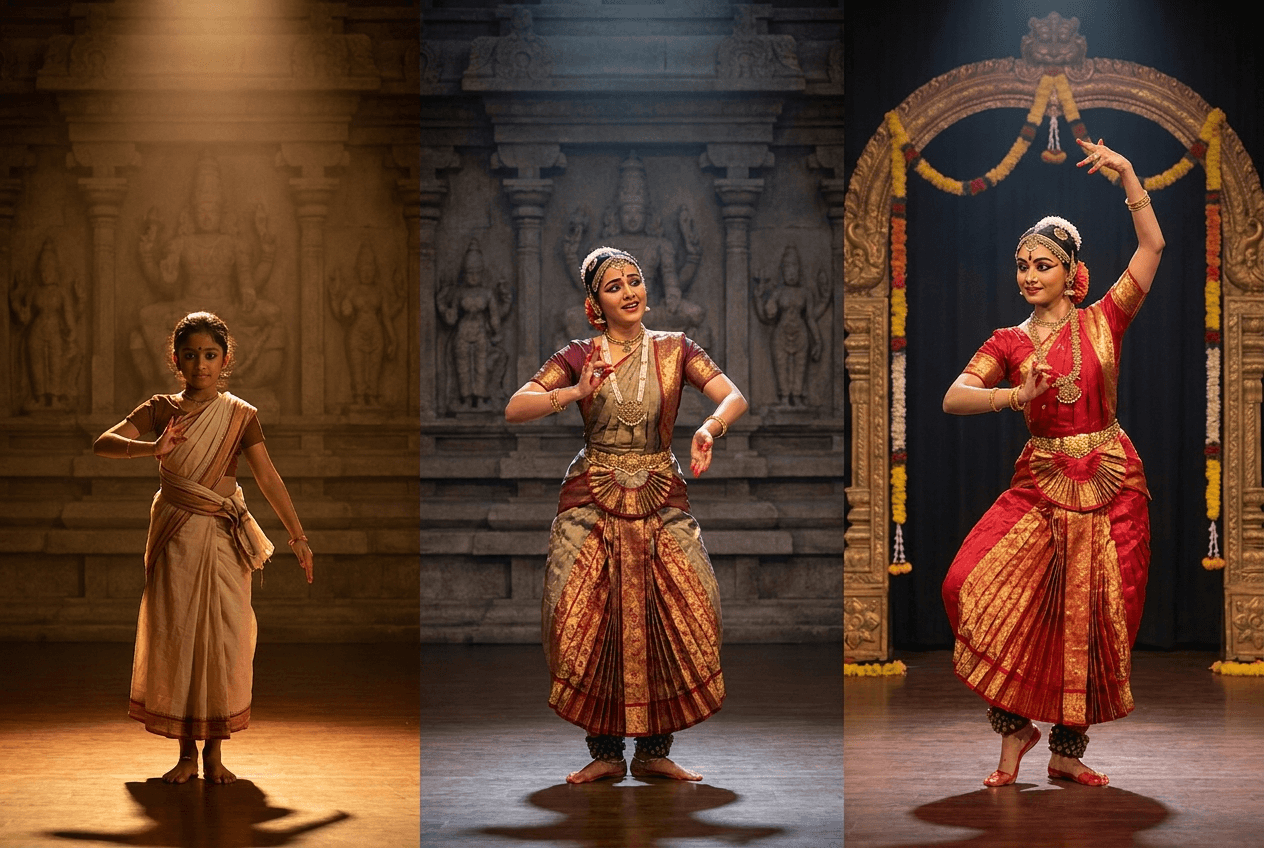
All Bharatanatyam training begins with the fundamental postures, basic adavu vocabulary and introduction to Carnatic rhythm. Students learn the aramandi stance, the primary hand gestures and the basic adavu patterns that form the building blocks of all choreography. The alarippu, the first compositional piece, is introduced once postural fundamentals are established. At the elementary level, students expand their adavu vocabulary and begin systematic abhinaya training.
Intermediate Stage and the Varnam
The varnam is the centrepiece of intermediate training: a complex composition combining pure rhythmic movement with expressive storytelling that demands the full technical and expressive range of the dancer. Working through a varnam is the defining experience of the intermediate stage, and the development it produces is visible in every dimension of the student's artistry.
Arangetram in Australia
The arangetram, the formal debut solo performance marking the culmination of foundational training, is one of the most significant cultural milestones in South Indian Australian family life. Art Gharana teachers guide students through every aspect of arangetram preparation, from repertoire selection and choreography to costume and jewellery, live musician coordination and the practical logistics of organising a performance at an Australian venue. Australia-based arangetrams, increasingly held at South Indian temples in Sydney, Melbourne and Brisbane, are a growing tradition in the community.
How Art Gharana Compares to Sydney Nrityasagara and Other Australian Providers
 Sydney Nrityasagara offers quality Kalakshetra-style instruction in the Hills Shire and has an online provision component. It serves its local Hills Shire community well. Its geographic base means it is not the right option for families in Blacktown, Parramatta, Bankstown, Melbourne, Brisbane or Perth. Art Gharana's nationwide programme serves all of these families with the same quality of live, personalised instruction.
The key differentiators for Art Gharana across the Australian Bharatanatyam landscape are nationwide availability (all states and territories), live one-to-one format (not group or semi-private), open gender enrollment (boys explicitly welcome, unlike several online competitors that are females-only), full Australian time zone scheduling and a completely free first lesson.
Bharatanatyam and Carnatic Vocal in Australia
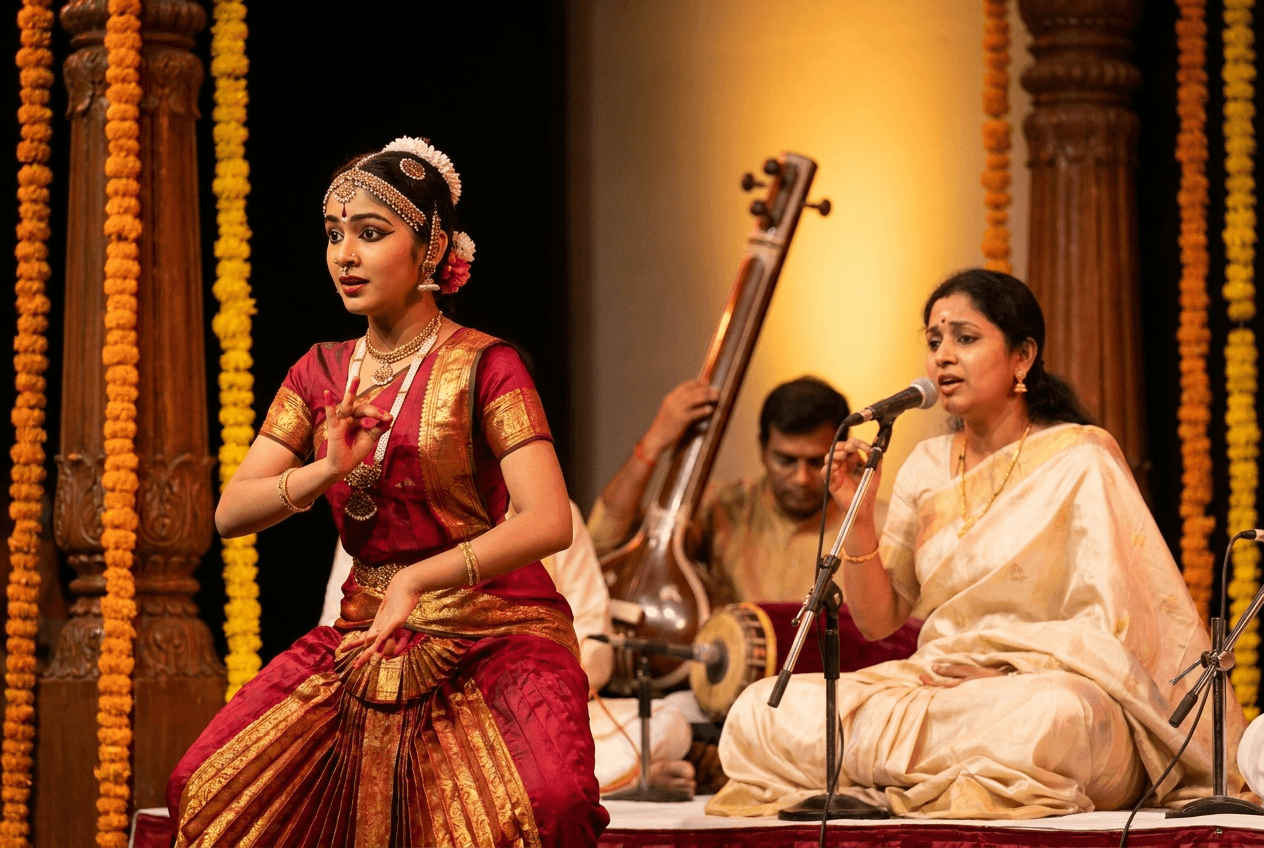 Bharatanatyam and Carnatic music are inseparable traditions, and many of Art Gharana's most accomplished Australian Bharatanatyam students also study Carnatic vocal classes. A dancer who can sing the Carnatic compositions they are performing brings a qualitatively different musical understanding to their abhinaya. The rhythmic structures, the raga character and the devotional meaning of each composition become personally known rather than externally imposed. Many Australian families enrol their children in both disciplines simultaneously, finding that the combination accelerates progress in each and creates a holistic South Indian classical education.
Our tabla classes are a natural complement for Indian percussion alongside dance. Our full range of courses covers all available disciplines. Explore it to find the right combination for your family.
About Art Gharana
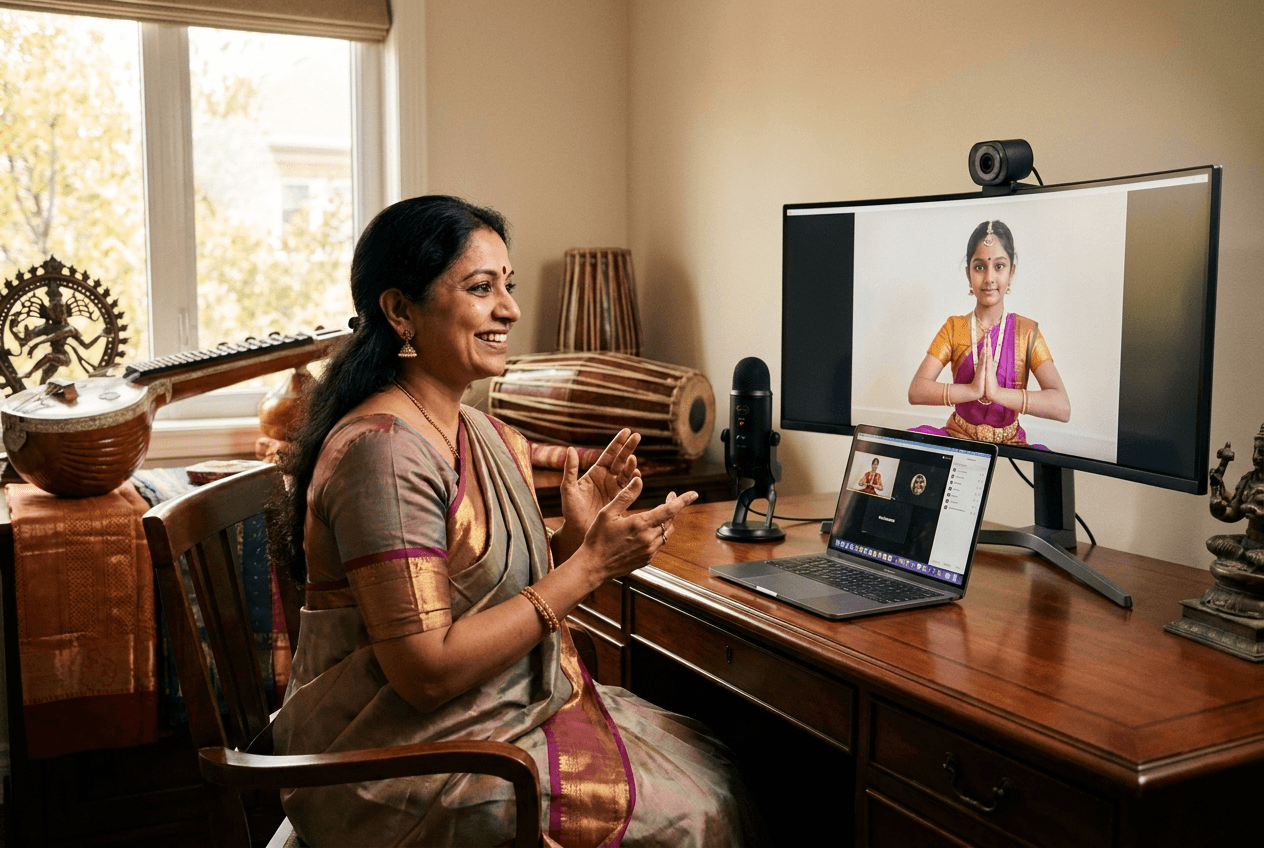 Art Gharana is a specialist online Indian arts education platform serving South Indian families across all Australian states and territories with live one-to-one classes in all Australian time zones. Browse our teacher profiles, review our plans and pricing and head to our book a free trial class page to take the first step.
Frequently Asked Questions
1. Are certified Bharatanatyam teachers available online for Australian families?
Yes. Art Gharana connects Australian families with certified Bharatanatyam teachers for live one-to-one classes in all Australian time zones.
2. Can Art Gharana support arangetram preparation in Australia?
Yes. Our teachers guide students through every aspect of arangetram preparation, including repertoire, choreography, costume, live musician coordination and organising the performance at an Australian temple or community venue.
3. Is Bharatanatyam open to boys in Australia?
Yes. Art Gharana has no gender restrictions. Several prominent online providers are females-only. Art Gharana is not, and our male Bharatanatyam students develop with the same quality of instruction as our female students.
4. Are classes available outside Sydney and Melbourne?
Yes. Art Gharana serves Tamil and South Indian families in Brisbane, Perth, Adelaide, Canberra, Darwin, Hobart and every regional city and town in Australia.
Book Your Child's Free Trial Class Today
Whether your family is in Sydney, Melbourne, Brisbane, Perth, Adelaide or anywhere else in Australia, Art Gharana's certified Bharatanatyam teachers are ready to begin your child's classical journey. Completely free first lesson, live one-to-one instruction, Australian time zone scheduling, full arangetram support. Head to our book a free trial class page and take the first step today.
The Arangetram Tradition in Australian South Indian Communities
The arangetram, the formal debut solo performance that marks the culmination of foundational Bharatanatyam training, is increasingly being held in Australia rather than in India. The South Indian temple communities of Sydney, Melbourne and Brisbane have developed the cultural infrastructure, the live Carnatic musicians, the experienced community audiences and the venues, to support arangetrams at a high standard of cultural authenticity. An Australia-based arangetram in front of the Tamil community of Parramatta or the South Indian community of Dandenong is a milestone that carries the same cultural weight as an India-based performance and has the added dimension of demonstrating cultural excellence within the Australian context.
Art Gharana teachers have supported students through multiple Australia-based arangetrams and can guide Australian families through every aspect of the preparation and organisation process. From repertoire planning and choreography refinement, through costume and jewellery selection and live musician coordination, to the practical details of venue booking and audience invitation, Art Gharana is the partner that makes an Australia-based arangetram achievable for families who want to celebrate their child's classical achievement in the community where they live.
Boys and Bharatanatyam in Australia
One of the most persistent misconceptions about Bharatanatyam in Australia is that it is exclusively for girls. This misconception is reinforced by online providers that explicitly restrict enrollment to female students, and it has prevented many Indian-Australian families from enrolling their sons in what would be an outstanding activity for them. The historical reality is that Bharatanatyam has always had exceptional male practitioners. Many of the most celebrated Bharatanatyam artists of the twentieth and twenty-first centuries have been men, and the physical demands of the form, its powerful footwork, athletic jumping sequences and technical precision, are particularly well suited to boys.
Art Gharana explicitly welcomes all students regardless of gender, and our male Bharatanatyam students in Australia develop with the same quality of instruction and depth of cultural engagement as our female students. For Indian-Australian families who want their sons to have the cultural grounding, physical development and performance confidence that Bharatanatyam provides, Art Gharana is the programme that makes this possible without the gender barriers that exclude them from other providers.
Building a Daily Practice Habit in Australian Family Life
The pace of progress in Bharatanatyam training is determined largely by what happens between weekly classes. Students who practise daily for 20 to 30 minutes advance significantly faster than those who only work during the class session itself. Art Gharana teachers provide specific home practice guidance after every class, covering exactly which adavus to consolidate, how long to practise them and what technical points to focus on. Many Australian families build a short daily practice session into the after-school routine, often in the same cleared area of the house used for online classes.
The physical demands of maintaining the aramandi position make daily practice genuinely important for progress in Bharatanatyam. The leg strength and flexibility required to execute adavus with proper technique develops through repetition over weeks and months. A student who only works on adavus once per week during their class session will develop significantly more slowly than one who practises daily. Art Gharana teachers monitor home practice through the progress they observe at each weekly class and adjust their guidance accordingly. The combination of consistent weekly classes and daily home practice is what produces the visible, cumulative development that makes Bharatanatyam training so rewarding to watch over a year.
Why Online One-to-One Beats Local Group Classes for Bharatanatyam
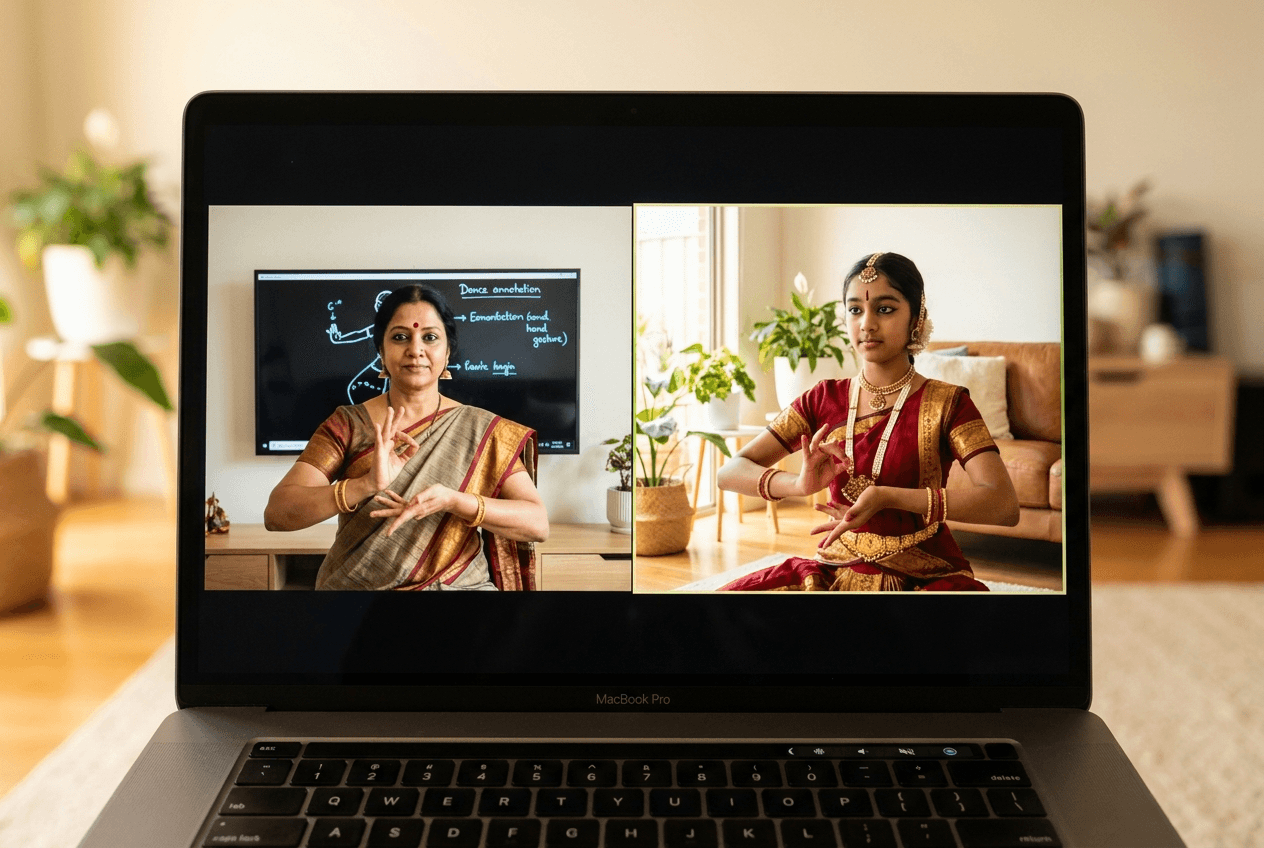
For Australian South Indian families weighing Art Gharana against local teachers and studios, the quality argument is clear. In a group Bharatanatyam class, each student receives minimal individual attention. The teacher must address the collective, correct the average, and move on. Individual students with specific postural problems, idiosyncratic learning styles or particular areas of difficulty do not receive the focused, sustained attention that resolves their specific challenges. In a one-to-one Art Gharana class, the teacher's entire 45 minutes is devoted to this specific child. The teacher sees this child's aramandi alignment, this child's hasta mudra precision, this child's abhinaya expression, and responds to what they see with immediate, personalised correction and guidance. Over a year of weekly classes, the compound effect of that individualisation produces results that group instruction simply cannot match.
Sydney Nrityasagara in the Hills Shire offers quality instruction with some online provision, and it serves the Hills Shire community well. But for families in Parramatta, Blacktown, Bankstown, Liverpool, Campbelltown, or any suburb of Melbourne, Brisbane, Perth or Adelaide, it is not a practical option. Art Gharana's nationwide programme is available to all of these families, delivering the same quality of personalised classical instruction to a family in Darwin as to one in Cherrybrook.
Bharatanatyam and Carnatic Music in Australian Community Life
Bharatanatyam and Carnatic music are not merely classical disciplines studied in isolation. They are living, active components of South Indian Australian community life. Tamil temple festivals in Parramatta and Blacktown, South Indian cultural events in Dandenong and Wyndham Vale, Tamil cultural association events in Brisbane and Perth, and the growing community of South Indian Australian performing arts practitioners in every major city all create a context in which trained Bharatanatyam dancers and Carnatic vocalists are genuinely valued and actively sought.
Students who reach an intermediate level of Bharatanatyam training find that their skills open doors into this community world that are simply unavailable to those who have not trained. Invitations to perform at temple events, opportunities to participate in cultural competitions, the recognition of community elders who value classical excellence, and the deepening friendships with other South Indian Australian families who share a commitment to classical arts: these social and community dimensions of Bharatanatyam training are some of its most enduring and meaningful rewards.
What Parents of Art Gharana Bharatanatyam Students Say
The consistency of feedback from Art Gharana Bharatanatyam families in Australia is striking. Parents describe watching their children develop not just as dancers but as culturally grounded, self-assured young Australians who carry the Bharatanatyam tradition with them as a source of pride and identity. The child who was initially reluctant, who found the aramandi uncomfortable and the adavus repetitive, who by the six-month mark was asking to practise between classes and showing the family newly learned mudras at the dinner table: this story repeats itself across the Art Gharana Australian community because the quality of teaching, the gradual building of competence and the joy of genuine classical skill produce it reliably.
Parents also describe the impact on grandparent relationships. Grandparents visiting from Tamil Nadu, Andhra Pradesh, Karnataka or Kerala who watch their grandchild perform even a simple alarippu respond with an emotional recognition that parents describe as deeply moving. The child who has been trained at Art Gharana is not performing something that grandparents appreciate politely. They are performing something that grandparents recognise with profound cultural familiarity, and that recognition creates a bond across generations and geographies that is one of the most irreplaceable outcomes of classical arts education in the diaspora context.
Bharatanatyam in Regional Australia
For Tamil and South Indian families in regional Australia, the online format of Art Gharana's programme is not merely convenient. It is the only viable pathway to quality classical Bharatanatyam instruction. A South Indian family in Townsville, Toowoomba, Ballarat, Geelong, Launceston or any regional city or town cannot access qualified Bharatanatyam teachers locally. For these families, Art Gharana represents a lifeline: a programme that brings genuine classical instruction from certified Bharatanatyam teachers directly into their home, in their time zone, on a schedule that fits their family life.
Art Gharana's experience serving regional Australian families has informed every aspect of the platform's design. The stable, low-latency video connection that makes it possible to see fine details of footwork and hand position even on a standard home internet connection. The scheduling flexibility that accommodates the time constraints of families who often do not have the extra travel time that city families take for granted. The teacher matching process that pairs regional students with teachers who are experienced in the specific challenges and opportunities of teaching diaspora students at a distance. All of these design choices reflect Art Gharana's genuine commitment to serving every Indian-Australian family, not just those in major metropolitan centres.
The free trial class is available immediately to families in every corner of Australia. Whether your family is in a capital city or a regional town, whether you are ten minutes from a South Indian temple or three hours from the nearest Indian cultural event, Art Gharana's Bharatanatyam programme is accessible to you right now. Book the trial class today and begin your child's classical journey wherever you are.
For Tamil and South Indian Australian families from Sydney to Perth, from Brisbane to Darwin, Art Gharana's Bharatanatyam programme provides the quality, authenticity, accessibility and cultural depth that the tradition deserves and that Australian Indian children deserve. The free trial class is available now. The teachers are ready. The art form, one of humanity's great classical traditions, is waiting to be transmitted to the next generation of Indian-Australian children. That transmission begins with a single free trial class. Book one today at artgharana.com.
The South Indian classical tradition is one of humanity's most enduring cultural achievements. For Tamil and South Indian Australian families, it is a living inheritance that connects each generation to the one before it across whatever geographic distance migration has introduced. Bharatanatyam is the most visible, most powerful and most publicly celebrated vehicle for transmitting that inheritance. Art Gharana is the platform that makes transmission possible for every South Indian Australian family, regardless of where in this vast and beautiful country they happen to live. The families of Dandenong and the families of Darwin, the families of Parramatta and the families of Perth, the families of the Hills Shire and the families of Hobart: all of them have access to the same certified Bharatanatyam instruction through Art Gharana. All of them have the same opportunity to give their children the art form that carries their heritage. Take that opportunity today.