ChatGPT
 Google AI
 Grok
Grok Claude
The Phrygian mode on piano is known for its dark, exotic sound that instantly creates tension and drama in music. Unlike the bright Ionian mode, the Phrygian mode music theory emphasizes a lowered second scale degree, giving melodies and chords a mysterious and intense character that defines modal music across classical, rock, and contemporary styles.
Understanding the Phrygian mode piano scale allows musicians to navigate diatonic scales with more depth. Pianists learn how scale degrees, tonic note, and leading tone interact to form a stable yet dramatic harmonic structure, making it easier to analyze compositions, improvise, and apply piano music theory scales in real music.
Introduction to the Phrygian Mode
 The Phrygian mode in music is the third mode of the diatonic scale, characterized by a half-step between the tonic note and the minor second, giving it a tense and exotic sound. It is widely used in modal music to create atmosphere and drama while exploring unique melodic structure and chord patterns.
Exploring what is the Phrygian mode helps pianists connect theory with emotion because its Phrygian scale notes naturally produce a sense of suspense. Learning the Phrygian mode piano pattern early builds a strong foundation for understanding musical modes beyond the major and minor scales.
Why the Phrygian Mode Sounds Dark and Exotic
The Phrygian mode intervals produce a dramatic effect due to the lowered major second above the root note combined with a minor third and perfect fifth, creating tension that is unresolved until returning to the tonic note, making it ideal for intense melodies in western music theory.
How the Phrygian Mode Shapes Modern Piano Learning
Piano students often learn the Phrygian mode piano scale after mastering Ionian and Aeolian modes because it teaches them how scale degrees and diatonic scale variations influence mood. Practicing this mode strengthens both technical skill and aural recognition of tension in tonal music.
Why Every Pianist Should Explore This Mode
Every pianist benefits from understanding Phrygian mode piano explained because it provides insight into exotic minor scale harmonies, chord progressions, and Phrygian mode melodies. Learning this mode enhances improvisation, composition, and the ability to interpret modal music creatively.
What the Phrygian Mode Means in Music Theory
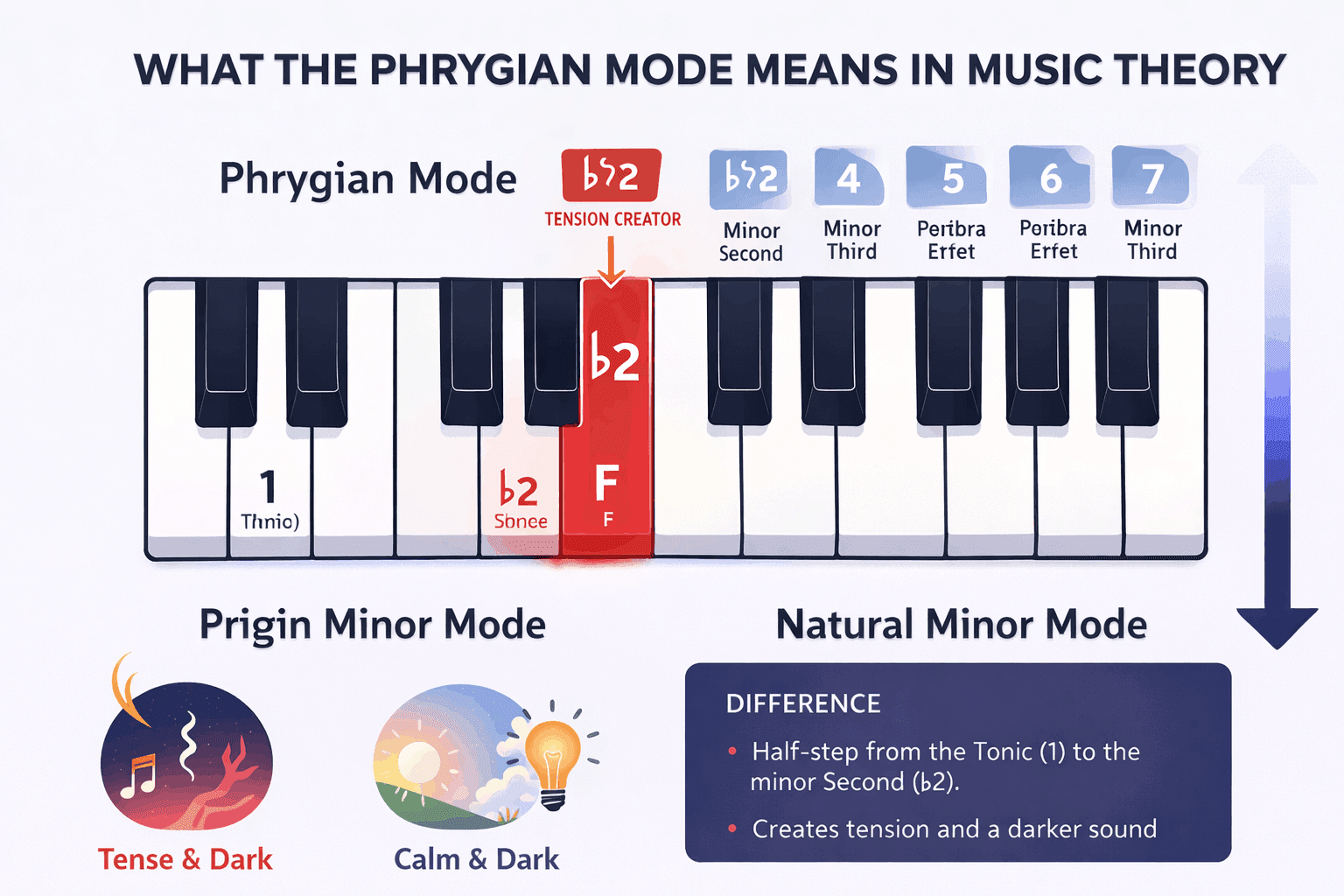 The Phrygian mode in music is defined by its half-step interval between the root note and the second scale degree, making it the most tension-filled of all musical modes. This unique pattern is widely used to create dark, dramatic, or Spanish-flavored tonal textures in piano and other instruments.
Understanding what is Phrygian mode in music helps musicians see how altering just one scale degree changes the harmonic structure of the minor scale, producing a distinct melodic structure used in jazz, rock, and classical compositions.
Definition of the Phrygian Mode
The Phrygian mode is a seven-note diatonic scale derived from the third degree of the major scale, forming a minor mode with a lowered second scale degree, producing tension between the tonic note and the leading tone that gives it a signature dark sound.
Relationship Between Phrygian Mode and the Minor Scale
The Phrygian mode scale is closely related to the natural minor scale (Aeolian mode) but with a lowered major second, which creates a more exotic and unresolved tone. This minor variation explains why the Phrygian mode piano scale is considered dramatic and expressive in tonal music.
Historical Origins of the Phrygian Mode
The Phrygian mode in music originates from ancient Greek greek modes, where it was associated with emotional intensity and exotic melodic gestures. Medieval and Renaissance theorists preserved this mode in modal music, and it later influenced Baroque, classical, and modern compositions.
Why Musicians Call It the “Exotic Minor Mode”
Musicians often describe the Phrygian mode formula as the “exotic minor mode” because the lowered second scale degree above the tonic note immediately signals tension and drama. Its Phrygian mode intervals allow composers to evoke dark, Spanish, or mystical moods that contrast with bright Ionian mode piano compositions.
Phrygian Mode Step Pattern Table
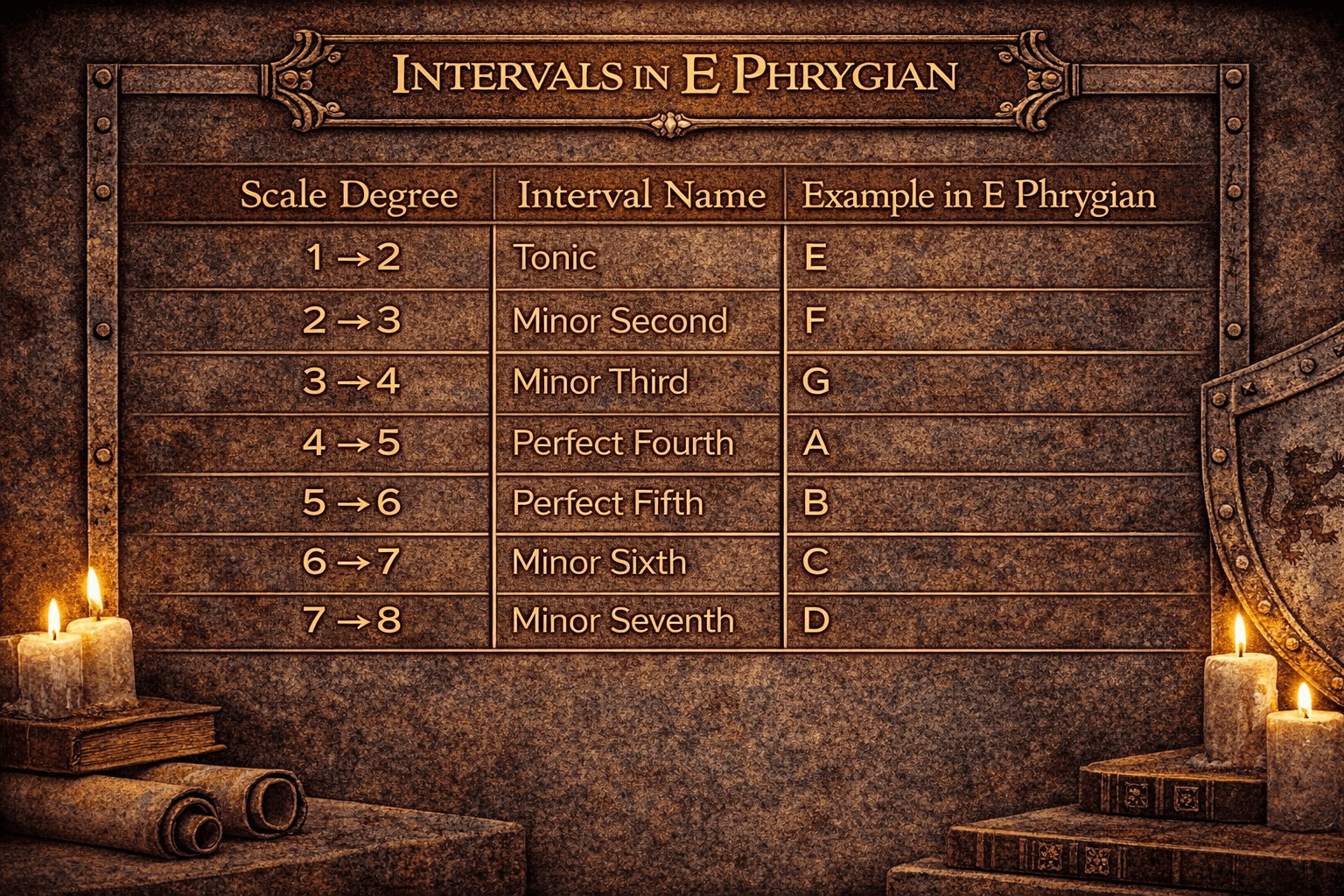
This table demonstrates the Phrygian mode intervals and shows how the Phrygian scale notes produce its characteristic exotic sound on the piano.
Structure and Formula of the Phrygian Scale
 The Phrygian mode piano scale follows a unique pattern of half and whole steps that defines its tense and exotic sound. Unlike the Ionian mode, the half-step between the tonic note and the minor second immediately sets a dramatic mood, making it a favorite in modal music, rock, and flamenco-style piano compositions.
Understanding the Phrygian mode formula allows pianists to build the scale in any key, identify scale degrees, and recognize how the diatonic scale produces dark tonal colors. Practicing the Phrygian scale for beginners strengthens both technical skills and knowledge of western music theory, making improvisation and composition easier.
Whole Step and Half Step Pattern
The Phrygian mode step pattern is Half–Whole–Whole–Whole–Half–Whole–Whole, which produces tension between the tonic note and the lowered major second. This pattern gives the Phrygian mode piano scale its signature mysterious and slightly unstable character, contrasting the brightness of the Ionian mode.
Phrygian Mode Scale Formula Explained
The Phrygian mode formula defines the order of Phrygian scale notes using scale degrees: 1 (tonic), ♭2 (minor second), ♭3 (minor third), 4 (perfect fourth), 5 (perfect fifth), ♭6 (minor sixth), ♭7 (minor seventh). These intervals create the exotic tonal atmosphere that makes the Phrygian mode piano ideal for dramatic compositions.
Semitone Pattern in the Phrygian Mode
The half-step between the 1st and 2nd scale degrees and another between the 5th and 6th notes produces tension within the Phrygian mode intervals. Pianists practicing this pattern learn how minor scale variations can evoke emotional intensity while maintaining a clear tonic note as the central reference.
Understanding the Dark and Tense Sound of Phrygian
The Phrygian mode piano scale sounds darker than other musical modes because of its lowered second, third, sixth, and seventh scale degrees. This arrangement emphasizes suspense and drama, making it essential for studying Phrygian mode chords, melodies, and modal improvisation techniques.
Phrygian Mode Step Pattern Table
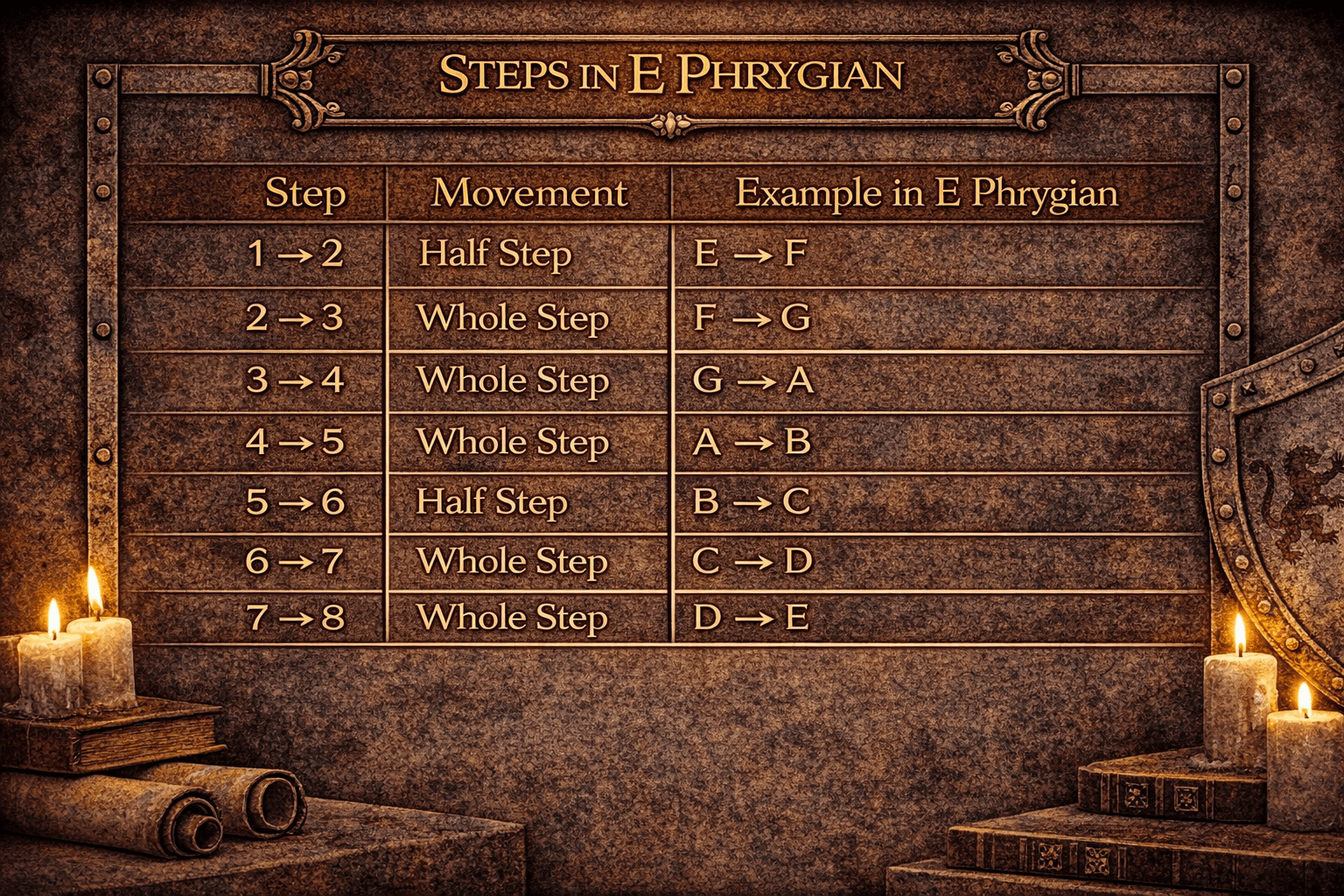
This table illustrates the Phrygian mode formula, helping pianists visualize Phrygian scale notes and practice the scale efficiently.
Intervals Found in the Phrygian Mode
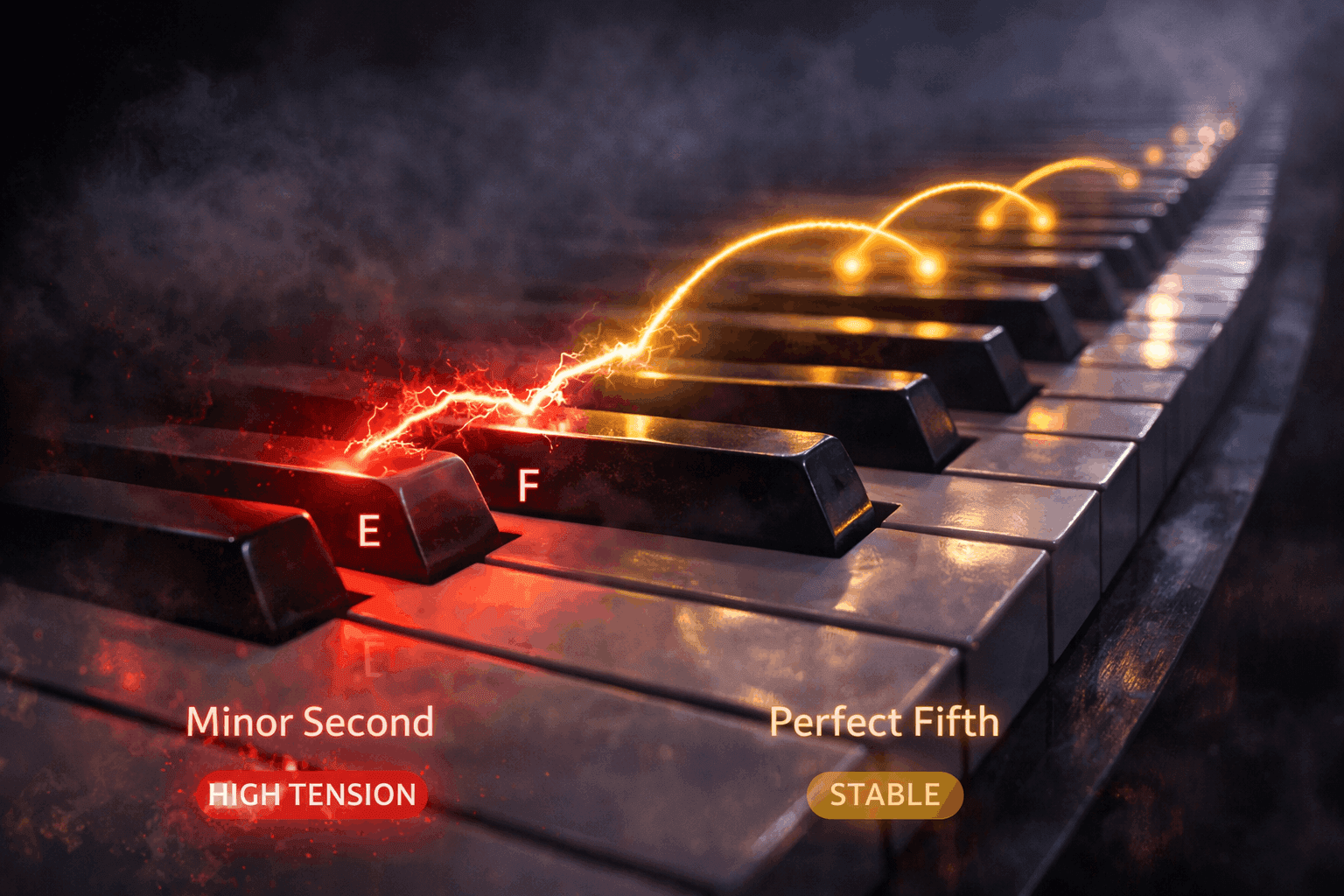 The Phrygian mode intervals give it a dark, exotic flavor because each scale degree contributes tension that resolves naturally to the tonic note. Pianists studying these intervals gain insight into modal music composition, as well as how Phrygian mode harmony differs from the major Ionian mode.
Practicing Phrygian mode piano helps students recognize interval relationships like the minor second, minor third, perfect fourth, and perfect fifth, all of which define the characteristic sound of the Phrygian scale for beginners.
Understanding Musical Intervals in Piano Theory
An interval represents the distance between two notes in the Phrygian mode piano scale, defining its tension and resolution. Phrygian mode intervals include minor second, minor third, perfect fourth, perfect fifth, minor sixth, and minor seventh, which produce the dark tonal atmosphere of Phrygian mode music theory.
Interval Pattern of the Phrygian Mode
The Phrygian mode interval pattern starts with a half-step from the tonic note to the minor second, creating immediate tension. This is followed by mostly whole steps with other minor intervals shaping its exotic melodic character and setting it apart from other musical modes.
How Intervals Create the Characteristic Phrygian Sound
The lowered major second and minor third generate a sense of unrest, while the perfect fifth anchors the harmony. These Phrygian mode intervals allow melodies to feel mysterious, unresolved, or Spanish-flavored, giving the Phrygian mode piano scale its dramatic reputation.
Visualizing Phrygian Intervals on the Piano Keyboard
Pianists often visualize the Phrygian scale notes on the keyboard using the E Phrygian scale: E, F, G, A, B, C, D, E. This pattern clearly shows the minor second and other key intervals, making it easier to practice Phrygian scale exercises and understand Phrygian mode piano explained.
Phrygian Mode Scales in Different Keys
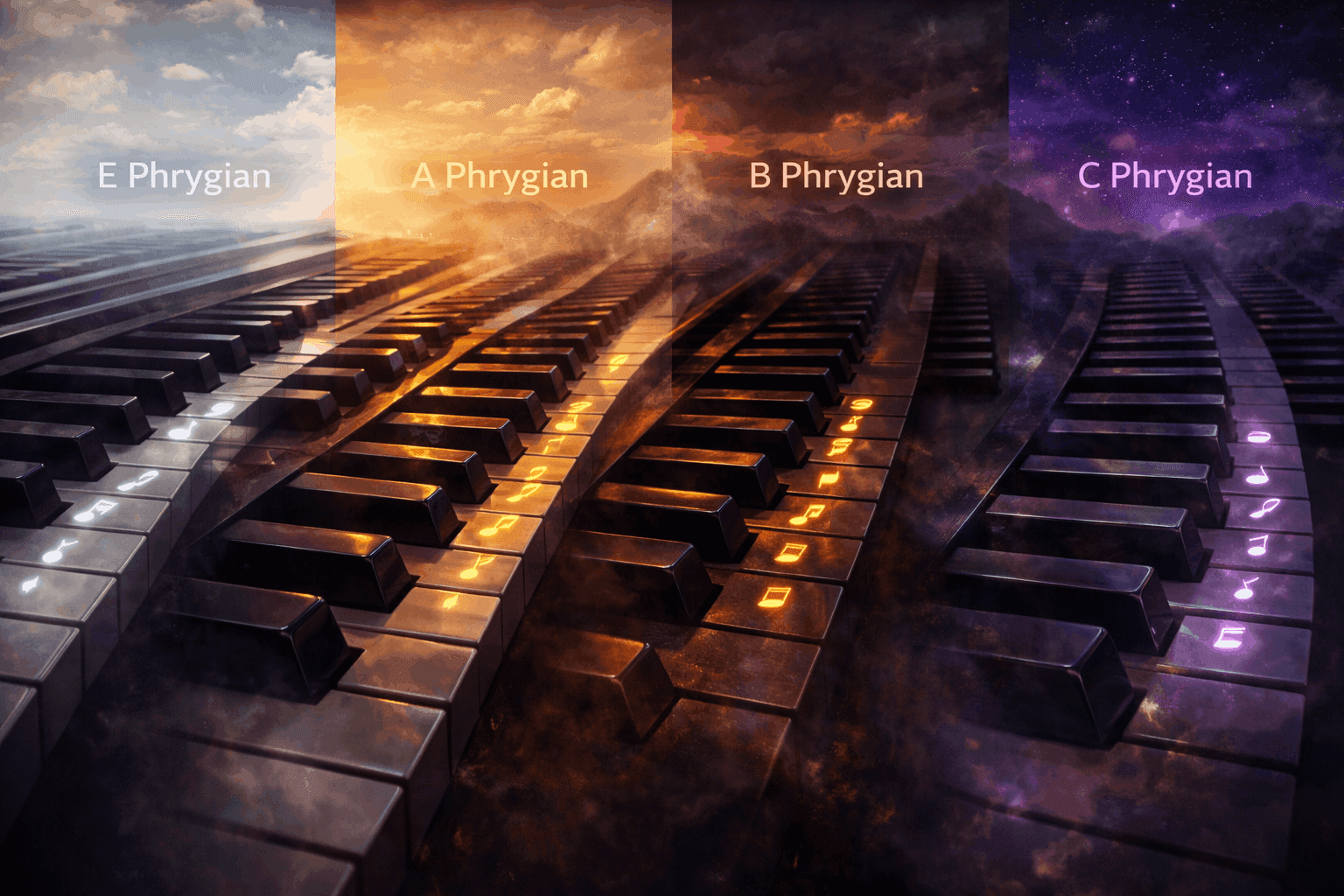 The Phrygian mode piano scale can be applied to any key, allowing musicians to explore tonal music and modal music in multiple contexts. Practicing these variations strengthens technique, ear training, and understanding of scale degrees across diatonic scales.
Playing the Phrygian mode piano scale in different keys shows how key signatures affect Phrygian mode intervals while maintaining the half-step between tonic and minor second, which is the defining characteristic of this exotic minor mode.
E Phrygian Mode (The Simplest Example)
E Phrygian uses all white keys: E, F, G, A, B, C, D. This is the simplest example for beginners to see how Phrygian mode piano works and to practice Phrygian mode step pattern without worrying about sharps or flats.
A Phrygian Mode
A Phrygian introduces G# as a note in harmonic variations, showing how the Phrygian scale notes adapt to different tonal contexts while keeping the characteristic half-step between tonic note and minor second intact.
B Phrygian Mode
B Phrygian has five black keys (F#, C#, G#, D#, A#) in its scale. This helps students practice Phrygian scale exercises in more advanced keys, understanding how Phrygian mode intervals translate across the chromatic scale.
C Phrygian Mode
C Phrygian uses C, D♭, E♭, F, G, A♭, B♭. This key demonstrates how the Phrygian mode piano scale works in minor tonal centers, teaching students to identify scale degrees and Phrygian mode chord progressions in real music.
Understanding Key Signatures in Phrygian Scales
Key signatures help musicians quickly identify which notes are sharp or flat in any Phrygian mode piano scale, ensuring the tonic note, leading tone, and Phrygian mode intervals remain accurate across all keys.
This table shows how the Phrygian mode formula translates across different keys for practice and improvisation.
Chords Built from the Phrygian Mode
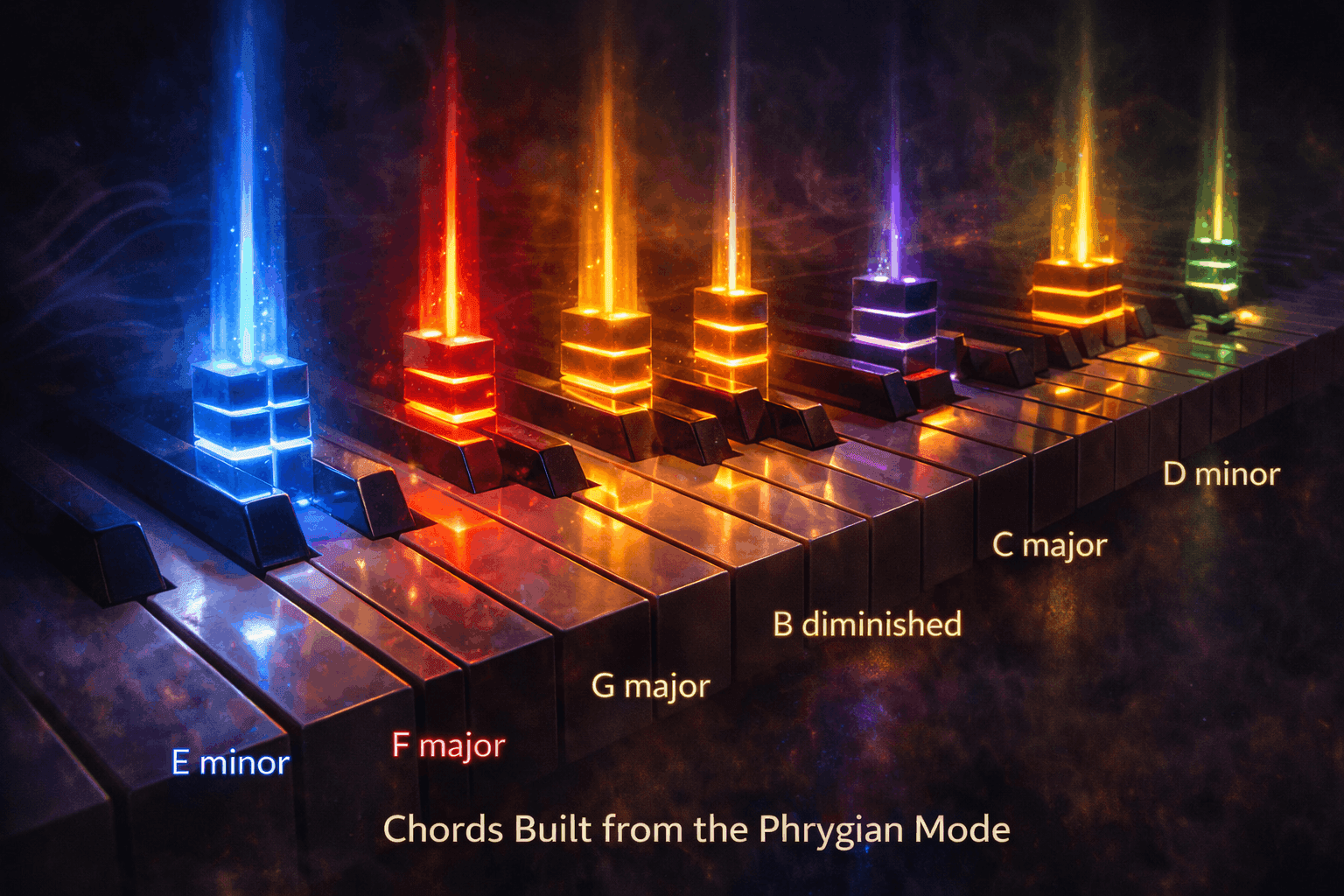 The Phrygian mode chords form the harmonic backbone of the Phrygian mode piano scale, giving compositions a dark, mysterious quality. Unlike the bright Ionian mode, the Phrygian mode produces minor triads with exotic tension due to the lowered major second above the root note, allowing musicians to create dramatic harmonic structure and modal progressions.
Understanding Phrygian mode harmony helps pianists explore both melodic structure and chordal relationships. Using Phrygian mode intervals to build triads and seven diatonic chords provides insight into how minor, diminished, and altered chords interact, making it easier to analyze songs and compose in the Phrygian mode piano system.
Triads in the Phrygian Mode
Triads in the Phrygian mode piano scale are formed by stacking every other scale degree, producing a series of minor and diminished chords. This pattern emphasizes tension and darkness, making the Phrygian mode chords perfect for dramatic or Spanish-style music.
The Seven Diatonic Chords Explained
The Phrygian mode scale produces seven diatonic chords, each built from a scale degree. These include minor, diminished, and major chords arranged to reflect the tension of the Phrygian mode intervals while providing harmonic movement that complements the tonic note.
Common Chord Progressions in Phrygian
Common Phrygian mode chord progressions emphasize the tension between the tonic note and minor second, creating unresolved movement that returns to the tonic. Progressions like I–II–I or I–IV–V highlight the exotic sound, making it useful in classical, flamenco, and metal styles.
How These Chords Support Melody and Harmony
The Phrygian mode chords provide a foundation for Phrygian mode melodies, allowing pianists to harmonize lines while maintaining suspense and tension. Chords built on scale degrees guide the ear through dark tonal landscapes, offering depth to modal music compositions.
Step-by-Step Guide to Playing the Phrygian Mode on Piano
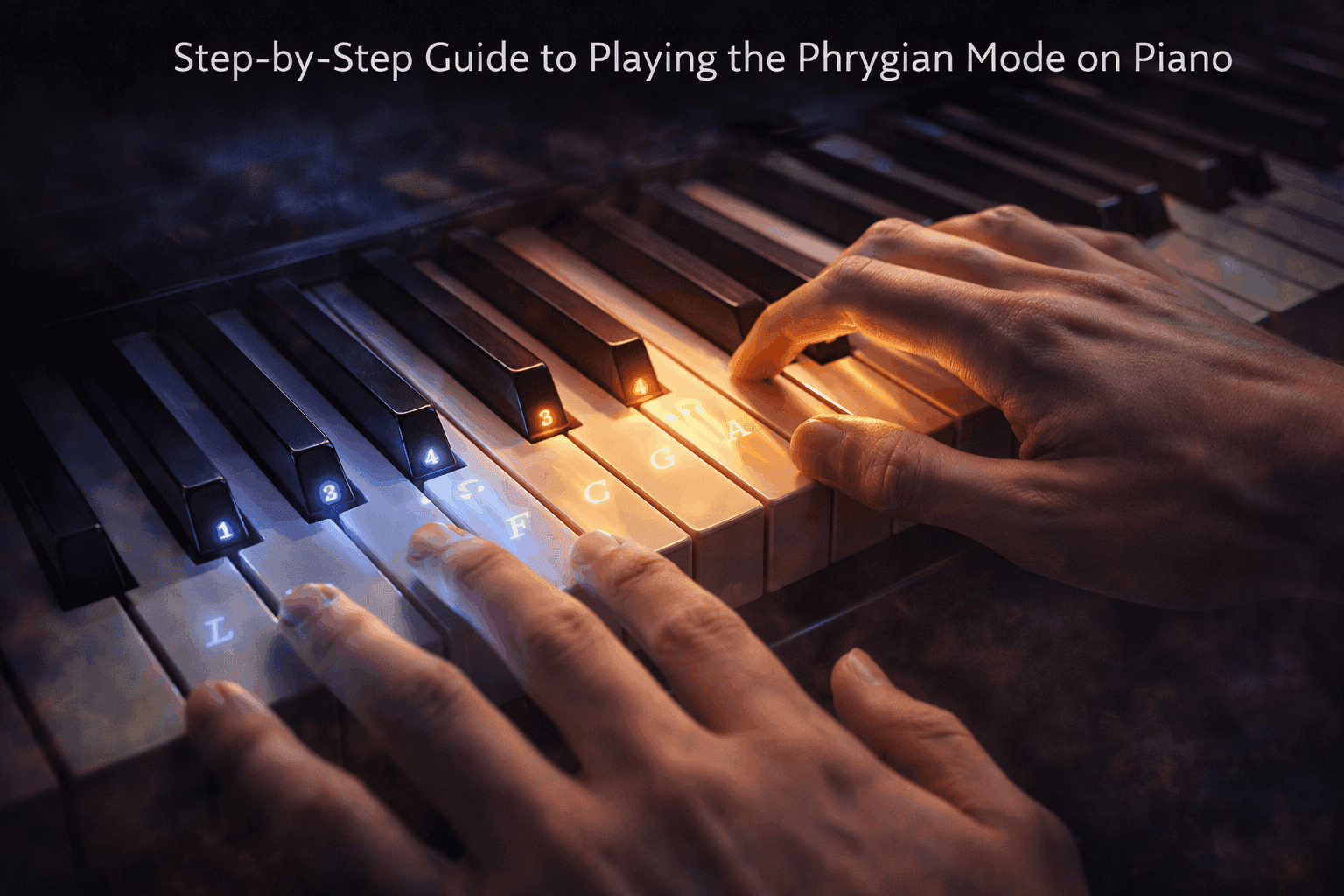 Learning how to play Phrygian mode on piano starts with understanding the scale pattern and finger positioning. Practicing the Phrygian scale for beginners develops muscle memory while reinforcing knowledge of Phrygian mode intervals, scale degrees, and the lowered second scale degree that defines its unique sound.
Using the Phrygian mode piano scale in multiple keys improves coordination and improvisation. Students can practice Phrygian scale exercises with one hand first, then combine hands, building comfort with both melodic structure and harmonic structure in real music.
Begin with the E Phrygian Scale
E Phrygian is ideal for beginners because it uses all white keys: E, F, G, A, B, C, D. Starting with this key helps students understand Phrygian mode piano explained, focusing on the lowered major second while learning proper fingering for smooth play.
Correct Finger Position and Hand Technique
Proper Phrygian mode fingering piano technique requires relaxed, curved fingers with smooth thumb transitions. Correct hand position ensures even tone and control when practicing Phrygian scale exercises or performing Phrygian mode melodies across the keyboard.
Practicing the Scale with the Right Hand
The right hand usually begins practicing the Phrygian mode piano scale to internalize the Phrygian mode step pattern. Repeating exercises with attention to minor second, perfect fifth, and minor seventh intervals builds accuracy and prepares for improvisation.
Adding the Left Hand
Introducing the left hand strengthens hand coordination and reinforces awareness of Phrygian mode intervals. Playing both hands together allows students to connect melodic structure with harmonic structure, essential for Phrygian mode chord progressions.
Playing Hands Together Smoothly
Combining both hands ensures students can maintain even tone and precise rhythm while practicing Phrygian mode piano scale, preparing them for real songs and improvisation. Mastery of scale degrees in both hands strengthens overall musicality.
Practicing the Mode in Multiple Keys
After mastering E Phrygian, pianists explore A, B, and C Phrygian. This helps them understand Phrygian mode piano explained across different tonal music contexts while strengthening familiarity with chromatic scale relationships.
Example Phrygian Mode Fingering (E Phrygian)
Hand Finger Pattern Right Hand 1 2 3 1 2 3 4 5 Left Hand 5 4 3 2 1 3 2 1
This fingering pattern is ideal for practicing Phrygian scale exercises and building smooth Phrygian mode melodies.
How Musicians Use the Phrygian Mode in Real Music
 The Phrygian mode in music is popular in classical, flamenco, rock, and metal because its lowered major second immediately creates tension. Composers use Phrygian mode piano scale to produce dark atmospheres while exploring exotic harmonic structure and modal music ideas.
Learning Phrygian mode examples helps students see how composers combine Phrygian mode intervals and scale degrees to build chord progressions, melodies, and improvisations that maintain a dramatic and unresolved feeling around the tonic note.
Phrygian Mode in Classical Music
Classical composers used the Phrygian mode piano scale to evoke tension and exoticism. Its half-step between the tonic note and minor second creates suspense, making it perfect for preludes, fugues, and piano études that explore modal variation.
Phrygian Mode in Rock and Metal Songs
Rock and metal musicians frequently use Phrygian mode chord progressions because its dark sound and lowered second scale degree fit aggressive, dramatic riffs. Bands often rely on E Phrygian and A Phrygian for signature tension in melodies and harmony.
Why the Phrygian Mode Feels Dark and Dramatic
The lowered second, third, sixth, and seventh scale degrees give the Phrygian mode piano a tense and exotic feeling. This contrasts bright Ionian mode piano sounds and is ideal for building suspense or dramatic emotional effects in tonal music.
Using Phrygian for Melody Writing and Improvisation
Musicians use the Phrygian scale notes to write melodies that emphasize tension. By combining Phrygian mode intervals with chords, pianists can create expressive, unresolved, and exotic Phrygian mode melodies suitable for improvisation or original composition.
Famous Songs Using the Phrygian Mode
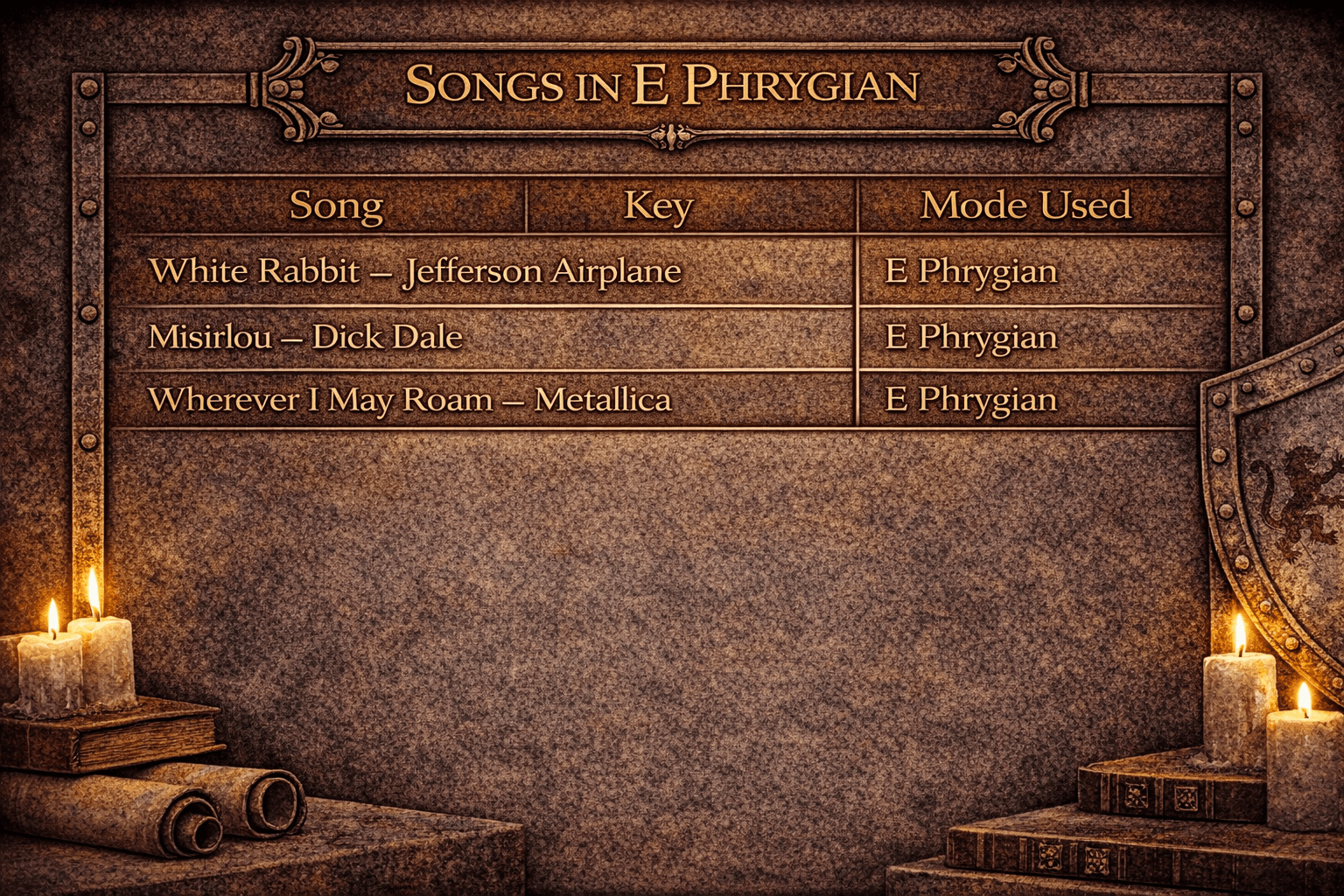
These examples demonstrate how the Phrygian mode piano scale creates exotic and dramatic tones in popular music.
Popular Songs That Use the Phrygian Mode
 The Phrygian mode in music appears in both classical and modern compositions because its lowered major second creates tension and an exotic, dramatic sound. Pianists analyzing Phrygian mode examples learn how melodies and chords interact around the tonic note, producing suspenseful music ideal for flamenco, rock, metal, and modal improvisation.
Studying songs in Phrygian mode helps learners practice Phrygian scale exercises, recognize Phrygian mode intervals, and understand harmonic structure in real music, making it easier to apply this knowledge to Phrygian mode piano scale improvisation and composition.
White Rabbit – Musical Analysis
Jefferson Airplane’s iconic song demonstrates the tension created by the half-step between the tonic note and minor second in E Phrygian. The use of Phrygian mode chords and exotic intervals gives the melody a psychedelic and mysterious feel, showcasing how Phrygian mode piano can shape modern music.
Misirlou – Harmonic Structure
Dick Dale’s “Misirlou” uses rapid E Phrygian riffs to highlight the exotic quality of Phrygian scale notes. The song illustrates how Phrygian mode intervals produce tension and drama while maintaining a clear tonic note, making it perfect for study in modal music and piano music theory scales.
Where the Phrygian Mode Creates Tension
The Phrygian mode naturally creates suspense due to the lowered second scale degree above the root note. This interval forces melodies and harmonies to resolve to the tonic note, giving songs a dark, unresolved feel that contrasts the brightness of Ionian mode piano compositions.
How to Practice These Songs on Piano
Practicing Phrygian mode piano scale songs allows students to internalize Phrygian mode chord progressions and Phrygian mode melodies. Start with hands separately, focusing on Phrygian scale notes and Phrygian mode intervals, then play hands together to connect melodic structure with harmonic structure in real musical contexts.
Learning the Phrygian Mode with Art Gharana
Learning the Phrygian mode piano scale becomes easier with structured guidance. Art Gharana teaches Phrygian mode music theory using simple, practical examples, helping beginners understand Phrygian mode intervals, scale degrees, and chord relationships while improving hand technique and piano music theory scales knowledge.
Students at Art Gharana practice Phrygian scale exercises and minor scale practice piano in real songs, connecting theory with performance. This approach reinforces understanding of Phrygian mode chords, improvisation, and the use of Phrygian mode melodies in real-world music.
Final Thoughts on Mastering the Phrygian Mode
 Mastering the Phrygian mode piano gives musicians the tools to create tension, drama, and exotic melodies in both classical and modern music. Understanding Phrygian mode intervals, scale degrees, and chord progressions ensures students can analyze songs, improvise, and compose confidently in modal music.
Once pianists understand what is the Phrygian mode, they can move beyond basic scales to explore modal music, complex harmonies, and Phrygian mode melodies, making this exotic minor mode an essential skill in advanced piano music theory scales.