ChatGPT
 Google AI
 Grok
Grok Claude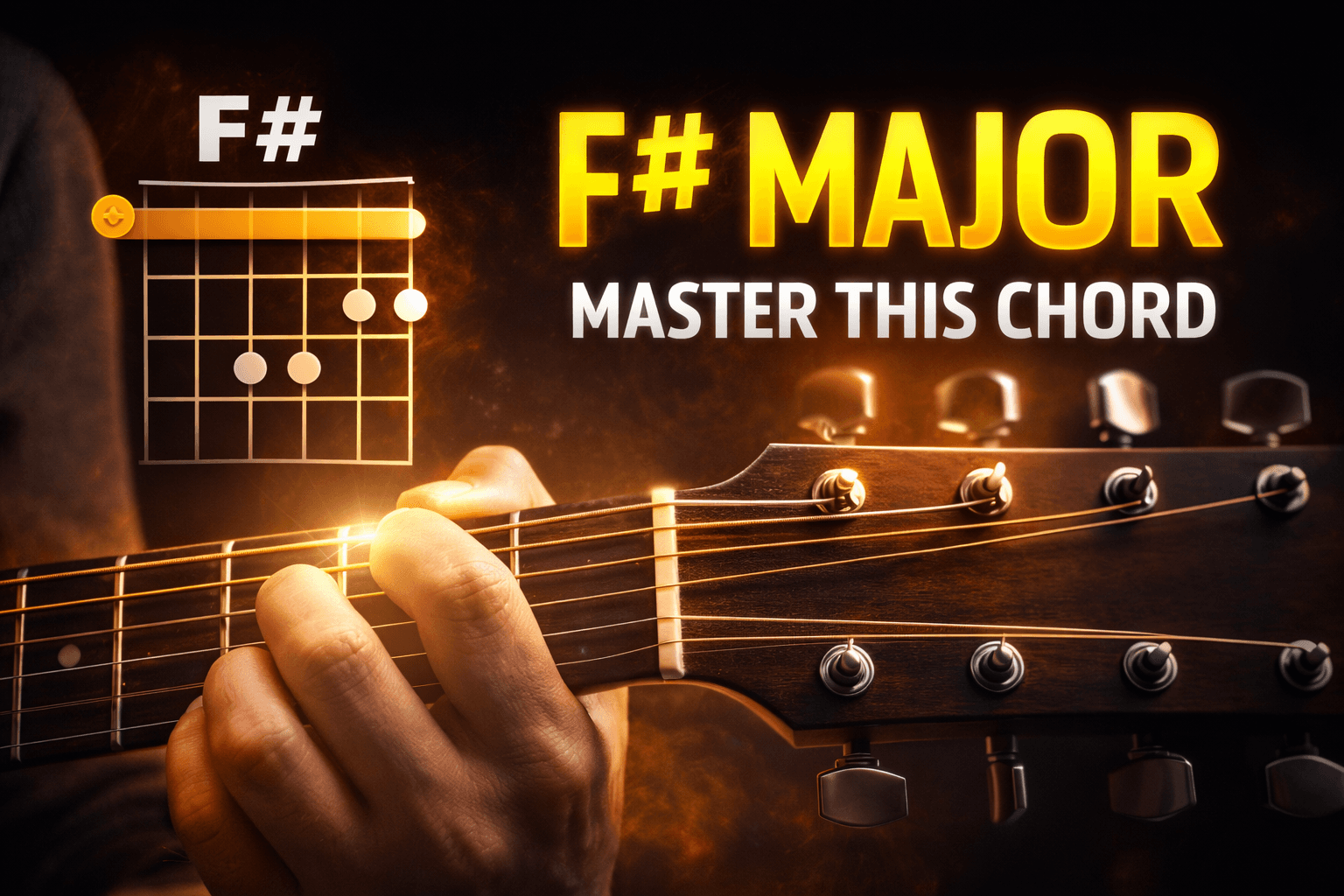
The F# Major chord is a bright, energetic, and powerful major chord widely used in pop, rock, R&B, worship, acoustic, and modern guitar-based music. Although the typical beginner-friendly open-position version does not exist, guitarists often learn F# Major early because it forms essential progressions in keys such as F# Major, B Major, E Major, and D# Minor. The most common version of the chord uses the barre shape on the second fret, making it an excellent chord for developing strength and technique.
Understanding the structure, intervals, finger placements, chord variations, theory background, and practical applications of F# Major helps guitarists master its sound in rhythm playing, lead shaping, and composition. This guide provides a complete, in-depth explanation of everything you need to know about the F# Major chord.
What Is the F# Major Chord?
 The F# Major chord is built from the F# major scale and contains three essential notes that define its tonality. These notes create a bright, uplifting, and stable sound typical of major chords. F# Major functions as the I chord in the key of F# Major and appears frequently in progressions in keys with sharps.
Notes of the F# Major Chord
The F# Major chord contains the following notes:
- F# (Root)
- A# (Major Third)
- C# (Perfect Fifth)
These three tones form the core of the chord, regardless of the voicing, position, or inversion.
F# Major Chord Formula and Intervals
 Every major chord is built on a simple formula. Understanding this helps you construct, analyze, and modify chords more effectively.
Formula
Major chord formula: Root – Major Third – Perfect Fifth
Intervals in F# Major
- F# to A#: Major Third
- A# to C#: Minor Third
- F# to C#: Perfect Fifth
The major third interval gives the chord its uplifting character, while the perfect fifth strengthens its consonance and stability.
F# Major Chord on Guitar: Basic and Barre Shapes
Since the guitar naturally favors certain shapes, the F# Major chord is most easily played using barre forms. There are no traditional open versions of F# Major, so mastering barre technique becomes essential for executing this chord with clarity.
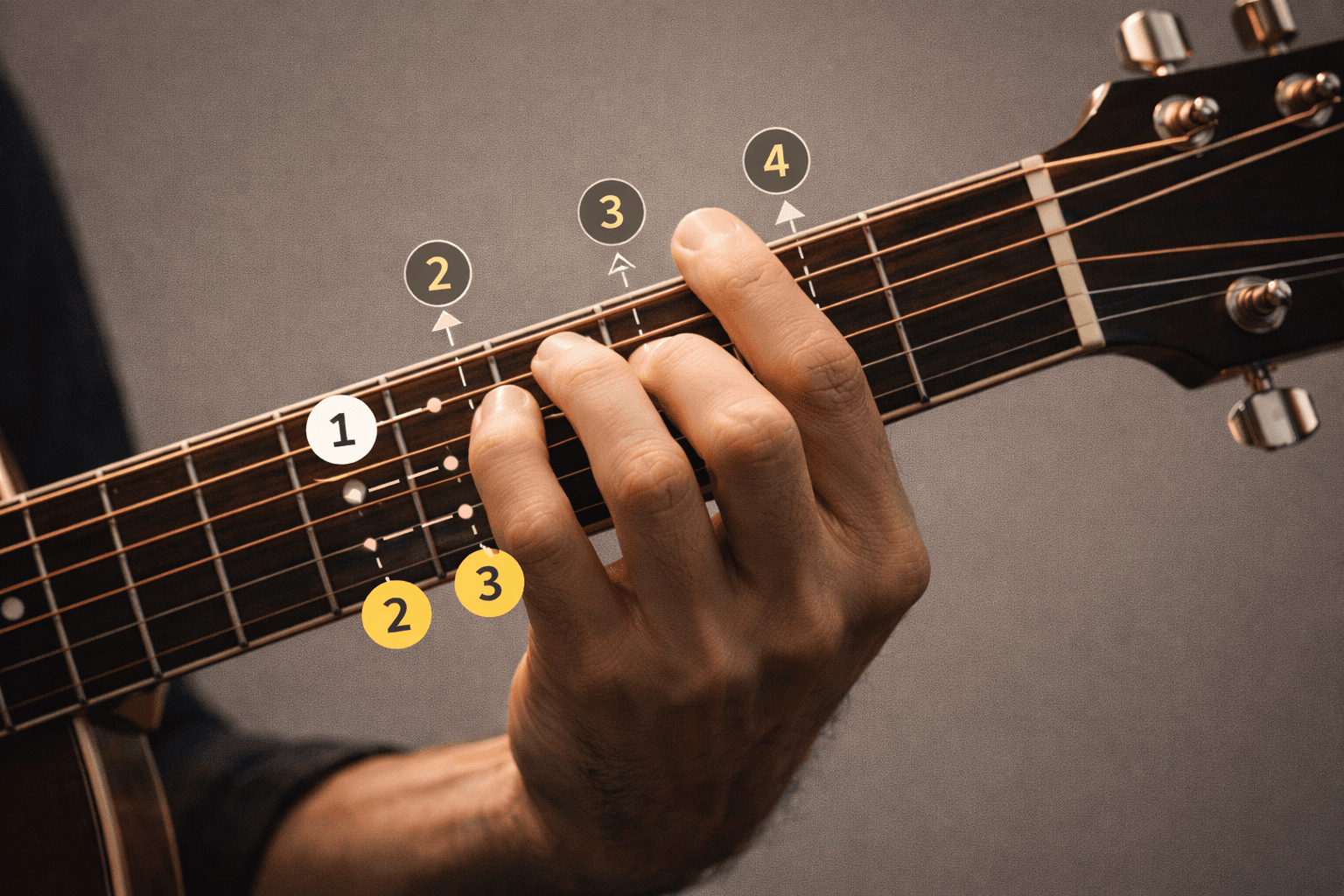
Standard F# Major Barre Chord (E-Shape)
This is the most common and practical shape for F# Major.
- Index finger barring all strings at the 2nd fret
- Ring finger at the 4th fret of the A string
- Pinky finger at the 4th fret of the D string
- Middle finger at the 3rd fret of the G string
Alternative F# Major Shapes
The chord can also be played using A-shape barre forms and smaller triad shapes across the fretboard. These shapes provide flexibility in rhythm guitar and lead-enhancing melodic playing.
F# Major Chord Notes Table
Component Note Root F# Major Third A# Perfect Fifth C#
How to Play the F# Major Chord (Step-by-Step Guide)
Step 1: Position the Index Finger
Barre the entire second fret. Ensure each string rings clearly by applying even pressure.
####Step 2: Add the Ring Finger Place it on the 4th fret of the A string. This provides the structure for the chord’s fifth.
Step 3: Add the Pinky Finger
Place it on the 4th fret of the D string. This reinforces the chord with an additional C#.
Step 4: Add the Middle Finger
Place it on the 3rd fret of the G string. This adds the A#, the major third of the chord.
Step 5: Strum All Strings
Avoid muting. Each note must ring clearly.
Common Challenges When Learning F# Major
 Since the chord relies heavily on barre technique, beginners often face certain difficulties:
- Inadequate finger strength for barring
- Muted high E or B strings
- Wrist strain due to poor hand posture
- Buzzing from inconsistent pressure
Overcoming these challenges requires practice, correct technique, and patience.
Tips for Clear F# Major Chord Execution
Keep the Thumb Behind the Neck
This improves leverage, making the barre easier.
Apply Pressure Using the Side of the Index Finger
The natural curvature helps press down strings more firmly.
Keep Fingers Close to the Frets
Reduces buzzing and produces cleaner tones.
Strengthen Finger Muscles
Daily barre chord exercises dramatically improve clarity.
F# Major Triad Variations
Triads offer lighter, more precise options ideal for rhythm articulation.
Basic F# Major Triad Shapes
Position Notes Use Root Position F# – A# – C# Classic bright tone First Inversion A# – C# – F# Smoother transitions Second Inversion C# – F# – A# Bright and stable
Triads allow more expressive rhythm guitar playing and cleaner sound in dense arrangements.
F# Major Chord on the Piano (Quick Reference)
Though this guide is for guitar, understanding the chord structure on piano offers valuable context.
- F#
- A#
- C#
The same three-note formula applies.
F# Major Scale (Reference for Chord Construction)
Degree Note 1 (Root) F# 2 G# 3 A# 4 B 5 C# 6 D# 7 E#
Understanding the scale degrees helps you contextualize the chord’s place in its key.
Chords in the Key of F# Major
F# Major appears as the I chord in the following diatonic set:
Scale Degree Chord Type I F# Major Major ii G# minor Minor iii A# minor Minor IV B Major Major
V C# Major Major vi D# minor Minor vii° E# diminished Diminished
These chords form foundational progressions widely used in modern music.
Popular F# Major Chord Progressions
Here are essential progressions that commonly include F# Major:
I – IV – V F# Major – B Major – C# Major
I – vi – IV – V F# Major – D# minor – B Major – C# Major
vi – IV – I – V D# minor – B Major – F# Major – C# Major
I – V – vi – IV F# Major – C# Major – D# minor – B Major
These progressions appear in thousands of songs and serve as a strong foundation for composing.
F# Major in CAGED System
 The CAGED system enables guitarists to play the F# Major chord across the neck using familiar shapes.
C Shape Appears near the 9th fret when transposed.
A Shape Barred at the 9th fret with A-form structure.
G Shape Used between the 6th and 9th frets.
E Shape Most common F# Major shape, barred at the 2nd fret.
D Shape Appears high on the fretboard for bright voicings.
This system is essential for navigating chords fluidly across the neck.
F# Major Chord Variations and Extensions
Once comfortable with the basic shapes, explore these variations:
F# Major 7 F# – A# – C# – E#
F# Dominant 7 F# – A# – C# – E
F# Major Add9 F# – A# – C# – G#
F# Sus2 F# – G# – C#
F# Sus4 F# – B – C#
These shapes add expressive feel and emotional depth to chord progressions.
F# Major Arpeggio
Arpeggiating the chord helps with picking, phrasing, and melodic control.
Notes F# – A# – C#
Common Arpeggio Pattern
- 2nd to 14th fret pathways
- Sweep picking applications
- Fingerstyle melodic lines
- Lead guitar phrasing exercises
Songs that Use the F# Major Chord
F# Major appears frequently in modern genres. Some well-known songs featuring F# Major include:
- Many pop songs written in B Major or E Major
- Numerous worship and gospel compositions
- Guitar-driven ballads emphasizing bright major resolutions
- R&B progressions relying on smooth I–vi–IV–V sequences
While song listings vary by arrangement, F# Major remains a versatile and widely used chord in the contemporary guitar landscape.
Finger Exercises for Mastering F# Major
1. Barre Strength Building Practice squeezing barre positions for 10–20 seconds.
2. Chord Switching Alternate between: F# Major → B Major → C# Major → D# minor
3. Partial Barres Strengthens index finger independence.
4. Triad Drills Play triads on strings 1–2–3, 2–3–4, 3–4–5 for versatility.
5. Strumming Variations Practice different rhythm patterns to increase control.
Practice Routine for F# Major (Daily Plan)
Warm-Up 5 minutes of finger stretching.
Barre Drills 10 minutes practicing F# Major and its variations.
Progressions 15 minutes playing I–V–vi–IV and I–IV–V.
Triads 10 minutes creating melodic rhythm shapes.
Song Application 10 minutes applying the chord in real musical contexts.
Frequently Asked Questions About the F# Major Chord
How can a beginner practice the F# Major chord effectively? Beginners should focus on strengthening their barre technique by holding the chord shape slowly and consistently. Practicing chord switches involving B Major and C# Major also helps develop fluidity. Slow strumming and finger pressure exercises improve accuracy.
Why is the F# Major chord difficult for beginners? F# Major requires a full barre on the second fret, which challenges beginners due to finger strength limitations. Muting, buzzing, and finger fatigue are common issues, but consistent practice resolves them over time.
Which chords pair well with F# Major? F# Major pairs naturally with B Major, C# Major, D# minor, and G# minor. These chords appear frequently in pop and worship progressions. The I–V–vi–IV progression is especially common.
Is the F# Major chord the same as Gb Major? Yes. F# Major and Gb Major are enharmonic equivalents, meaning they sound identical but are written differently in music notation. Guitarists usually refer to the chord as F# Major.
How do I make the F# Major chord sound cleaner? Keep your thumb behind the neck, maintain curved fingers, apply even pressure on the barre, and position fingers close to the frets. Cleanliness improves significantly with slow practice and strength-building.